
How to Identify the Syracuse Dekadrachm
A collector's guide to recognizing the Syracuse dekadrachm by its Nike-crowned quadriga, dolphin-ringed head of Arethusa, and heavy silver fabric.
Read the full Syracuse Dekadrachm encyclopedia entry →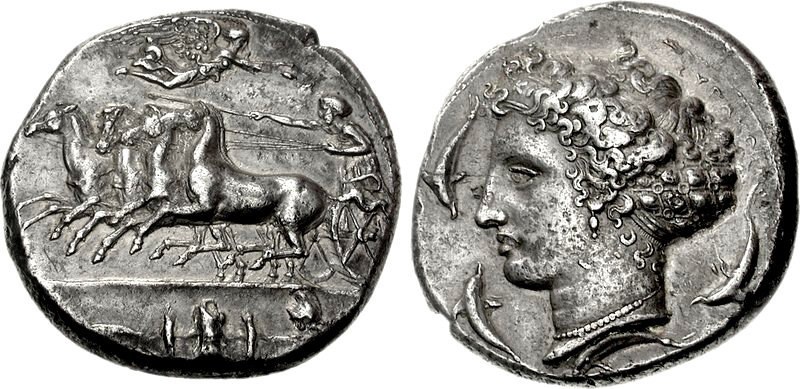
Start with size and weight, because the dekadrachm is defined by its scale. A genuine piece is a large, heavy silver coin on the order of roughly 40 to 44 grams and about 34 to 37 mm across, clearly bigger and thicker than a tetradrachm. Weigh and measure any candidate first: a coin of this design that is much lighter or smaller is a smaller denomination or a modern reproduction, not a true dekadrachm.
Read the chariot side carefully. You want a galloping four-horse quadriga with a charioteer holding the reins, and above it a small winged Nike flying in to crown the driver. Look below the ground line for an exergue filled with armor (typically a helmet, cuirass, round shield, and greaves), sometimes over an inscription. The combination of the racing team, the crowning Victory, and the trophy of arms beneath is the core diagnostic of the type; a static chariot with no Nike or no armor points elsewhere.
Turn to the head of Arethusa. Confirm a profile head of a female with abundant, finely engraved hair, wearing a wreath of grain or reeds and framed by four dolphins, with the Greek city name in the field. On the finest dies the hair is elaborately waved or bound in a net and the modeling is remarkably naturalistic. Tiny engraver signatures may appear near the neck truncation or along a dolphin; where present they support the attribution, but they are often worn and should never be invented from a hopeful reading.
Check fabric and strike. Genuine coins are hand-struck and slightly irregular, with an oval or off-round flan, uneven edges, and centering that can crop part of the design at the rim. High relief on the head and horses is normal, and authentic silver typically shows old grey or iridescent toning over metallic surfaces. A perfectly round, seam-edged, or dull grey blank surface is a warning sign.
Finally, treat authentication as essential rather than optional. The Syracuse dekadrachm is one of the most reproduced designs in numismatics: electrotypes, cast copies, museum replicas, and outright forgeries are everywhere. Watch for an edge seam, a soft or bubbly surface, repeating die flaws known from fakes, and detail that looks pressed or scratchy rather than struck. Because genuine examples are extremely valuable, any serious candidate should be examined by an ancient-coin specialist and, ideally, backed by third-party certification and documented provenance.
Frequently asked questions
How do I tell a dekadrachm from a Syracuse tetradrachm with a similar design?
Both can show a quadriga and a head of Arethusa with dolphins, so size settles it. The dekadrachm is much larger and heavier, on the order of roughly 40 to 44 grams and about 34 to 37 mm across, while a tetradrachm is around 17 grams and 25 to 28 mm. Weigh and measure the coin to be sure.
What details confirm the chariot side?
Look for four horses in motion, a charioteer with reins, a small winged Victory flying above to crown the driver, and an exergue of armor such as a helmet, cuirass, shield, and greaves beneath the ground line. That full combination is diagnostic of the dekadrachm type.
Where are the engravers' signatures?
On signed dies of Kimon or Euainetos the artist's name appears in tiny letters, often near the truncation of Arethusa's neck or on one of the dolphins. Signatures are frequently worn or off the flan, so their absence does not by itself condemn a coin, and their presence should be read carefully rather than assumed.
How can I avoid buying a fake?
Because this is one of the most copied ancient designs, watch for an edge seam, a soft or bubbly cast surface, a dull non-metallic tone, and detail that looks pressed rather than struck. Given the value of genuine coins, have any candidate authenticated by an ancient-coin specialist and prefer examples with certification and documented provenance.