
How to Identify the Sybaris Bull Stater
An archaic incuse silver stater from wealthy Sybaris in Lucania, showing a bull looking back over its shoulder, struck before the city's destruction in 510 BC.
Read the full Sybaris Bull Stater encyclopedia entry →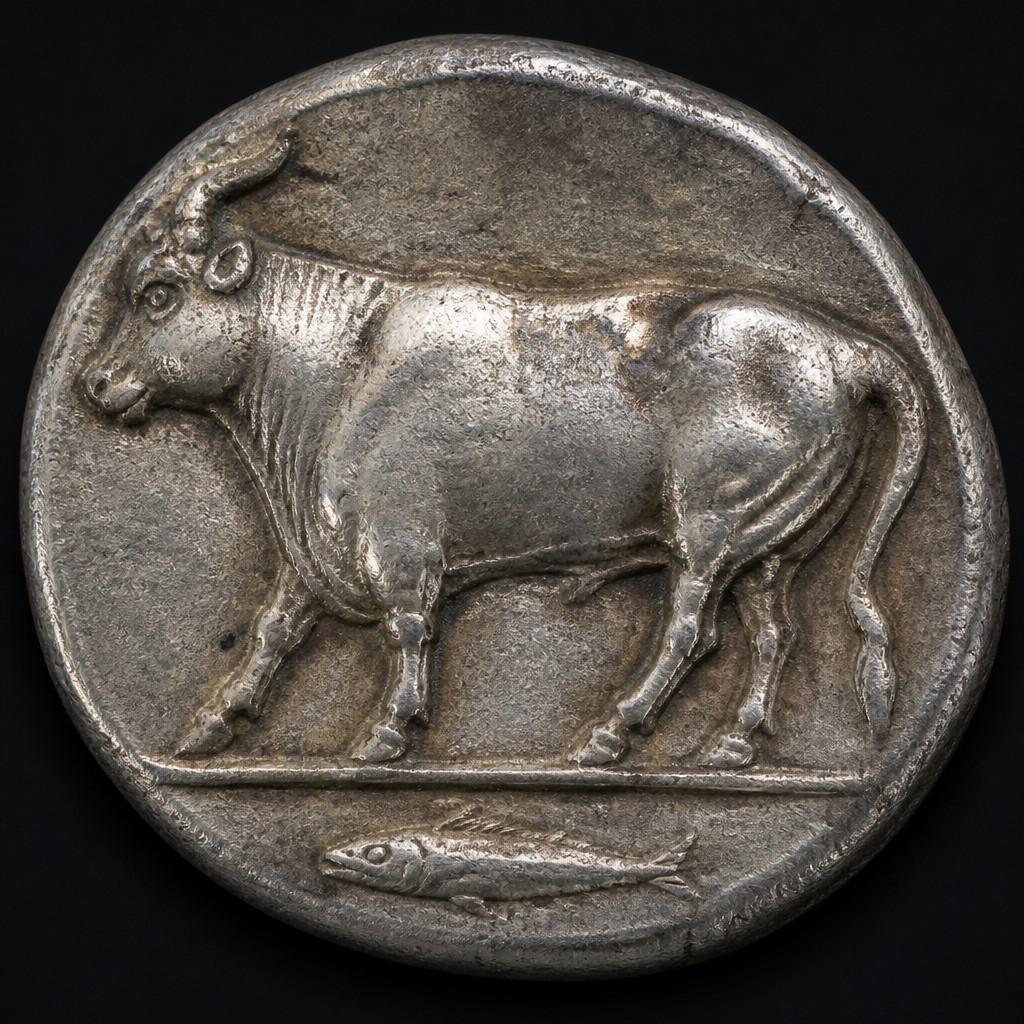
What the Coin Is
Sybaris was one of the wealthiest Greek cities in southern Italy before its destruction by rival Kroton in 510 BC, and its coinage, struck in the sixth century BC, is among the earliest and most sought-after examples of South Italian incuse silver. Because production ended abruptly with the city's fall, surviving examples represent a relatively short and well-defined minting period.
Obverse Design
The obverse shows a bull standing to the left with its head turned back over its shoulder, a "retrospective" pose shared with a few other archaic animal types in the region. The bull often stands on a simple ground line or dotted exergual line, and the modeling, while archaic in style, conveys a solid, weighty animal form.
Reverse Design
Following the incuse technique used by several nearby Achaean colonies, the reverse of a Sybaris stater carries a sunken, mirror-image rendering of the same bull design seen on the obverse, rather than a separate unrelated type. This shared obverse/reverse composition is a defining feature of the coinage from this era across the region.
Size, Weight, and Metal
These are silver staters weighing approximately 7.5 to 8 grams, consistent with the Achaean weight standard used by Sybaris and its neighboring colonies. The flans are thin, broad, and often slightly dish-shaped or cupped as a result of the incuse striking method.
Mint Marks and Legends
A short abbreviated legend in the local archaic Achaean alphabet, sometimes rendered retrograde (reading in the opposite direction from standard Greek), appears near the bull. Because the lettering is brief and the flan area is small relative to the design, the legend is frequently partial or worn on surviving coins, so identification relies heavily on the bull's distinctive retrospective pose and the incuse fabric.
Telling It Apart from Similar Coins
Sybaris shares the incuse fabric with neighboring mints like Kroton, Metapontion, Poseidonia, and Kaulonia, so the specific animal matters most for attribution: only Sybaris pairs this backward-glancing bull as its sole design. Kroton's tripod, Metapontion's barley ear, and Poseidonia's striding Poseidon are all visually distinct, making confusion with those types unlikely once the design is clearly visible.
Judging Condition at a Glance
Look at the bull's head, horns, and the turn of the neck, since this is both the artistic focal point and the area most likely to show wear or weak striking. A well-centered, sharply struck example with a clear incuse counterpart on the reverse is considered especially desirable given the historically short minting period and limited surviving supply.
Authenticity Red Flags
Given the historical fame of Sybaris and the relative rarity of genuine examples, modern casts and fantasy pieces exist. Check for the correct cupped, thin fabric rather than a flat or overly thick flan, and look for a reverse incuse that genuinely mirrors the obverse bull in reverse relief rather than showing a vague or mismatched depression, which is typical of low-quality reproductions.
Frequently asked questions
Why is Sybaris coinage relatively short-lived?
Sybaris was destroyed by the rival city of Kroton in 510 BC, so its coinage was struck only during the decades before that event, limiting the total volume produced.
What does the backward-turned head of the bull signify?
This retrospective pose was a common stylistic convention in archaic Greek animal engraving and does not carry a specific documented symbolic meaning beyond artistic tradition.
How is this different from other incuse bull or animal coins in the region?
The specific pairing of a backward-glancing bull as both the obverse relief and its incuse reverse counterpart is unique to Sybaris among the Achaean colonial mints.
What should the coin weigh if genuine?
A full-weight silver stater from Sybaris typically weighs around 7.5 to 8 grams, matching the broader Achaean weight standard of the region.