
How to Identify the Swiss Franc (Helvetia Seated)
A classic 19th and early 20th century Swiss silver coin featuring a seated female figure personifying Switzerland, used for several larger-denomination Swiss silver coins.
Read the full Swiss Franc (Helvetia Seated) encyclopedia entry →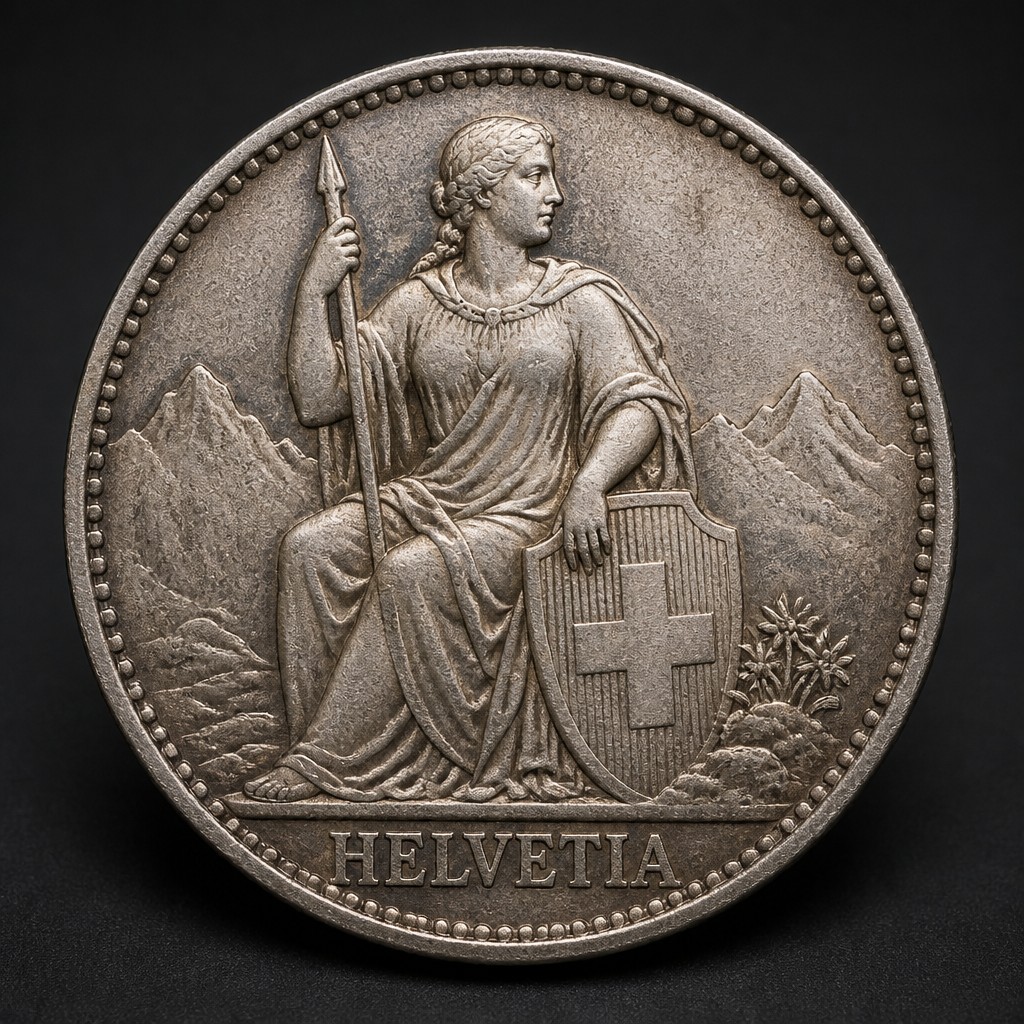
What It Is
The Seated Helvetia design appeared on Swiss silver coinage, most notably the 5 francs denomination, beginning in the mid-19th century and continuing with periodic changes through the early-to-mid 20th century. Helvetia is the traditional female personification of Switzerland, similar to Britannia for the United Kingdom or Marianne for France.
Obverse Design
The obverse shows Helvetia seated, often resting one arm on a shield bearing the Swiss cross, with an alpine mountain backdrop and sometimes a small dog at her feet in certain design varieties, along with "HELVETIA" and the date in the surrounding legend.
Reverse Design
The reverse typically displays the denomination within a wreath, along with the words "CONFOEDERATIO HELVETICA" (Switzerland's official Latin name) arcing around the rim, reflecting the country's multilingual identity by using neutral Latin rather than German, French, or Italian text.
Size, Weight, and Metal
The 5 francs Seated Helvetia coin is a large silver crown, roughly 37 mm in diameter, weighing about 25 grams in .900 fine silver during the 19th century; later 20th-century strikes reduced the fineness to .835 silver while keeping a similar size and weight.
Mint Marks and Where to Find Them
Swiss coins of this type were struck at the Bern mint, and a small "B" mint mark or mint symbol may appear near the rim or base of the design, though Switzerland's centralized minting system means fewer mint mark varieties compared to countries with multiple regional mints.
Telling It Apart from Similar Coins
The Seated Helvetia 5 francs is sometimes confused with the later Standing Helvetia design used on some Swiss silver coinage, which shows Helvetia upright rather than seated; comparing the pose immediately distinguishes the two types. It can also be confused with other European silver crowns of similar size, so checking for the distinctly Latin "CONFOEDERATIO HELVETICA" legend confirms Swiss origin.
Judging Condition at a Glance
Examine Helvetia's drapery folds, facial features, and the mountain background detail for wear, along with the wreath leaves on the reverse. High-grade examples retain sharp, well-defined drapery and mountain texture, while worn coins show these details smoothed and the seated figure's outline softened.
Authenticity Red Flags
Check for the correct silver fineness and weight matching the specific date range (earlier .900 fine versus later .835 fine issues), inspect for a clean, well-struck design without a cast seam or grainy surface, and confirm the edge shows the expected reeding or lettering. Mismatched weight for the claimed date, or blurry lettering, suggests a counterfeit or altered piece.
Frequently asked questions
Who is Helvetia?
Helvetia is the traditional female personification of Switzerland, comparable to Britannia in Britain or Marianne in France, and she appears on many historic Swiss coins.
Why does the coin say 'Confoederatio Helvetica' instead of 'Switzerland'?
Switzerland uses this Latin name on its coinage to remain neutral among its four national languages, and the country's official abbreviation 'CH' comes from this same phrase.
What is the difference between Seated and Standing Helvetia coins?
The Seated Helvetia design shows the figure sitting with a shield and mountain backdrop, while the Standing Helvetia design used on other Swiss coinage shows her upright; comparing the pose distinguishes the two easily.
Did the silver purity of this coin change over time?
Yes, earlier 19th-century strikes used .900 fine silver, while later 20th-century issues were reduced to .835 fine silver.