
How to Identify the Swiss 5 Francs Shooting Thaler
A commemorative Swiss silver crown struck for national shooting festivals (Schützenfeste), identified by its host-canton imagery, marksman or alpine scenes, and "SCHUTZENFEST" legend.
Read the full Swiss 5 Francs Shooting Thaler encyclopedia entry →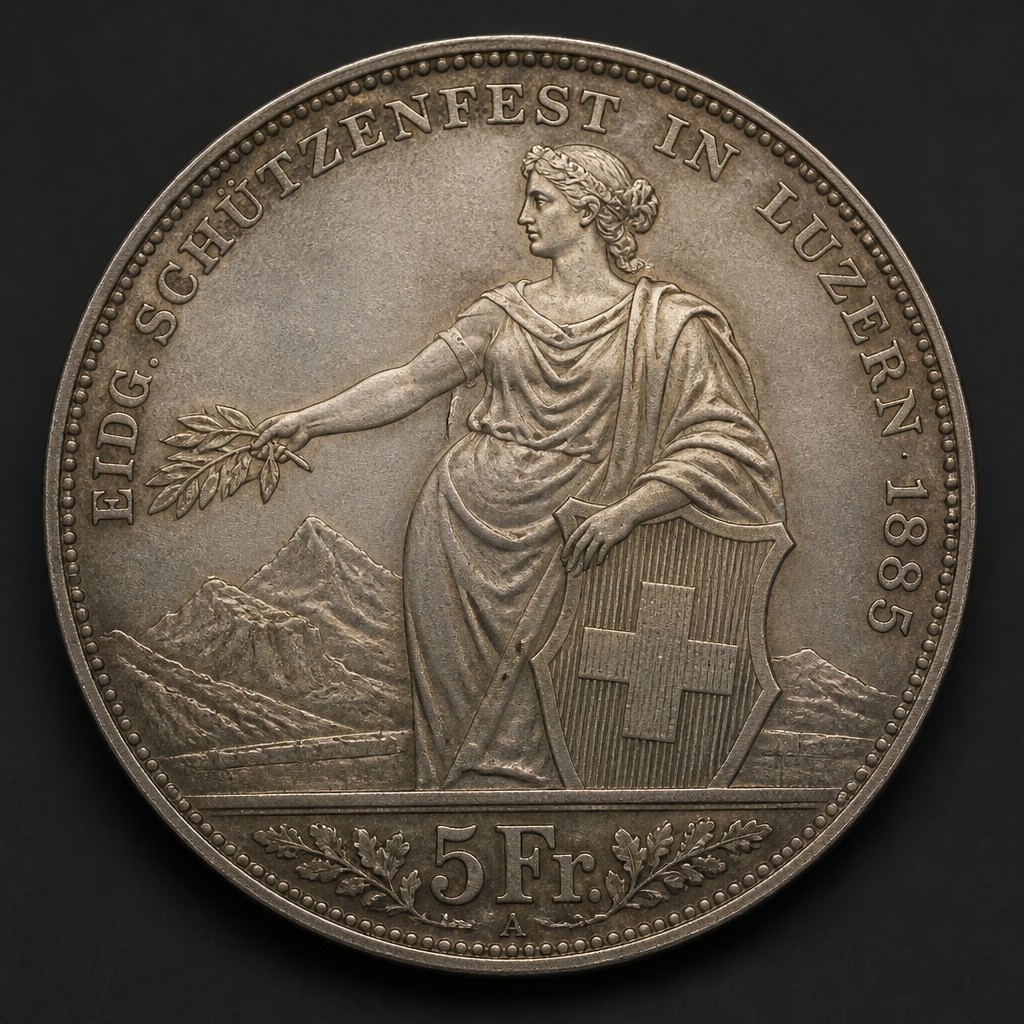
What It Is
The Swiss Shooting Thaler (Schützentaler) is a series of commemorative silver crowns struck to mark Switzerland's national shooting festivals, patriotic gatherings that combined marksmanship competitions with civic celebration. Unlike regular circulating Swiss francs, each shooting thaler was issued for a specific festival year and host canton, so the design changes from issue to issue while sharing a common denomination and purpose.
Obverse Design and Inscriptions
The obverse generally features either a bust or full-length figure related to Swiss liberty or the host canton, such as a Helvetia figure, a standing soldier or marksman in traditional dress, or the canton's coat of arms, along with "CONFOEDERATIO HELVETICA" or "HELVETIA" identifying the Swiss federation.
Reverse Design and Inscriptions
The reverse carries the festival-specific imagery: alpine landscapes, cantonal shields, crossed rifles, target and laurel motifs, or a scene tied to the host town. The words "EIDGENÖSSISCHES SCHÜTZENFEST" (Federal Shooting Festival) or a similar phrase, along with the host city name and festival year, appear prominently, making the reverse legend the fastest way to pin down which specific issue you are holding.
Size, Weight, Metal, and Edge
These are crown-sized silver coins, roughly 37-40 mm in diameter, struck in .900 fine silver, with weight and face value varying by period; later 19th-century issues were denominated 5 francs while some earlier festival thalers carried different face values. The edge is typically reeded, matching standard Swiss silver coinage of the period.
Mint Marks and Where to Find Them
As official federal commemoratives, these were struck at the Swiss federal mint (Bern), and any mint identifier is usually a small "B" or mint symbol near the date rather than a separate branch-mint letter, since Switzerland used a single central mint for this coinage.
Telling It Apart from Similar Coins
Shooting thalers are sometimes confused with standard circulating Swiss 5 franc pieces, which show a consistent Helvetia head or standing Helvetia design year after year without festival-specific scenery. The clearest distinguishing feature of a shooting thaler is the presence of a named festival, host city, and unique commemorative artwork rather than the recurring standard design. Shooting thalers are also sometimes mistaken for other European commemorative shooting medals, but true shooting thalers are official legal-tender coinage struck to a fixed denomination, while medals are unofficial souvenir pieces with no face value.
Judging Condition at a Glance
Examine the high-relief elements, such as raised laurel wreaths, cantonal shield details, or a marksman's clothing folds, since these wear first. A well-preserved example shows crisp separation in fine engraved lines, while a worn coin shows smoothed, rounded relief and a flattened central design.
Authenticity Red Flags
Watch for coins with an incorrect diameter or weight for genuine .900 silver crowns, blurry or shallow lettering in the festival legend, or a reverse scene that does not match any known historical festival design. Cast reproductions often show a grainy surface texture and a faint seam line along the edge, unlike the sharp, cleanly struck edge of an authentic mint product.
Frequently asked questions
How can I identify which festival a Swiss Shooting Thaler commemorates?
Read the reverse legend closely; it names the host city and often the year of the Eidgenössisches Schützenfest, which pins down the specific issue.
What's the difference between a Shooting Thaler and a regular Swiss 5 Francs coin?
Regular circulating 5 franc coins use a consistent standing or head Helvetia design, while shooting thalers carry unique festival-specific imagery and a named host city.
What metal and size should genuine examples have?
Most are struck in .900 fine silver at roughly 37-40 mm in diameter, matching standard Swiss crown-sized coinage of the period.
Where would a mint mark appear?
Look near the date for a small letter or symbol tied to the Bern federal mint, since Switzerland used one central mint rather than multiple branches.