
How to Identify the Swedish Gold Commemorative
Read the SVERIGES KONUNG legend, the fatherland motto, and the reverse value to pin down this early-20th-century Swedish gold coin.
Read the full Swedish Gold Commemorative encyclopedia entry →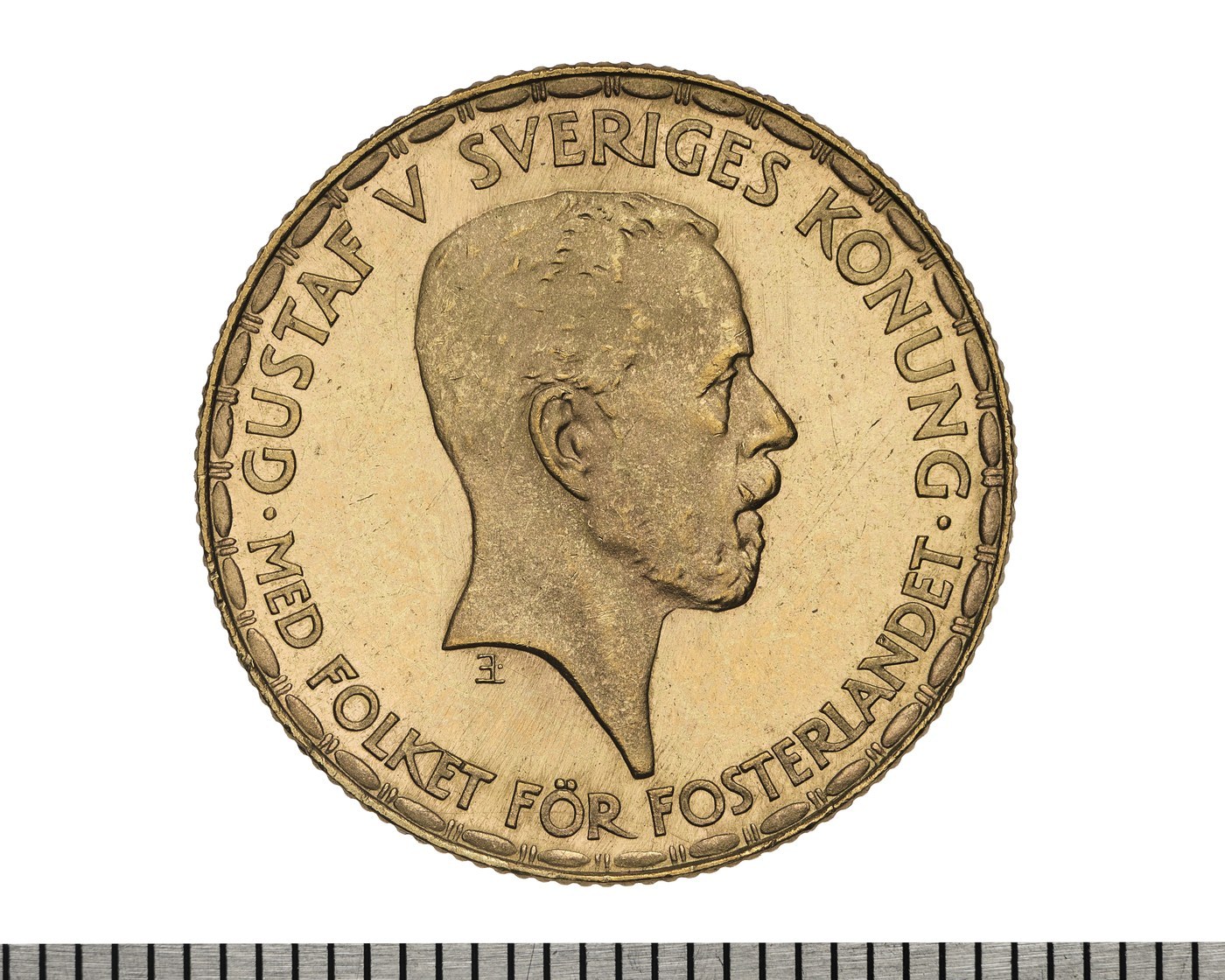
Start with the obverse legend and portrait. This type shows a bare-headed royal profile facing right, encircled by SVERIGES KONUNG ("King of Sweden"). A Swedish motto referencing the fatherland (fosterlandet) is a strong diagnostic: the wording "With the people for the fatherland" points to Gustaf V (reigned 1907–1950), while an earlier right-facing portrait may belong to Oscar II (reigned 1872–1907). Worn strikes can leave only fragments like "SVERIGE KONUNG" or "...FOSTERLANDET," so read the letters as part of the full royal legend rather than as separate words.
Turn the coin over to settle the denomination and date, which cannot be judged from the obverse alone. The reverse of Swedish gold kronor normally carries the value (for example 5, 10, or 20 kronor), the year, and the crowned Swedish arms with the three crowns. Look near the date for the Royal Swedish Mint's marks. The year and value together are what convert a generic "Swedish gold" identification into a specific catalogue entry.
Measure and weigh the piece. Period Swedish gold was struck at high fineness (typically .900). A 20-kronor coin runs about 23 mm and near 9 grams; smaller denominations are lighter and under 20 mm. A coin that is off-weight, off-diameter, magnetic, or discolored is a red flag. Genuine gold is dense, non-magnetic, and holds a warm, even color.
Beware of look-alikes and altered pieces. Other Scandinavian Monetary Union gold coins (Danish and Norwegian kronor/kroner) share the same size and standard but carry different legends and arms, so read the country name and heraldry carefully. Jewelry-mounted, polished, or ex-solder examples lose value, and modern replicas and gold-plated fakes exist. When value or authenticity is material, confirm with precise weight and specific-gravity testing, or submit the coin to a reputable dealer or third-party grading service rather than relying on a single photo.
Frequently asked questions
How do I tell which king is on the coin?
Read the motto and match the portrait direction. The fatherland motto "With the people for the fatherland" indicates Gustaf V; an earlier right-facing portrait with a different motto may be Oscar II. The reverse date confirms the reign.
The denomination isn't on the side I can see — where is it?
On the reverse. Swedish gold kronor place the value and year on the reverse alongside the crowned arms, so you must view that side to identify the denomination.
How can I check the gold without damaging the coin?
Start with accurate weight and diameter, then specific-gravity (water displacement) testing, which is non-destructive. For a definitive answer, use a reputable dealer or grading service instead of scratch or acid tests.
Does a mount or polishing hurt the value?
Yes. Coins that were mounted in jewelry, polished, cleaned, or bent lose their original surfaces and trade at a discount to problem-free examples, often close to bullion value.