
How to Identify the Straits Settlements Silver Dollar
A British colonial silver trade dollar issued for Singapore, Penang, and Malacca in the early 1900s, identified by the reigning monarch's portrait on the obverse and a multilingual wreathed value on the reverse.
Read the full Straits Settlements Silver Dollar encyclopedia entry →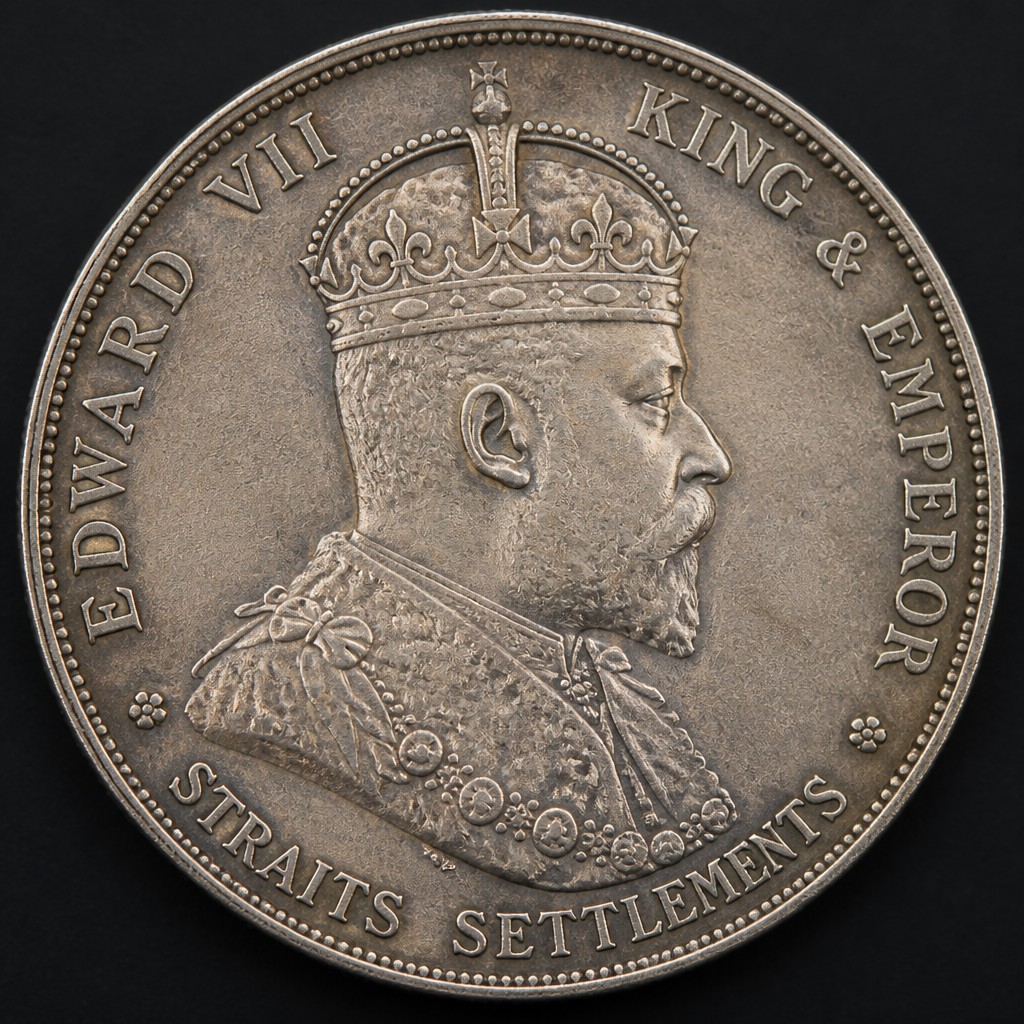
What It Is
The Straits Settlements dollar was the official silver trade coin of Britain's Straits Settlements colony — comprising Singapore, Penang, and Malacca — issued in the early 20th century to standardize currency across the region and compete with other silver trade dollars circulating in Southeast Asian and Chinese ports.
Obverse Design & Inscriptions
The obverse bears a right- or left-facing portrait of the reigning British monarch of the period, encircled by a Latin legend giving the ruler's name and titles, such as king and emperor of India, reflecting the coin's place within the broader British imperial coinage system.
Reverse Design & Inscriptions
The reverse is distinctive for its multilingual presentation: the denomination "ONE DOLLAR" appears in English, accompanied by the equivalent value rendered in Chinese characters and in Jawi (Arabic-script Malay), reflecting the diverse trading communities of the Straits Settlements. These are typically arranged around a central wreath or value numeral.
Size, Weight & Metal
The coin is a large silver piece, similar in scale to other regional trade dollars, struck in high-fineness silver (around .900) with a weight in the high-20-gram range and a diameter in the high-30mm range. The edge is reeded, typical of machine-struck trade coinage of the era.
Mint Marks & Where to Find Them
These dollars were struck at British Empire mints (including facilities in Britain and Bombay), and where present, small mint marks or engraver initials sit near the date on the obverse or reverse rather than as a large stand-alone symbol. Some circulated examples carry Chinese merchant chop marks from use in regional trade, similar to other Asian trade dollars of the period.
Telling It Apart from Similar Coins
The trilingual reverse text (English, Chinese, and Jawi script) is the clearest identifying feature separating this coin from other regional trade dollars such as the British Trade Dollar (which uses different design elements) or the French Indochina piastre (which carries French rather than English legends). The portrait bust on the obverse also helps date the coin to a specific reign.
Judging Condition at a Glance
High-grade examples show sharp definition in the monarch's hair and facial features and crisp, fully separated letterforms in all three reverse scripts. Circulated coins show flattening across the portrait's highest points — cheek and hair — and softened, less distinct multilingual text, along with an overall grayer, more worn surface.
Authenticity Red Flags
As with other historic silver trade dollars, confirm correct diameter, weight, and a properly executed reeded edge. Watch for softness or blurring in the fine multilingual reverse text, which is difficult for counterfeiters to replicate cleanly, as well as any unnatural surface texture suggesting a cast rather than struck coin.
Frequently asked questions
Why does the reverse have three different scripts?
The Straits Settlements had large Malay, Chinese, and British trading communities, so the coin's value was spelled out in English, Chinese, and Jawi (Malay in Arabic script) to serve all groups.
How do I know which monarch's portrait is on my coin?
Compare the facial profile and the Latin titles in the surrounding legend to reference images of the British monarchs of the early 1900s who issued Straits Settlements coinage.
What size and metal should this coin be?
It is a large silver coin, roughly comparable in size and fineness to other regional trade dollars of the period, with a reeded edge.
Are chop marks on this coin unusual?
No, small punched Chinese merchant chop marks are commonly found on circulated Straits Settlements dollars that passed through regional trade.