
How to Identify the Standing Liberty Quarter
How to recognize the standing Liberty and shield obverse, the flying-eagle reverse, silver size and weight, date and mint-mark placement, and the heavily faked 1916.
Read the full Standing Liberty Quarter encyclopedia entry →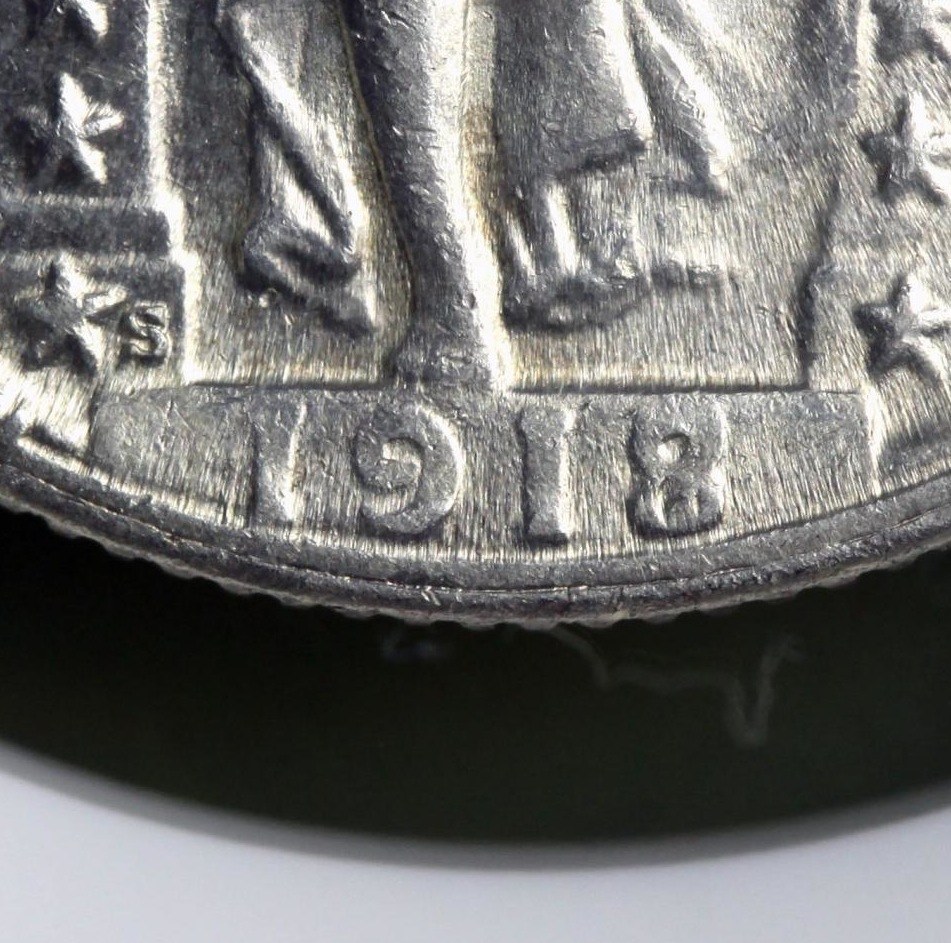
Read the Obverse Figure
Look for a full-length figure of Liberty facing forward, standing within a gateway or archway. She holds a shield across her left arm and an olive branch in her right hand. "LIBERTY" arcs across the top and "IN GOD WE TRUST" appears at the sides. On the earliest style, seen on this 1916 coin, Liberty's right breast is bare and the drapery is open; later coins from mid-1917 add a coat of chain mail over her torso. Distinguishing these two types is the first step in identifying the coin.
Check the Reverse Eagle
Turn the coin over to find an eagle flying to the right with wings fully spread, ringed by "UNITED STATES OF AMERICA" and "E PLURIBUS UNUM," with "QUARTER DOLLAR" along the bottom. On Type 1 coins the eagle sits lower with three stars beneath it; on Type 2 coins the eagle is raised and the stars are rearranged. The 1916 example here shows the Type 1 layout.
Confirm Size, Metal, and Edge
The Standing Liberty Quarter is 90% silver: about 24.3 mm in diameter, close to 6.25 grams, with a reeded (grooved) edge and a bright silver-gray color. It is the same size and weight as a Barber or Washington Quarter of the same era. If a coin this size has a smooth edge or feels too light, treat it with suspicion, as genuine silver quarters always have a reeded edge.
Locate the Date and Mint Mark
The date is on the raised pedestal beneath Liberty's feet — read it carefully in raking light, since on pre-1925 coins it wears away easily. The mint mark, when present on later dates, is on the obverse just to the left of the date near the base of the shield: "D" for Denver or "S" for San Francisco, with no mark for Philadelphia. The 1916 coin shown here has no mint mark because it was struck only at Philadelphia.
Beware the Altered 1916 and Look-Alikes
The 1916 is the key date and one of the most counterfeited U.S. quarters. A common trick is to re-engrave a genuine 1917 Type 1 coin so the date reads 1916, since the two share the same design. Examine the date under magnification for tooling, unnatural spacing, or a mismatched surface, and compare the fine details of Liberty against known-genuine images. Do not confuse this series with the earlier Barber Quarter (a Liberty head profile) or the later Washington Quarter (Washington's profile). For any coin presented as a 1916 or as a scarce high-grade piece, rely on a reputable third-party grading service to confirm authenticity before you buy.
Frequently asked questions
How do I tell Type 1 from Type 2 quickly?
On Type 1 (1916 and early 1917) Liberty's right breast is bare and the reverse eagle sits low with three stars beneath it. On Type 2 (later 1917 onward) chain mail covers Liberty and the eagle is raised with the stars rearranged. The 1916 is always Type 1.
How can I spot a faked 1916 quarter?
Because a 1916 is worth far more than a 1917, fakers re-engrave the last digit of a genuine 1917 to read 1916. Look for tooling marks, uneven digit spacing, or a disturbed surface around the date, and have any suspected 1916 authenticated by a professional grading service.
What if the date is completely worn off?
On pre-1925 coins the date sits on a high, exposed point and often wears flat. A dateless coin is still identifiable as a Standing Liberty Quarter by its design, but without a readable date it cannot be attributed to a specific year and has limited collector value.
Should I clean the coin to read it better?
No. Cleaning scratches the silver and reduces value to collectors. Examine the coin under good light and magnification instead, and leave any conservation to professionals.