
How to Identify the Spanish Doubloon (8 Escudos)
Collector checks for the Charles IV gold doubloon: bust, crowned shield, size and metal, mint marks, look-alikes, and authentication cautions.
Read the full Spanish Doubloon (8 Escudos) encyclopedia entry →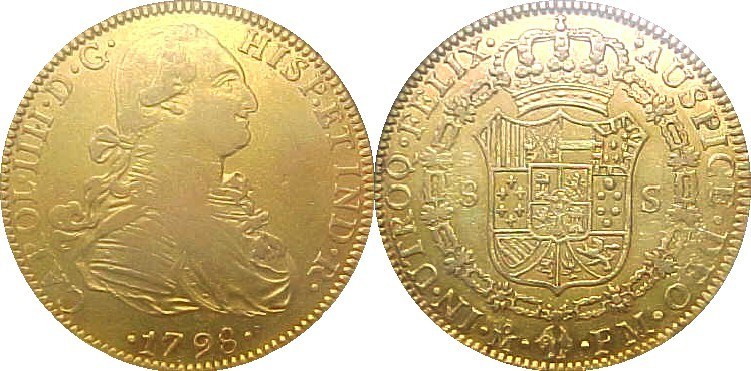
Start with size and metal. The 8 Escudos is a large gold coin, roughly 34-37 mm in diameter and near an ounce in weight, with the deep yellow color of high-fineness gold. If your piece is noticeably smaller or lighter, it may be a lower escudo denomination (4, 2, or 1 escudos) sharing similar designs, or a modern reproduction.
Read the obverse. You should see a draped, armored bust of a king facing right, ringed by a Latin legend naming Carlos IV (Charles IV) with his titles. Confirm the date falls within his reign of 1788-1808; the pictured coin reads 1798. A bust facing the opposite way, or a different name in the legend, points to a different ruler such as Charles III or Ferdinand VII.
Check the reverse. Look for the crowned Spanish coat of arms with a cross, typically surrounded by the linked collar of the Order of the Golden Fleece. Within the legends, locate the mint mark and the assayer's initials, plus the "8" denomination mark; these identify where and by whom the coin was struck. Spain and several American mints each used their own marks.
Distinguish look-alikes. Lower escudo denominations use nearly identical designs at smaller sizes, so verify the denomination mark and measure carefully. Coins of Charles III (to 1788) and Ferdinand VII (from 1808) carry different busts and names, and later Spanish-American republican gold drops the king entirely. Do not confuse the term "doubloon" with the smaller 2 escudos, which some sources also called a doubloon historically.
Authenticate with caution. Gold coins of this type have been widely counterfeited, from period fakes to modern cast and struck copies and gold-plated base-metal pieces. Weigh and measure the coin precisely, inspect the edge and fields for casting seams or a dull, soapy surface, and be wary of coins that feel too light. When value is significant, seek third-party grading or an experienced dealer before buying or selling.
Frequently asked questions
How do I tell an 8 Escudos from a smaller escudo coin?
Check the denomination mark and the size. The 8 Escudos is the largest, around 34-37 mm and close to an ounce; 4, 2, and 1 escudo coins share the design but are visibly smaller and lighter.
How do I know it is Charles IV and not another king?
Read the obverse legend and the date. It should name Carlos IV and fall within 1788-1808. Charles III (to 1788) and Ferdinand VII (from 1808) have different busts and legends.
Where are the mint mark and assayer initials?
They appear within the coin's legends alongside the shield. Spanish and American mints each used distinct marks and assayer letters, which pin down the exact issue.
Are fakes common?
Yes. Because these are valuable gold coins, counterfeits and gold-plated copies exist. Verify weight, diameter, and metal, and get expert authentication before a significant purchase or sale.