
How to Identify the Spanish Colonial Cob 8 Reales (Macuquina)
A hand-hammered, irregularly shaped Spanish colonial silver coin known as a cob or macuquina, identified by its crude cross and shield design rather than a perfectly round shape.
Read the full Spanish Colonial Cob 8 Reales (Macuquina) encyclopedia entry →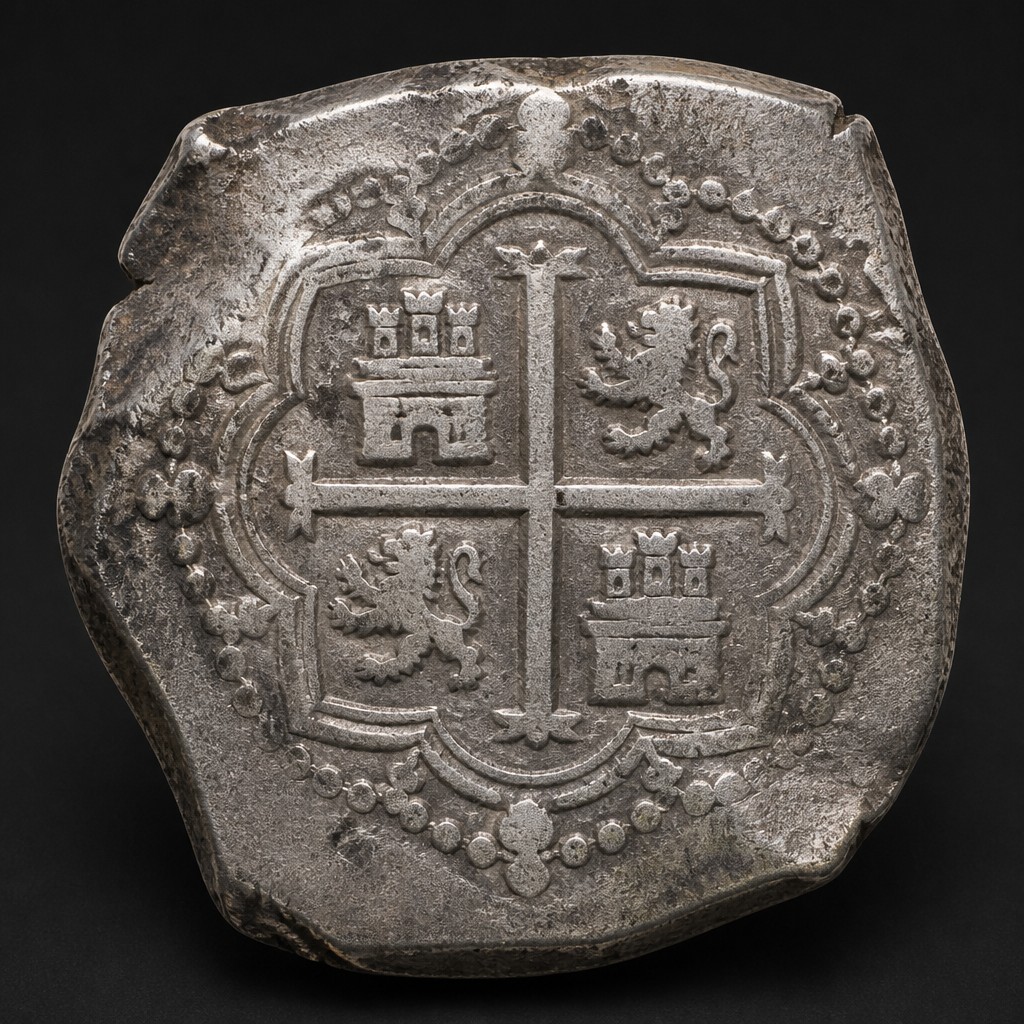
What It Is
Cobs, known in Spanish as macuquina, were crudely hand-struck silver coins produced at Spanish colonial mints in the Americas from the 1500s through the 1700s, before machine-milled coinage became standard. They were cut from irregular silver bars, weighed to approximate value, and struck by hand, resulting in a rough, irregular shape rather than a neat circle.
Obverse Design
Most cobs show a cross design on one side, often a Jerusalem-style cross with small castles and lions filling the quarters, representing the arms of the Spanish crown (Castile and León). Because of the hand-striking process, this design is frequently off-center or only partially visible on any given piece.
Reverse Design
The other side typically carries a crowned shield design or, in later types, columns representing the Pillars of Hercules with a banner beneath, along with small lettering indicating the mint and assayer. As with the obverse, this design is often only partially struck due to the irregular hand-cutting and striking process.
Size, Weight, and Metal
An 8 reales cob weighs approximately 27 grams in silver of varying fineness depending on mint and era, but because pieces were hand-cut from silver bars, exact weight and shape vary from coin to coin rather than following a precise standard diameter. The edge is simply the cut edge of the silver planchet, with no reeding or design.
Mint Marks
Small mint and assayer initials are often found tucked into a corner of the design, denoting mints such as Mexico City, Potosí, or Lima. Because these marks are frequently struck off the edge of the irregular planchet, they can be partially or fully missing on any individual coin, and locating a legible mint mark on a cob is often a matter of luck.
Telling It Apart from Similar Coins
The irregular, non-circular shape is the immediate giveaway that a coin is a cob rather than a later milled Spanish colonial coin, which is perfectly round with a defined edge design. If the coin looks hand-cut and lopsided with only partial design elements visible, it is a cob rather than a later "pillar dollar" or portrait-type coin.
Judging Condition
Because cobs were hand-struck, "full strike" examples showing a complete, well-centered cross and shield are considered exceptional and far less common than typical pieces with partial, off-center designs. Condition assessment for cobs focuses as much on how much design is visible as on wear, since even lightly circulated examples may show minimal detail purely due to how they were struck.
Authenticity Red Flags
Cobs are a popular target for modern reproductions due to their historical romance (many are associated with shipwreck treasure). Genuine examples show natural, uneven hand-cut edges and file marks from period weight adjustment, along with an aged, naturally toned surface. Be cautious of pieces that look too uniformly shaped, have suspiciously sharp, fresh-looking design details for a supposedly centuries-old hand-struck coin, or lack any file marks or edge irregularities at all.
Frequently asked questions
Why is this coin such an irregular shape?
Cobs were cut by hand from silver bars and struck without the precision of later milling machinery, so each piece has an irregular, non-round shape unique to itself.
Why can't I see the full design on my cob?
Hand striking often resulted in off-center or incomplete impressions, so it is normal and expected for only part of the cross or shield design to appear clearly.
How do I find the mint mark on a cob?
Look for small initials tucked into a corner of the design, though due to the irregular striking process, the mint mark may be partially cut off or missing entirely on many pieces.
Are cobs often faked?
Yes, due to their association with shipwreck treasure and colonial history, cobs are commonly reproduced, so genuine file marks, natural toning, and irregular hand-cut edges are important things to look for.