
How to Identify the Spanish Colonial Cob 2 Reales
A collector's walkthrough for confirming a cob 2 reales by its crude shape, cross-and-shield design, size and marks, and spotting fakes.
Read the full Spanish Colonial Cob 2 Reales encyclopedia entry →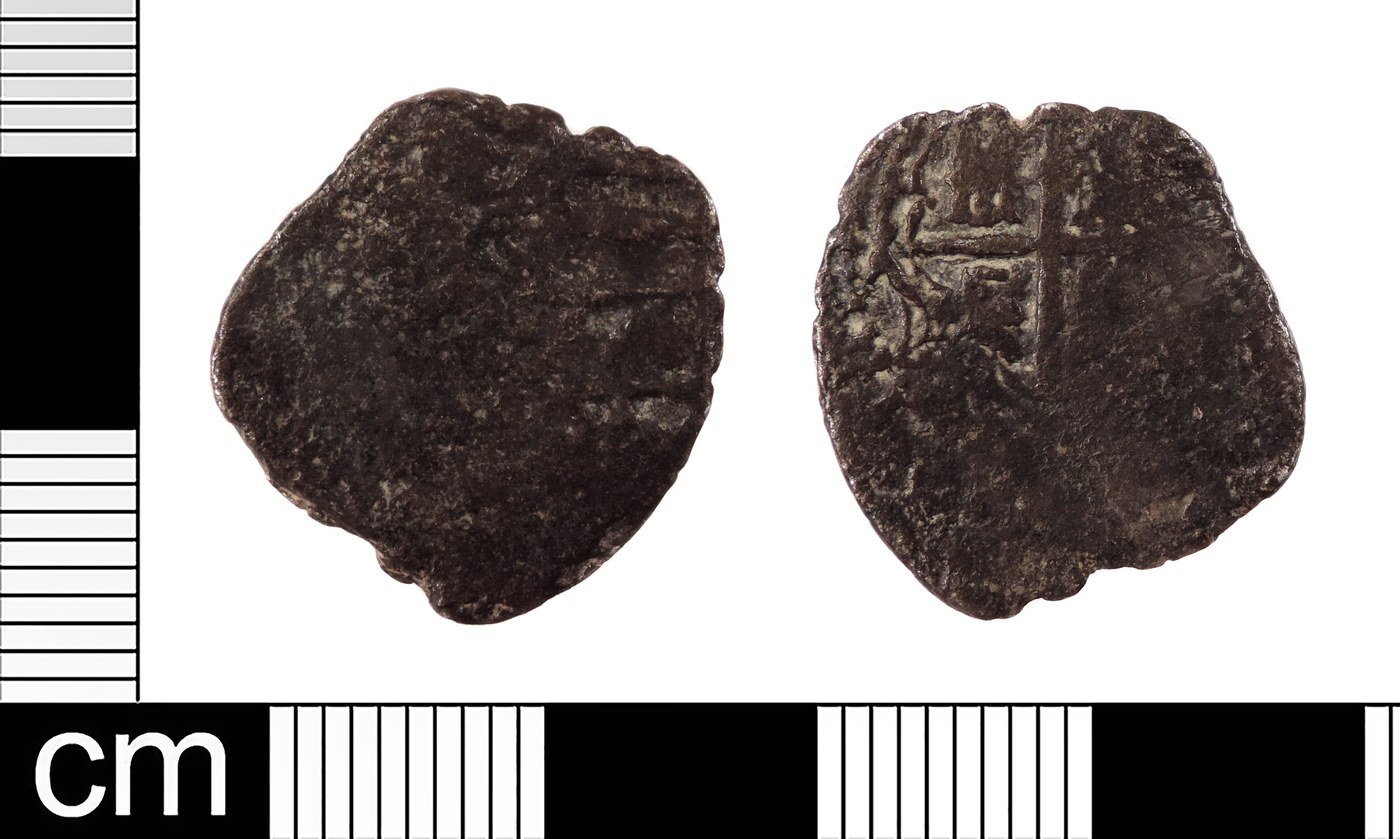
Begin with shape and fabric, because cobs are unlike milled coins. A genuine cob 2 reales is irregular, off-round and often angular or clipped, with an uneven thickness and a hand-struck, off-center design. Expect parts of the legend and frequently the date to be missing off the edge of the flan. A perfectly round, evenly struck "cob" is a warning sign.
Read the two faces. This type pairs an ornamented cross, its ends finished with decorative motifs inside a border, with the quartered Spanish Habsburg coat of arms. Confirm you can see a cross on one side and a shield on the other rather than a portrait or a pillars-and-globe design; that cross-and-arms pairing is the hallmark of the 1556-1665 cob reales.
Check size and weight to confirm the denomination. The 2 reales is a small silver cob, plainly larger than a 1 real but much smaller and lighter than a 4 or 8 reales. Weighing and measuring it separates the 2 reales from its neighbors on the reales ladder, since worn cobs can be hard to judge by eye alone.
Hunt for mint and assayer marks in the fields, usually beside the shield or within the cross legend. A mint letter or monogram (for example Mexico City, Potosi, Lima or Santa Fe de Bogota) and an assayer initial help attribute the coin and, together with the king named in the legend, place it in the reign even when no full date survives. These marks matter far more than overall neatness for cataloguing a cob.
Authenticate carefully. Cobs are heavily faked with cast copies, and genuine pieces are often cleaned, tooled, holed, salt-corroded from the sea, or mounted as jewelry. Look for cast seams, bubbles or unnaturally soft, uniform surfaces; check that weight and diameter match silver; and for anything of value seek third-party grading or an expert opinion rather than trusting the design alone.
Frequently asked questions
How do I tell a cob 2 reales from a 4 or 8 reales?
By size and weight. The 2 reales is a small cob, while the 4 and 8 reales are markedly broader and heavier. Weighing and measuring the coin quickly separates the denominations, which is useful when wear obscures the design.
Which side is the obverse on a cob?
Conventions vary, but on these Habsburg cobs the shield (arms) side is generally treated as the obverse and the cross side as the reverse. Either way, look for a cross on one face and the quartered Spanish arms on the other.
How can I spot a fake cob?
Watch for cast seams, surface bubbles, soft mushy detail, a suspiciously round or even flan, and weight that does not match silver. Genuine cobs are irregular but crisply hammer-struck. When in doubt, get the coin authenticated.
Should I clean a cob before identifying it?
No. Cleaning strips original surfaces and cuts value, and sea-salvage cobs need specialist conservation. Identify and authenticate the coin as-is and leave any cleaning to a professional.