
How to Identify the Spanish Colonial 8 Reales (Milled Bust)
A collector's walkthrough for identifying the milled-bust Spanish 8 reales by its portrait, arms, size, mint marks, and authenticity cues.
Read the full Spanish Colonial 8 Reales (Milled Bust) encyclopedia entry →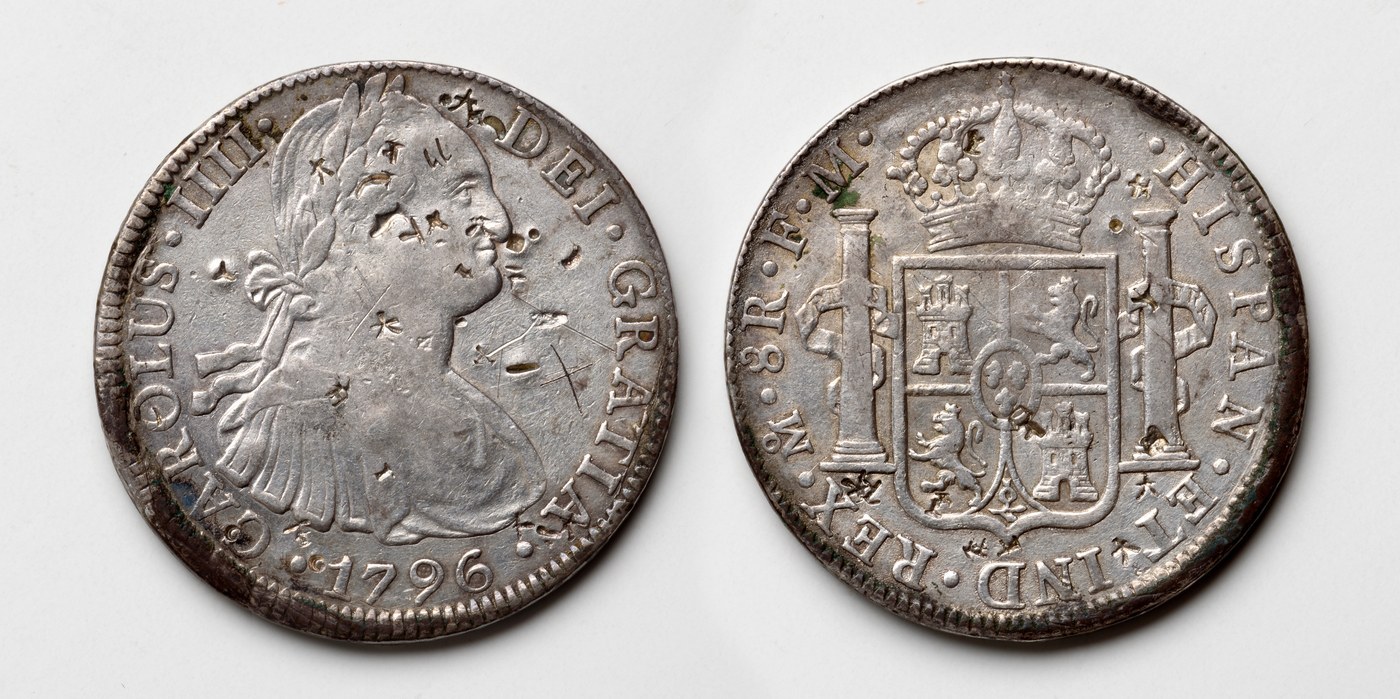
Start with size and metal. A genuine milled-bust 8 reales is a substantial silver coin, about 39–40 mm across and roughly 27 grams, with a decorated or reeded edge rather than a plain one. It should not be attracted to a magnet. These physical checks quickly separate the real coin from lightweight cast fakes and base-metal replicas.
Read the obverse. The milled-bust type shows an armored bust of the Spanish king facing right, surrounded by a Latin legend giving his name and “DEI GRATIA,” with the date in the field—on this example, 1796. The legend spells the ruler “CAROLUS IIII,” which identifies Carlos IV; combined with the date, that confirms the reign. Compare the portrait style against reference images, since the earlier Carlos III bust looks similar to casual eyes.
Read the reverse. Expect a crowned, quartered coat of arms flanked by two crowned Pillars of Hercules carrying “PLVS VLTRA” scrolls, with the legend “HISPAN ET IND REX.” The small characters to the left and right of the shield are the key attribution marks: the mint mark (for example, an “Mo” monogram for Mexico City, “PTS” for Potosí, or “LIMA”/“LM” for Lima), the assayer's initials, and the “8R” denomination. Recording these lets you attribute the exact mint and issue.
Watch for look-alikes and later relatives. The earlier pillar (columnario) 8 reales shows a two-globes-and-pillars reverse instead of a portrait, and later Latin American republic 8 reales borrow similar layouts but different legends and emblems. Contemporary counterfeits and modern tourist copies also exist, some cast from real coins.
Authenticate carefully. Genuine strikes show crisp, detailed devices and lettering; soft, mushy, or seam-lined surfaces suggest a cast copy. Off weight, magnetic response, or a greasy gray look are red flags. Old Chinese merchant chopmarks are normal on trade specimens and do not make a coin fake. For a high-value attribution, third-party grading or an experienced dealer's opinion is worth the cost.
Frequently asked questions
What is the fastest way to spot a fake 8 reales?
Weigh and measure it (about 27 g and 39–40 mm), confirm it is non-magnetic, and inspect the strike. Casting seams, soft details, or wrong weight are common signs of a replica.
Where do I find the mint mark?
On the reverse, in the small letters beside the crowned shield, alongside the assayer's initials and the “8R” denomination. The mint mark tells you which colonial mint produced the coin.
How is this different from a pillar dollar?
The pillar (columnario) 8 reales has two globes between pillars on the reverse and no royal portrait. The milled-bust type shows the king's bust on the obverse and a crowned coat of arms on the reverse.
Do chopmarks lower the value?
Chopmarks are stamps applied by Asian merchants to verify silver and are part of the coin's trade history. They can reduce eye appeal but are collected in their own right and do not indicate a counterfeit.