How to Identify the Spanish Colonial 8 Reales Ferdinand VII
A visual guide to the Spanish colonial 8 Reales bearing King Ferdinand VII's bust, identified by its pillars-and-crowned-arms reverse, mint marks, and classic milled-dollar specifications.
Read the full Spanish Colonial 8 Reales Ferdinand VII encyclopedia entry →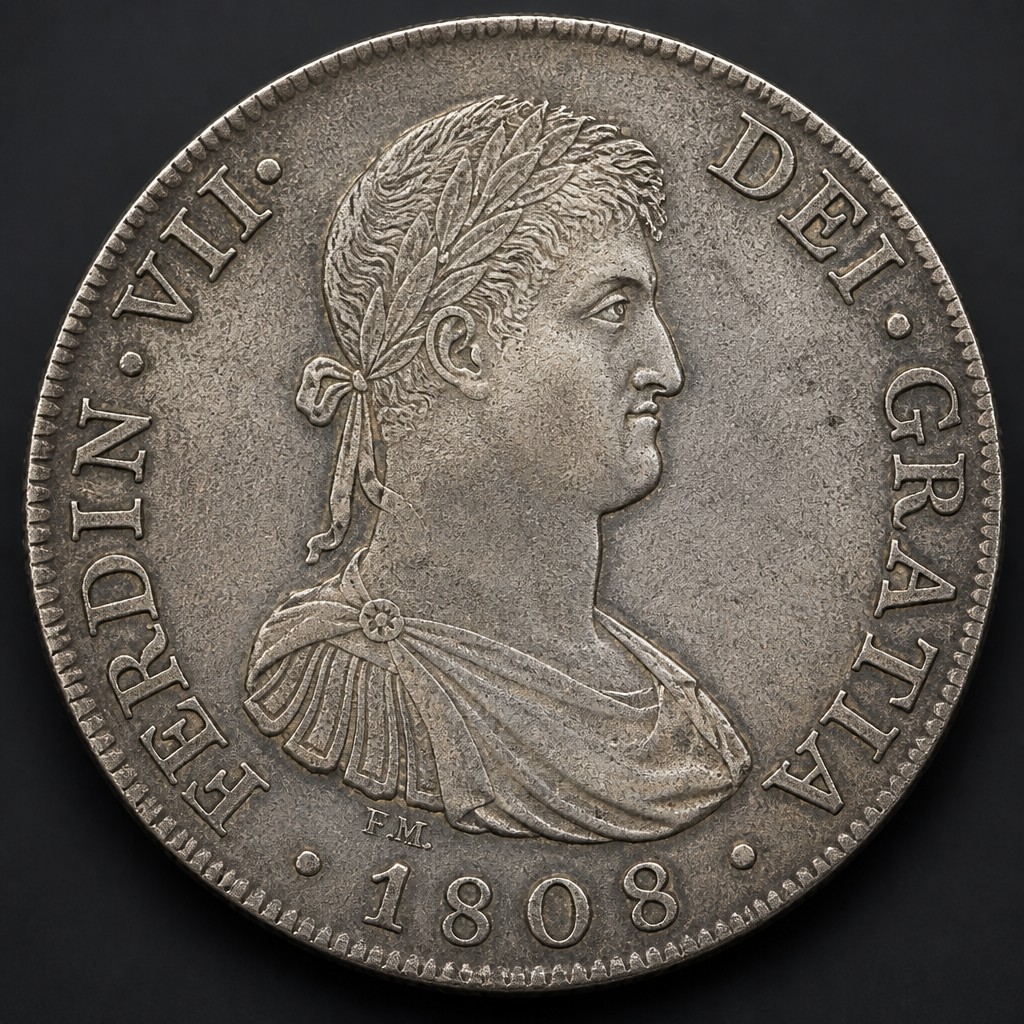
What It Is
This large silver coin was struck across Spain's American colonial mints during the reign of King Ferdinand VII, in the early 19th century, continuing the long tradition of the Spanish "piece of eight" that had circulated worldwide as a trusted trade coin for centuries. It remained legal tender and widely circulated in many regions even after several colonies achieved independence.
Obverse Design
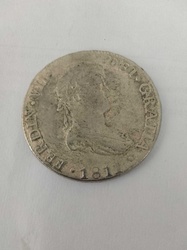
The obverse shows a bust of Ferdinand VII, either bare-headed or in armor depending on the specific mint and year, with a Latin legend naming him king ("FERDIN VII DEI GRATIA" or similar) along with the date.
Reverse Design
The reverse depicts the crowned Spanish coat of arms flanked by the two Pillars of Hercules, each wrapped with a banner reading "PLUS ULTRA," with the Latin legend "HISPAN ET IND REX" (King of Spain and the Indies) around the rim.
Size, Weight, Metal, and Edge
This is a full crown-size coin, roughly 39-40 mm in diameter and about 27 grams, struck in approximately .903 fine silver. The edge typically carries an engrailed or diagonally reeded pattern characteristic of the period's minting technology.
Mint Marks
Small mintmark letters appear near the base of the coat of arms, identifying which colonial mint struck the coin—common examples include "Mo" (Mexico City), "LM" (Lima), "PTS" (Potosí), "NG" (Guatemala), "S" (Santiago), and "P" (Popayán)—paired with one or two assayer initials. These letters are essential for identifying the exact origin of a given coin.
Telling It Apart From Similar Coins
Because this basic design was struck for years under Ferdinand VII across many colonial mints, and similar designs were used under earlier and later Spanish monarchs, careful reading of the king's name and the mintmark/assayer letters is necessary to pin down the exact issuing mint and monarch.
Judging Condition
Wear appears first on the king's cheek, hair, and ear, and on the high points of the crown and pillars on the reverse. A coin with crisp facial detail and a fully legible mintmark is in notably better condition than one with a smoothed, indistinct portrait.
Authenticity Red Flags
Because of the historical significance and value of these coins, contemporary counterfeits (some made and circulated even during the period itself) and modern fakes both exist. Warning signs include incorrect weight or diameter, a soft or mushy strike, mintmark letters that look re-cut or inconsistent with genuine references, and a grainy surface suggesting a cast copy rather than a hammered or milled strike.
Frequently asked questions
How do I find the mint that struck my Ferdinand VII 8 Reales?
Look for small mintmark letters near the base of the crowned arms on the reverse, such as "Mo" for Mexico City, "LM" for Lima, or "PTS" for Potosí, paired with assayer initials.
What do the pillars on the reverse represent?
They are the Pillars of Hercules, flanking the Spanish crowned arms, with a banner reading "PLUS ULTRA," a motto referencing Spain's overseas empire.
How heavy should this coin be?
A genuine example weighs about 27 grams and measures roughly 39-40 mm in diameter, in about .903 fine silver.
Why does the king's bust style vary between coins?
Different colonial mints and years used slightly different bust styles (bare-headed or armored), so variation in portrait style alone does not indicate a fake.
Spanish Colonial 8 Reales Ferdinand VII identified by the community
Recent Spanish Colonial 8 Reales Ferdinand VII coins identified with Coin Identifier.