
How to Identify the South African ZAR Kruger Pond
A gold pound coin of the old Transvaal (South African Republic) featuring President Paul Kruger, prized for its wagon-reverse varieties and sovereign-like specifications.
Read the full South African ZAR Kruger Pond encyclopedia entry →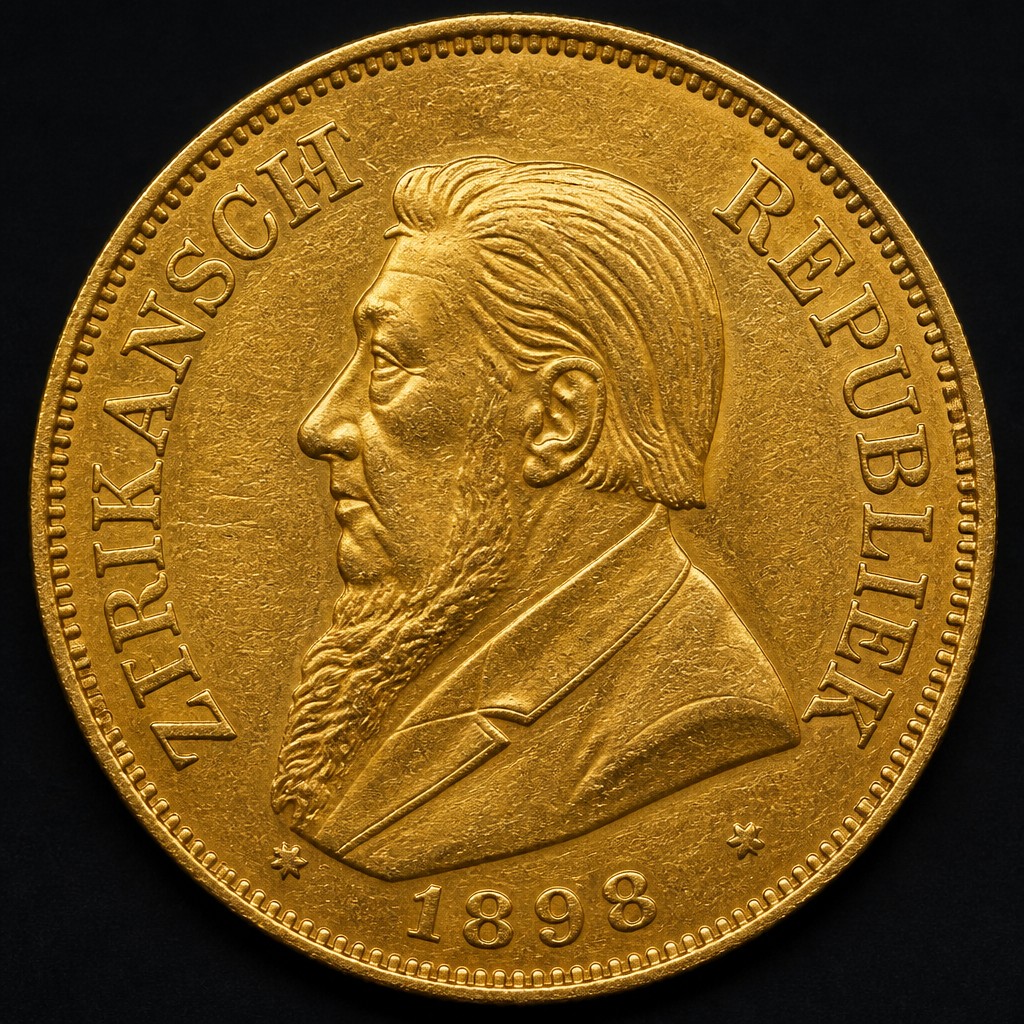
What Is the Kruger Pond?
The Kruger pond is a gold coin struck by the Zuid-Afrikaansche Republiek (ZAR), the old Transvaal Republic, in the final years of the 19th century under President Paul Kruger. It functioned as the republic's pound, comparable in size and gold content to the British sovereign, and was struck at the ZAR's own Pretoria mint shortly before the republic fell during the Second Boer War. Because the ZAR only minted gold coinage for a short window of years, the series is compact enough that collectors can become familiar with every date and variety without too much difficulty.
Obverse Design
The obverse shows a left-facing bust of President Paul Kruger in profile, with his characteristic beard and collar. The legend "ZUID-AFRIKAANSCHE REPUBLIEK" runs around the rim, with the date placed below the bust.
Reverse Design
The reverse carries the coat of arms of the ZAR: a shield flanked by an anchor, an orange tree, and a wagon, with a lion below, all beneath the motto "EENDRAGT MAAKT MAGT" ("Unity Is Strength") on a ribbon. The wagon at the center of the arms is the key detail collectors examine closely.
Size, Weight, and Metal
The Kruger pond was struck in 22-karat (approximately .916 fine) gold, weighing around 7.98 grams with a diameter close to 22-23mm, essentially matching British sovereign specifications. The edge is reeded. This close match to sovereign specifications was intentional, since it let the coin trade smoothly alongside British gold coinage already circulating in the region at the time.
Key Varieties: Single Shaft vs Double Shaft
Look closely at the wagon in the coat of arms: some strikes show a single shaft (pole) extending from the wagon, while more common strikes show a double shaft (two parallel poles). The single-shaft variety is scarcer and more sought after, and distinguishing the two usually requires a loupe and good lighting since the difference is subtle.
Mint Marks
All Kruger ponds were struck at the ZAR's single mint in Pretoria, so there is no separate mint-mark letter to check. Any claim of a different mint origin should raise suspicion. This is a useful simplifying fact for new collectors, since it removes an entire layer of variety-hunting that applies to many other national coinages of the same era.
Condition and Grading at a Glance
Because these coins circulated as everyday currency of the day, wear shows first on Kruger's cheek, eyebrow, and hair curls, and on the high points of the wagon and lion on the reverse. Sharp, unworn beard curls and a crisp rim indicate a higher-grade coin.
Authenticity Red Flags
Given the coin's gold value, counterfeits and casts are common. Check the exact weight and diameter against the specifications above, examine the reeding for consistency (cast fakes often show mushy or irregular reeding), and compare the legend's lettering, which is crisp and evenly spaced on genuine strikes. A coin that is noticeably underweight, magnetic, or shows a seam line is suspect.
Frequently asked questions
What is a Kruger pond equivalent to?
It is roughly equivalent to a British sovereign, sharing a similar gold weight and fineness, and served as the pound of the old Transvaal republic.
How can I tell single-shaft from double-shaft?
Examine the wagon's pole in the coat of arms under magnification; a single unbroken pole is the rarer variety, while two parallel poles is more common.
Are there mint marks on Kruger ponds?
No, all were struck at the ZAR's Pretoria mint, so there is no mint-mark variation to check.
Why are fakes so common for this coin?
Because it carries meaningful gold bullion value along with strong collector demand, so verifying weight, diameter, and edge reeding against known specifications is important.