
How to Identify the Solidus of Honorius
Collector checks for a Honorius gold solidus — reading the obverse legend, reverse type, mint marks, weight, and spotting the common fakes.
Read the full Solidus of Honorius encyclopedia entry →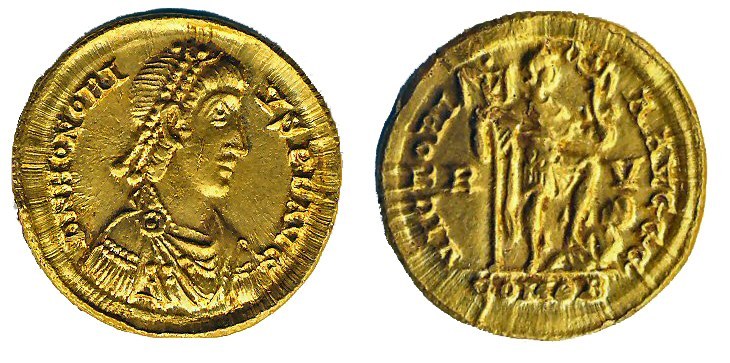
Start with the obverse legend, because late Roman portraits are stylized and one diademed emperor looks much like another. On a solidus of Honorius the legend usually reads D N HONORIVS P F AVG around a pearl-diademed bust. Confirming the name in the legend is the single most reliable way to attribute the coin to Honorius rather than a contemporary such as Arcadius, Theodosius II, or Valentinian III.
Next read the reverse. The observed type shows an armored standing figure holding a spear and shield; late Western solidi commonly pair this military imagery with a legend such as VICTORIA AVGGG. Look closely at the letters beside the figure and in the exergue — these are mint and control marks. An exergue reading COMOB or CONOB signals imperial gold, while flanking letters such as R V (Ravenna), M D (Milan), or R M (Rome) tell you the mint. These marks narrow the issue far more precisely than the portrait alone.
Check the physical specifications. A genuine solidus is a thin, broad flan of high-purity gold, about 20-21 mm in diameter and close to 4.5 grams. It should have the warm, untarnished color of gold and feel dense for its size. Significant deviation in weight or diameter, a pale or coppery tone, or a coin that feels light are all reasons for caution.
Watch for look-alikes and fakes. Solidi of the other emperors of this era share the same formats, so always verify the name in the legend. Modern counterfeits include cast copies with soft, mushy detail, gilded base-metal forgeries, and tooled or repaired coins. Edge or surface mount marks indicate former jewelry use and reduce both authenticity confidence and value.
Because ancient gold is heavily faked and valuable, do not rely on a seller's photo or description alone. For any meaningful purchase, obtain independent authentication from a specialist in ancient coins, confirm weight and diameter, and cross-check the exact type and mint against recent auction records.
Frequently asked questions
How do I know it's Honorius and not another emperor?
Read the obverse legend. Honorius solidi typically name him as D N HONORIVS P F AVG. Portraits of the period are generic and interchangeable, so the legend — not the face — is what attributes the coin.
What do the letters on the reverse mean?
They are mint and control marks. An exergue of COMOB or CONOB marks imperial gold, and letters flanking the figure identify the mint, such as R V for Ravenna, M D for Milan, or R M for Rome.
What should it weigh?
A genuine solidus is about 4.5 grams of high-purity gold and roughly 20-21 mm across. Weight and diameter well outside these ranges, or a coin that feels light, are warning signs of a fake or a plated piece.
Should I clean or test it myself?
No. Do not clean an ancient coin — it can permanently damage the surface and value. Leave metal testing and authentication to a reputable ancient-coin specialist, and identify the piece from clear photos as-is.