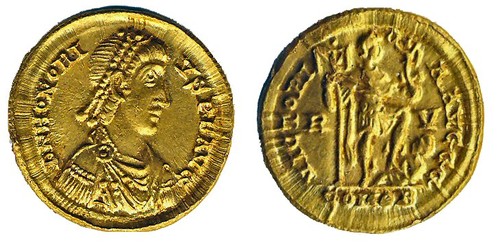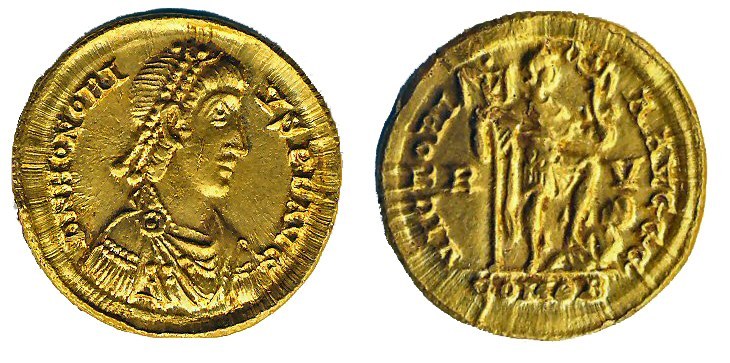
Solidus of Honorius
A late Roman gold solidus of Emperor Honorius (r. 393-423 CE), with his diademed bust and an armored standing figure holding a spear and shield.
- Country
- Roman Empire
- Denomination
- Solidus
- Metal
- Gold
Got a coin like this?
Identify any coin from a photo, free.
Overview
This is a gold solidus struck under Honorius, the Western Roman emperor who reigned from 393 to 423 CE. The obverse shows his diademed bust, and the reverse displays an armored standing figure holding a spear and shield — a martial image of imperial power typical of the coin's era.
The solidus was the standard high-value gold coin of the late Roman and early Byzantine world, introduced by Constantine the Great in the early 4th century and struck at roughly 4.5 grams of nearly pure gold. It became the backbone of imperial finance and the most trusted gold coin across the Mediterranean for centuries.
Solidi of Honorius are among the more frequently encountered late Western Roman gold coins, but each is still a genuine ancient artifact from the final decades of the Western Empire. Condition, mint, and reverse type all affect how a given example is valued.
History & Background
Flavius Honorius became Western Roman emperor as a child in 393 CE, elevated by his father Theodosius I, and ruled the West until his death in 423 CE. His long reign coincided with the disintegration of Roman authority in the West: the crossing of the Rhine by Germanic peoples, repeated Gothic campaigns in Italy, and — most famously — the sack of Rome by Alaric's Visigoths in 410 CE. For much of this period real power lay with generals such as Stilicho, and the imperial court relocated to the more defensible city of Ravenna.
Despite the turmoil, the solidus remained a remarkably stable currency. First established by Constantine I around 309 CE at 72 to the Roman pound, it held its weight and purity while lesser denominations were debased. Honorius's solidi were struck at western mints including Ravenna, Milan, and Rome, as well as eastern mints, and they circulated widely alongside the coinage of his eastern colleagues.
The design vocabulary of these coins — a diademed imperial portrait paired with military and victory imagery — reflected an empire that continued to project strength on its money even as its western territories were slipping away. The solidus outlived the Western Empire itself, carrying on as the standard gold coin of Byzantium.
How to Identify
Begin with the obverse portrait: a bust of Honorius wearing a pearl diadem, usually with a surrounding Latin legend naming him, commonly in the form D N HONORIVS P F AVG (Dominus Noster Honorius Pius Felix Augustus). Late Roman portraits are stylized and fairly generic, so the legend is the key to attributing the coin to Honorius rather than a contemporary emperor.
The reverse shows an armored standing figure with a spear and shield, a common military type of the period. Late Western solidi frequently carry legends such as VICTORIA AVGGG and an exergue reading COMOB or CONOB, with letters flanking the figure that identify the mint (for example, R V for Ravenna, M D for Milan, R M for Rome). Read these carefully, as they pin down where and roughly when the coin was made.
The physical coin should be gold, about 20-21 mm across and close to 4.5 grams in weight. Genuine solidi are thin, broad flans of high-purity gold with a warm, even color that does not tarnish. Weight and diameter that fall well outside these figures are a warning sign.
Value & Collectibility
A solidus of Honorius carries value both as ancient gold and as a collectible historical artifact. Its metal alone (roughly 4.5 g of high-purity gold) sets a bullion floor, but genuine examples typically trade well above melt because of their age and appeal. Most collectable pieces change hands in the range of a few hundred to a couple of thousand US dollars, with exceptional strikes, rare mints, or superb preservation reaching higher.
Value is driven by grade, centering, strike sharpness, mint, and reverse type. A well-centered coin with a full, clear portrait and sharp reverse detail commands a strong premium over a worn, clipped, or off-center example. Coins with ancient mounting or jewelry marks are worth less.
Because ancient gold is widely counterfeited, realistic pricing comes from recent auction records for the specific type and mint rather than generic lists. For any significant purchase, buy from reputable specialists and seek independent authentication.
Frequently asked questions
Who was Honorius?
Flavius Honorius was the Western Roman emperor from 393 to 423 CE, son of Theodosius I. His reign saw the sack of Rome in 410 CE and the steady collapse of Roman control in the West, with the court based at Ravenna.
What is a solidus?
The solidus was the standard gold coin of the late Roman and Byzantine world, introduced by Constantine the Great around 309 CE. It weighed about 4.5 grams of nearly pure gold and remained a stable, trusted currency for centuries.
What is shown on the reverse?
An armored standing figure holding a spear and shield — a military type common on late Roman gold. The reverse legend (often VICTORIA AVGGG) and mint letters help identify the specific issue and where it was struck.
Is it made of real gold?
Yes. Genuine solidi are struck in high-purity gold, about 4.5 grams and roughly 20-21 mm across. The metal gives them a warm yellow color that does not tarnish, though modern fakes in gilded base metal do exist.
How much is a solidus of Honorius worth?
Most collectable examples sell for a few hundred to a couple of thousand US dollars, depending on grade, mint, and strike, with the gold content setting a floor. Auction records for the exact type are the best pricing guide.
Solidus of Honorius guides
In-depth guides for identifying, valuing, and collecting Solidus of Honorius.