
How to Identify the Solidus of Gratian
A collector's guide to attributing a late Roman gold solidus of Gratian by its portrait, legend, weight, size, and mint marks.
Read the full Solidus of Gratian encyclopedia entry →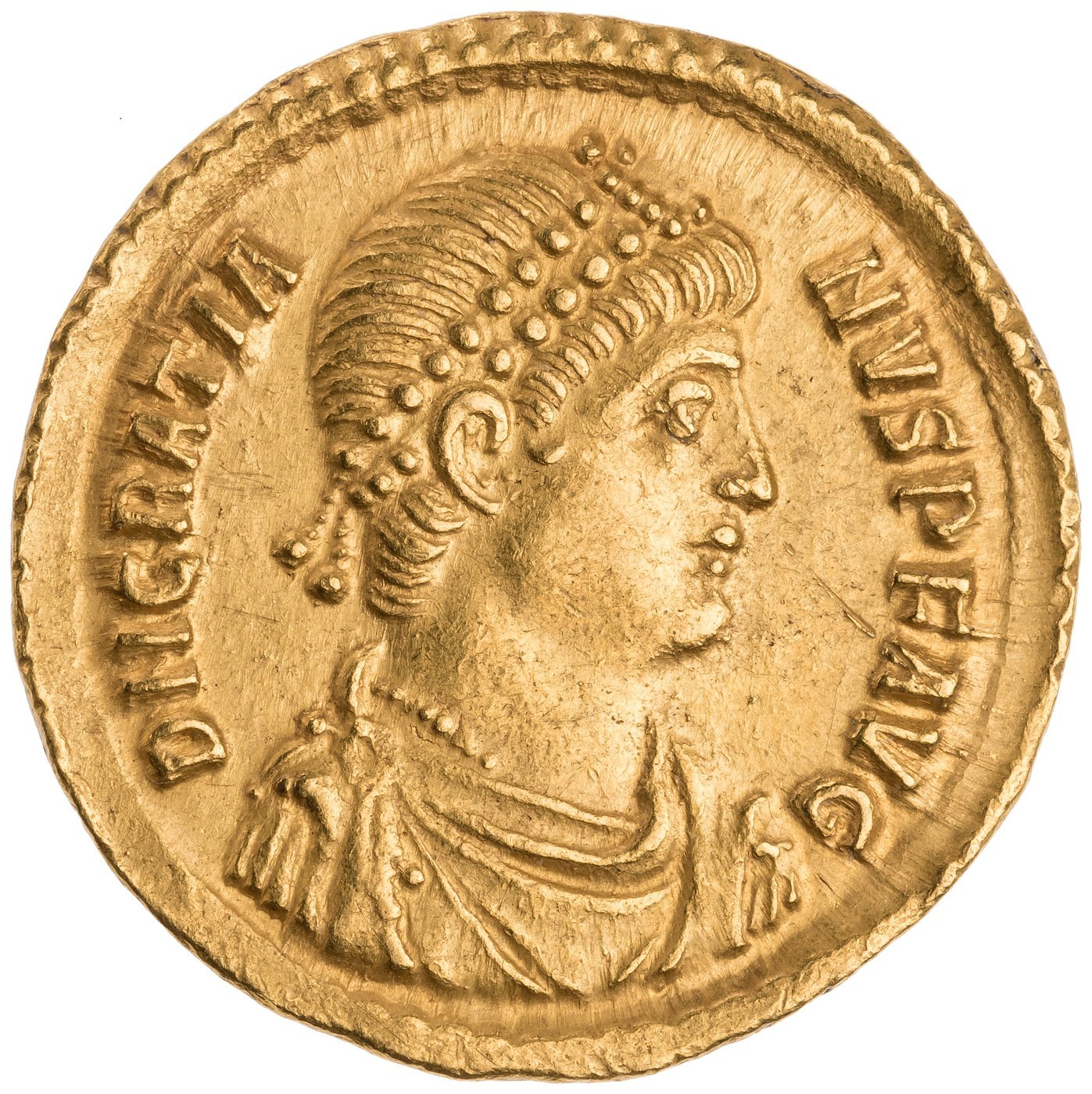
Begin with the metal and physical specifications, because they narrow the field quickly. A solidus of Gratian should be gold of high purity, roughly 20–21 mm across and close to 4.5 grams in weight, with a warm yellow tone and a broad, thin fabric. A coin that is markedly heavier, lighter, off-color, or magnetic is not a genuine solidus and may be a forgery or a base-metal reproduction.
Study the obverse portrait and legend, the primary diagnostics. Gratian is shown as a youthful ruler with characteristic curly hair, wearing a pearl or rosette diadem, draped and cuirassed, and facing right. The encircling legend should name him, most often D N GRATIANVS P F AVG. Read the legend carefully: it is the difference between Gratian and other diademed late-fourth-century emperors such as Valentinian I, Valens, Valentinian II, or Theodosius I, whose busts look broadly similar.
Turn the coin over to attribute the exact issue, since an obverse alone cannot do this. Gratian reverses commonly feature victory or imperial themes with legends like VICTORIA AVGG, and the exergue below the design carries a mint mark identifying the striking city and workshop. Cross-referencing both the reverse type and the mint mark against the Roman Imperial Coinage (RIC) catalogue is the standard way to reach a precise identification.
Watch for look-alikes and altered pieces. Contemporary and modern forgeries of gold solidi are common, and genuine coins are sometimes mounted, holed, cleaned, or tooled to sharpen worn detail. Inspect the rim for traces of a removed mount, check that lettering and portrait style match published examples, and be cautious of coins with unnaturally crisp surfaces or suspiciously low weight.
For any coin of this value, seek expert confirmation. Weigh and measure the piece, compare it against catalogued specimens, and consult a specialist in late Roman gold or a reputable auction house. Documented provenance and, where available, a professional opinion or slabbing greatly strengthen an attribution and protect against costly fakes.
Frequently asked questions
What obverse legend should I look for?
Most Gratian solidi read D N GRATIANVS P F AVG around a youthful, curly-haired diademed bust. Confirming that legend distinguishes him from contemporary emperors with similar portraits.
Why does the reverse matter for identification?
The reverse type and its exergual mint mark pin down the exact issue and striking city. An obverse portrait alone tells you it is Gratian but not which specific catalogued variety, so both sides are needed for full attribution.
How do I spot a fake solidus?
Check weight and diameter against the roughly 4.5 gram, 20–21 mm standard, look for correct high-purity gold color, and examine lettering and style against published examples. Wrong weight, off-color metal, mount traces, or unusually crisp surfaces are warning signs. Expert authentication is strongly advised.
Which emperors are easily confused with Gratian?
Other diademed late-fourth-century rulers such as Valentinian I, Valens, Valentinian II, and Theodosius I share a similar bust style. The obverse legend naming Gratian is the reliable way to tell them apart.