
How to Identify the Silver Dirham of Salm ibn Ziyad
A collector's guide to attributing an Arab-Sasanian dirham to Salm ibn Ziyad: the bust, fire-altar reverse, Pahlavi name, Arabic margins, size and cautions.
Read the full Silver Dirham of Salm ibn Ziyad encyclopedia entry →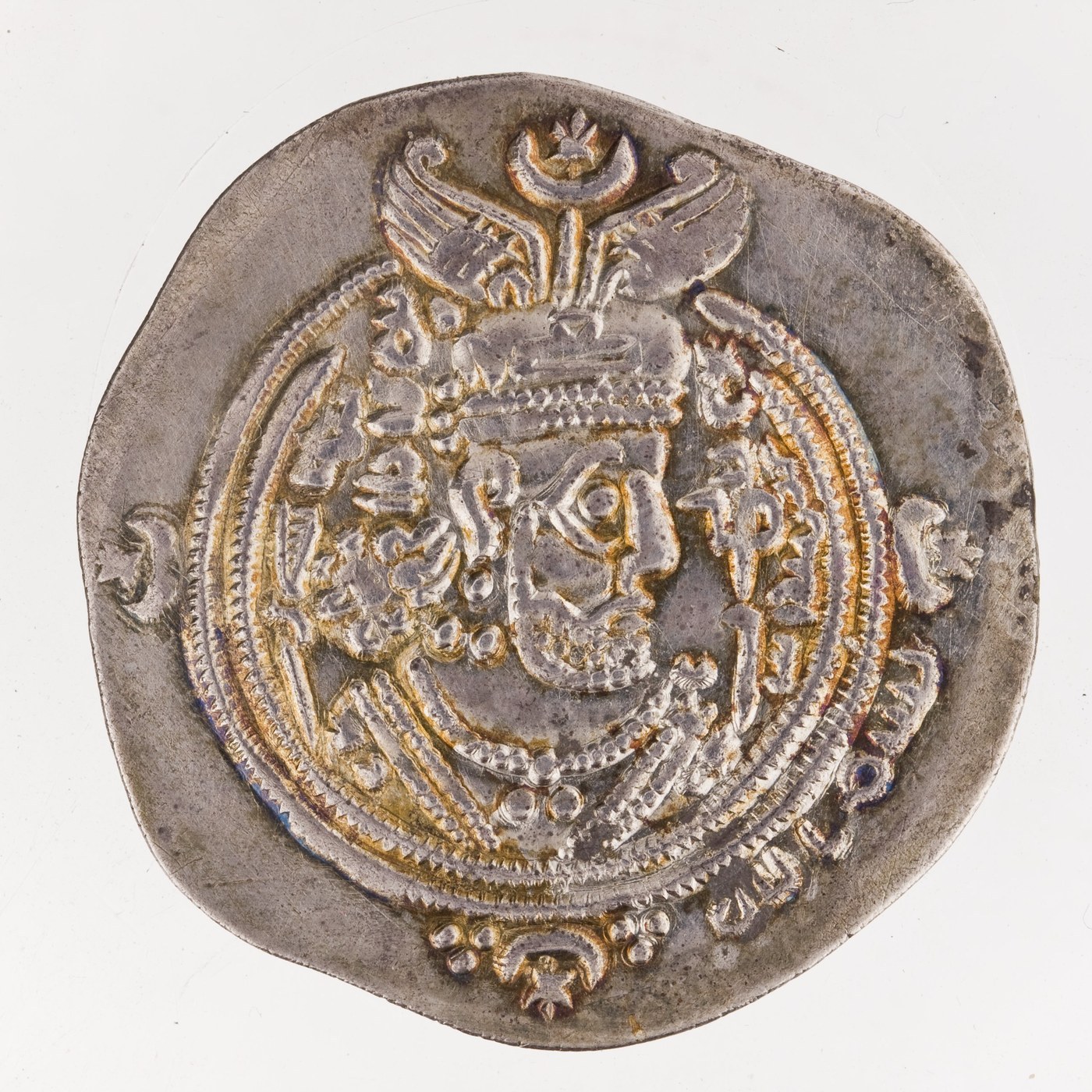
Begin with the fabric of the coin. An Arab-Sasanian dirham is silver, thin and broad rather than small and thick, typically about 28-33 mm across yet only around 3.5-4.1 grams. A coin that is small and chunky, magnetic, or clearly base metal is not this type. Because the pieces were hand-struck on wide flans, expect some off-centering and legends that run off the edge; that is normal and not a defect.
Read the two faces as a pair. The obverse should show a crowned royal head in profile, copied from Sasanian kings, ringed by a border of script and usually framed with beaded circles and crescent-and-star ornaments. The reverse should show a fire altar with a flame, flanked by two standing attendants, in a broadly symmetrical 'mirror' arrangement. This bust-plus-fire-altar combination is the signature of the whole Arab-Sasanian series.
Attribution to Salm ibn Ziyad specifically depends on the legends, not the imagery. The governor's name is written in Pahlavi (Middle Persian) script beside the obverse bust, and an Arabic phrase such as 'in the name of God' commonly appears in the margin. The reverse gives the mint abbreviation and the date, again in Pahlavi. Because the same bust and altar were used by Sasanian kings and by many different Arab governors, you cannot identify Salm from the picture alone; the Pahlavi name is the decisive element and usually needs a specialist or reference to read.
Separate it from look-alikes. A purely Sasanian drachm has the same bust and altar but no Arabic wording; if there is no Arabic in the margins, the coin is likely pre-Islamic rather than an Arab-Sasanian issue. Other Arab governors' dirhams look almost identical apart from the name and the mint-and-date, so never assume a governor without confirming the legend. The later reformed Islamic dirham, by contrast, has no bust or altar at all, only Arabic text.
Apply normal authentication caution. Genuine coins are struck, not cast, with crisp detail and correct thin, broad weight. Be wary of cast copies and tourist replicas showing soft or mushy detail, casting seams, bubbles, or a wrong weight, and of tooled or re-engraved legends meant to turn a common issue into a named governor. When value hinges on reading a worn Pahlavi name, weigh and measure the coin, photograph both faces clearly, and have the legends verified against standard Arab-Sasanian references or by a specialist.
Frequently asked questions
How do I tell an Arab-Sasanian dirham from a plain Sasanian drachm?
Both share the crowned bust and the fire-altar reverse. The difference is the added Arabic wording in the margins on Arab-Sasanian coins. If there is no Arabic at all, the coin is probably a pre-Islamic Sasanian drachm rather than a governor's issue like Salm ibn Ziyad's.
How do I know it is Salm ibn Ziyad and not another governor?
The governor's name is written in Pahlavi script beside the obverse bust. Since the bust and altar are shared across the whole series, only reading that name confirms Salm ibn Ziyad, so the legend usually needs checking against references or by a specialist.
What size and weight should the coin be?
It should be a thin, broad silver coin, roughly 28-33 mm across but only about 3.5-4.1 grams. A thick, small, or magnetic piece, or one well outside that weight, is a warning sign of a different coin or a fake.
How can I spot a fake?
Genuine dirhams are struck with sharp detail, not cast. Watch for casting seams, bubbles, soft mushy surfaces, incorrect weight, or legends that look re-engraved to add a governor's name. Given that value depends on the name, have questionable examples authenticated.