
How to Identify the Shield Nickel
A collector's checklist for confirming a Shield Nickel: reading the shield and numeral 5 design, checking size and metal, and spotting the rays variety.
Read the full Shield Nickel encyclopedia entry →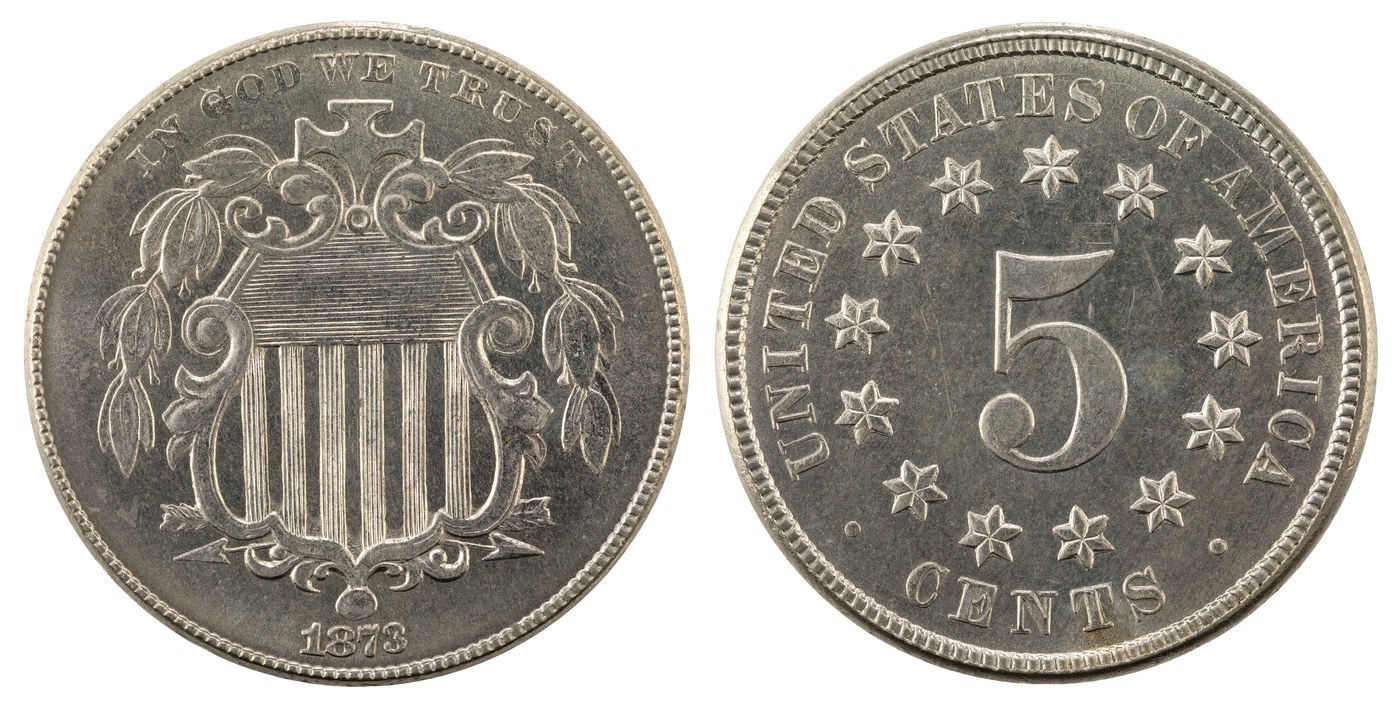
Start with the two design elements that define the type. The obverse must show a Union shield topped by a cross, framed by leaves and scrolls, with IN GOD WE TRUST across the top and the date below. The reverse must show a large numeral 5 at the center, surrounded by thirteen stars, with UNITED STATES OF AMERICA around the top and CENTS below. On the pictured coin the date reads 1866.
Next, verify the physical coin. It should be copper-nickel, roughly 20.5 mm in diameter, weigh about 5 grams, and have a plain, smooth edge with no reeding. The alloy gives it a pale gray, harder look than a copper cent and makes it thicker and heavier than the small silver half dime it replaced.
Check the reverse for the ray variety. Coins of 1866 and part of 1867 show short rays radiating between the stars around the 5; the Mint removed them later in 1867, so most Shield Nickels have plain fields between the stars. The presence or absence of rays is the single most important variety check on the type.
Do not look for a mint mark. All Shield Nickels were struck in Philadelphia and carry none, so an absent mint mark is expected and does not signal a problem. Identify the coin instead by the shield obverse, the large 5 reverse, and the copper-nickel composition.
Finally, be cautious with condition and authenticity. The hard alloy often struck weakly, so soft detail is not automatically wear, but cleaned, corroded, or re-toned surfaces reduce value sharply. For scarce dates or high-grade examples, seek authentication and grading from a recognized third-party service before buying or selling.
Frequently asked questions
How do I tell a Shield Nickel from a later Liberty Head nickel?
Check the designs. The Shield Nickel has a shield on the obverse and a large numeral 5 on the reverse; the Liberty Head nickel shows a Liberty portrait with a large V. Both are copper-nickel and about the same size.
What size and weight should it be?
A genuine Shield Nickel is copper-nickel, roughly 20.5 mm across, weighs about 5 grams, and has a plain edge without reeding.
Where is the mint mark located?
There is none. Shield Nickels were struck only in Philadelphia, which used no mint mark, so you should not expect to find one.
What are the biggest authentication risks?
Cleaned or corroded surfaces and weak strikes that can be mistaken for problems, plus premium prices on rare dates and the With Rays variety. Valuable examples should be verified by a reputable grading service.