
How to Identify the Shah Jahan Rupee
A collector's checklist for recognizing a hand-struck silver rupee of Shah Jahan, dated AH 1064, from its calligraphy, flan, and date.
Read the full Shah Jahan Rupee encyclopedia entry →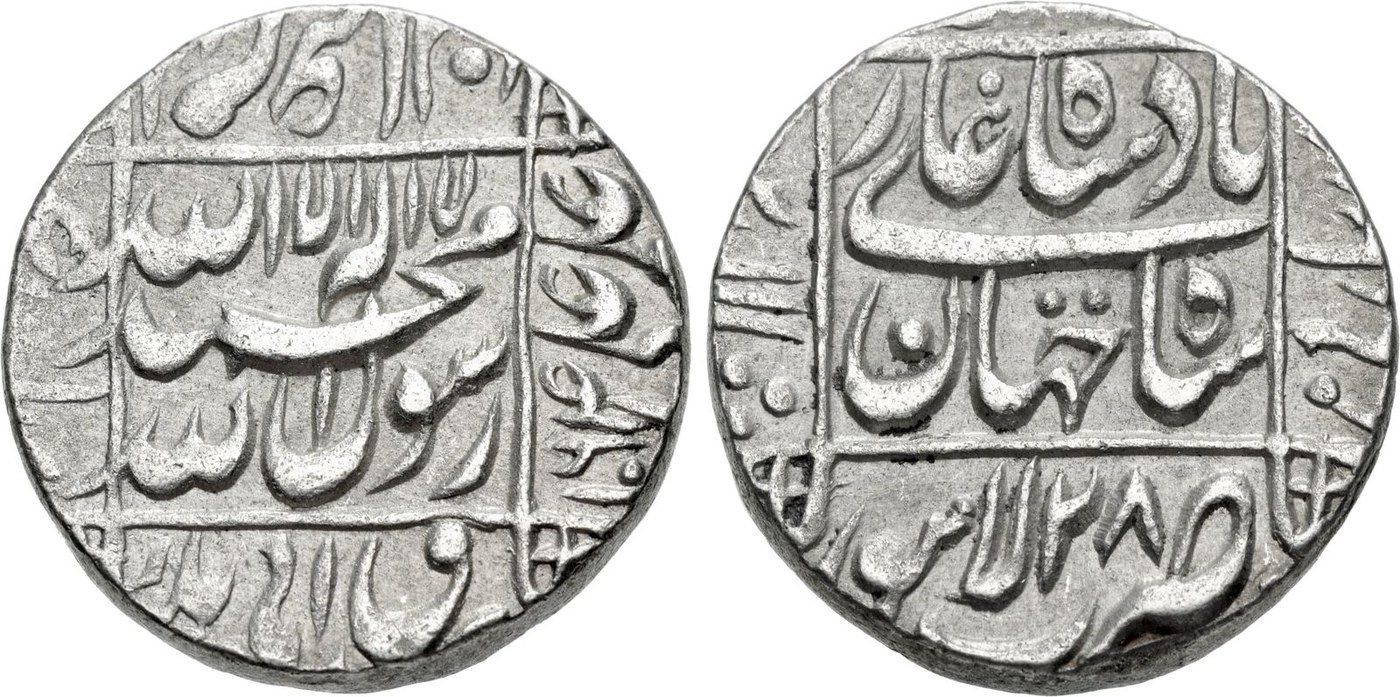
Start with the overall impression: a Shah Jahan rupee is a silver coin covered edge to edge in Persian (Nastaliq) calligraphy, with no portrait or figural image. On this type the legends sit inside decorative cartouches with ornamental flourishes. If you see any human or animal figure, it is not a Mughal imperial rupee of this kind.
Check size and metal. Expect a hand-struck silver piece broadly in the 11 to 11.7 gram range and roughly 19 to 24 mm across, with an irregular, sometimes oval or off-round flan because it was hammered between hand-cut dies. Uniform, perfectly round, machine-milled edges argue against an authentic period rupee. A specific-gravity or weight check is a useful first screen for silver.
Read the legends for the diagnostics. The obverse commonly carries the kalima (the Islamic profession of faith); the reverse gives the ruler's name and titles, the mint name, and the date. Confirm the Hijri date AH 1064 (AD 1653-1654) and look for a regnal (julus) year. The mint name within the reverse legend tells you where it was struck and is central to attribution and value.
Beware of look-alikes. Rupees of Jahangir, Aurangzeb, and later Mughal and provincial rulers share the same calligraphic format, so the ruler's name and the AH date must match Shah Jahan's reign (1628-1658). Later imitations, restrikes, and outright forgeries exist. Watch for cast rather than struck surfaces (soft, bubbly detail, a seam on the edge), lettering that looks mushy or copied rather than crisply engraved, and coins that are underweight or non-magnetic-test failures for silver.
When in doubt, photograph both faces clearly and consult a catalogue of Mughal coinage or a specialist dealer. Attribution by mint and couplet, plus verification of weight and metal, is the reliable path; do not rely on the emperor's name alone.
Frequently asked questions
How can I tell a Shah Jahan rupee from other Mughal rupees?
They all use Persian calligraphy in a similar format, so read the ruler's name and the AH date in the legend. A date in Shah Jahan's reign (roughly AH 1037-1068, AD 1628-1658) with his name confirms the ruler.
What are the signs of a fake or cast copy?
Cast forgeries show soft, bubbly detail, a raised edge seam, and often the wrong weight. Genuine coins are struck, with crisp engraved lettering and an irregular hand-hammered flan. Verify silver by weight and specific gravity.
Do I need to read Persian to identify it?
It helps greatly, especially for the mint name and date. But the combination of all-calligraphy design, silver metal, hand-struck irregular flan, cartouche framing, and an AH date in Shah Jahan's range gives a strong provisional identification.
Where is the date and mint on the coin?
The Hijri (AH) year and the mint name are written within the reverse Persian legend, often alongside a regnal year. Locating and reading that legend is the key step in attributing the coin.