
How to Identify the Sestertius of Vespasian (Iudaea Capta)
A collector's guide to recognizing Vespasian's large bronze Judaea Capta sestertius by its portrait, palm-tree reverse, size, and legends.
Read the full Sestertius of Vespasian (Iudaea Capta) encyclopedia entry →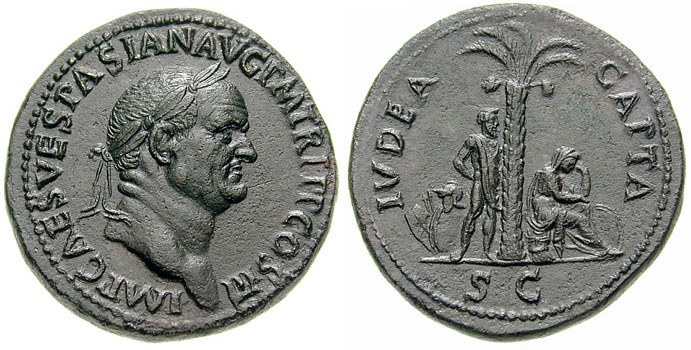
Begin with the physical coin. A genuine sestertius of this era is a large, heavy bronze, generally about 33–35 mm across and weighing more than an ounce, with a thick flan and a natural brown, green, or reddish patina. If the piece is small, thin, silvery, or lightweight, it is not this denomination; the sestertius was the big bronze coin of the Roman system.
Read the obverse. You should see a laureate male head facing right, wrapped by a Latin legend that names Vespasian, typically opening with IMP CAES VESPASIAN AVG and continuing with abbreviated titles, tribunician power, and consulships. The portrait is realistic and mature, with the characteristic Flavian features. The exact wording varies by year, so treat the name VESPASIAN(VS) as the anchor rather than expecting an identical legend on every coin.
Study the reverse, which is the diagnostic heart of the type. Look for a central palm tree flanked by figures: a seated mourning woman (Judaea personified), a bound or standing captive, and on many dies the armed emperor standing with one foot raised. The words IVDAEA or IVDAEA CAPTA and the large letters S C in the field are common. This palm-and-captive scene is what distinguishes a Judaea Capta issue from Vespasian's many other reverse types.
Be alert to look-alikes and imitations. Titus struck closely related Judaea Capta coins, so check whether the obverse names Vespasian or Titus. Modern tourist replicas, electrotypes, and cast forgeries of this famous type are common; cast fakes often show a seam on the edge, soft mushy detail, bubbles in the surface, or an unnaturally uniform "paint-on" patina. Genuine ancient strikes have crisp lettering, hand-cut die variation, and a hard, layered patina.
Because the value is high and fakes are frequent, do not rely on eye appeal alone. Confirm the size and weight, compare the coin against published references for the specific reverse variety, and for any meaningful purchase seek an attribution from a recognized ancient-coin dealer, auction house, or authentication service.
Frequently asked questions
How do I tell a Vespasian issue from a Titus Judaea Capta coin?
The reverse imagery is similar, so read the obverse legend. If it names VESPASIAN(VS) as Augustus it is Vespasian's; if it names TITVS or gives him as Caesar or Augustus, it is a Titus issue.
What size and weight should the coin be?
A genuine Flavian sestertius is a large bronze roughly 33–35 mm in diameter and heavy in hand, typically well over 20 grams. Small, thin, or lightweight pieces are a different denomination or a replica.
What do the letters S C mean on the reverse?
S C stands for Senatus Consulto, "by decree of the Senate," a standard mark on Roman imperial bronze denominations. Its presence is normal on the sestertius and helps confirm the coin is a bronze issue.
How can I spot a cast forgery?
Cast fakes often have a visible edge seam, soft or blurry detail, tiny surface bubbles, and an even, artificial patina. Genuine struck coins show crisp lettering, sharp die-cut relief, and a hard, layered natural patina.