
How to Identify the Seleucus I Nicator Tetradrachm
A collector's guide to recognizing the Seleucus I tetradrachm by its horned Alexander-type head, spear-bearing reverse, Attic weight, and Greek legend.
Read the full Seleucus I Nicator Tetradrachm encyclopedia entry →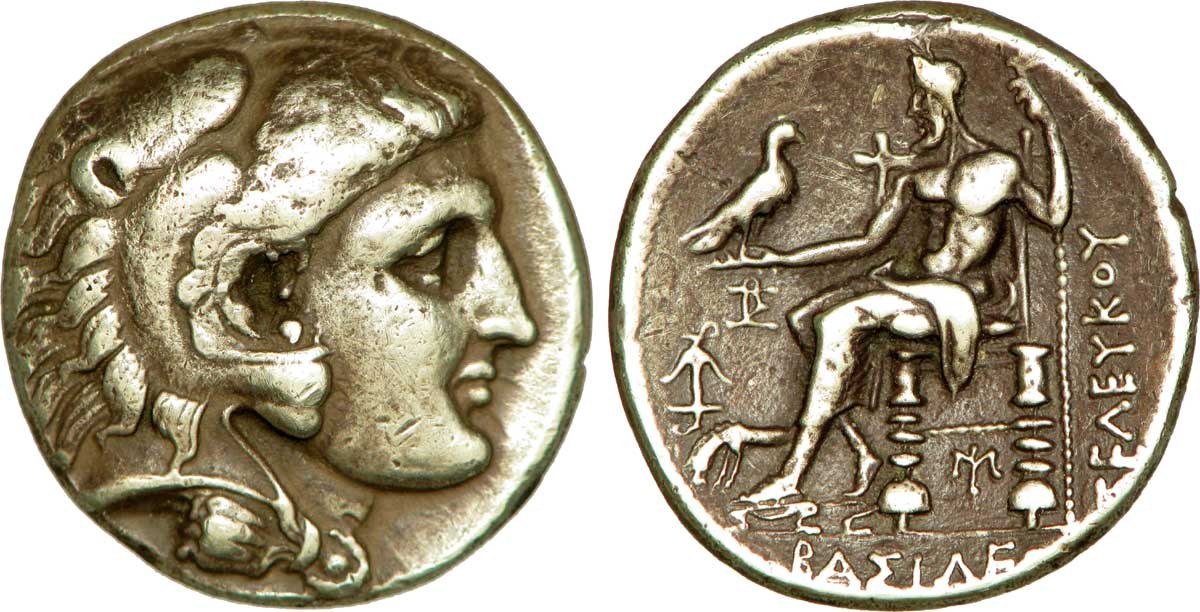
Start with the obverse head. A tetradrachm of this type shows a youthful, idealized head facing right with abundant curly hair and small horns at the brow. Those horns of divinity, set on Alexander-inspired features rather than a realistic aged face, are the primary clue that you are looking at deified Hellenistic imagery of the kind Seleucus used. A lifelike, individualized ruler portrait points to a later king, not this Alexander-derived type.
Turn to the reverse and read the figure and the legend together. Expect a spear-bearing figure, shown here as a mounted rider or standing deity, drawn from the victory and divine repertoire of the period. Hellenistic royal silver normally carries a Greek legend naming the king, commonly BAΣIΛEΩΣ ΣEΛEYKOY, "of King Seleucus," arranged beside or around the figure. Even partial letters help confirm the attribution, and the small monograms or control symbols in the field are what pin the coin to a specific mint.
Check fabric, size, and weight. This is a broad, heavy tetradrachm of good silver on the Attic standard, on the order of about 17 grams and roughly 25-30 mm across. Genuine strikes are hand-made and irregular: an oval or slightly off-round flan, uneven edges, occasional flat areas from weak striking, and grey or iridescent old toning. A coin that is unusually light, thin, or perfectly round for its size warrants a closer look.
Beware of look-alikes. Alexander the Great's own posthumous tetradrachms are very common and use a Herakles head in a lionskin with a seated Zeus reverse, not a horned head with a spear-bearing rider, so do not confuse the two. Other successor kings and later Seleucid rulers also struck Alexander-influenced silver; the reverse type, the legend, and the control marks are what separate an issue of Seleucus I from these related coinages.
Finally, watch for authenticity problems. Cast forgeries show a seam around the edge, soft or bubbly surfaces, and a dull, non-metallic look, while tooled or re-engraved coins have unnaturally sharp, scratchy detail added to worn areas. Because well-preserved Seleucid tetradrachms are valuable, treat bargain offers with caution and, for a significant purchase, rely on specialist attribution or third-party certification and, where possible, documented provenance.
Frequently asked questions
How do I tell this from an ordinary Alexander the Great tetradrachm?
Alexander's own posthumous tetradrachms show a Herakles head in a lionskin and a seated Zeus holding an eagle. This Seleucus type shows a horned, Alexander-inspired head and a spear-bearing rider or deity, usually with a legend naming Seleucus rather than Alexander.
The legend is worn away. Can I still identify it?
Yes. When the Greek legend is unreadable you rely on the types: the horned youthful head and the spear-bearing reverse figure, together with any visible monograms or control marks. These support an attribution even without a clear inscription.
What should the coin weigh?
As an Attic-standard tetradrachm it should sit on the order of about 17 grams and measure roughly 25-30 mm across in good silver. A markedly light, thin, or undersized piece may be a fraction, a plated forgery, or a different denomination.
What are the main warning signs of a fake?
A seam around the edge, soft or bubbly surfaces, and a dull tone suggest a cast copy, while unnaturally sharp detail on an otherwise worn coin suggests tooling. For valuable examples, seek specialist attribution or certification.