
How to Identify the Segesta Hound Tetradrachm
A Sicilian silver tetradrachm from Segesta featuring a hunting hound on the obverse and the head of the local nymph Segesta on the reverse.
Read the full Segesta Hound Tetradrachm encyclopedia entry →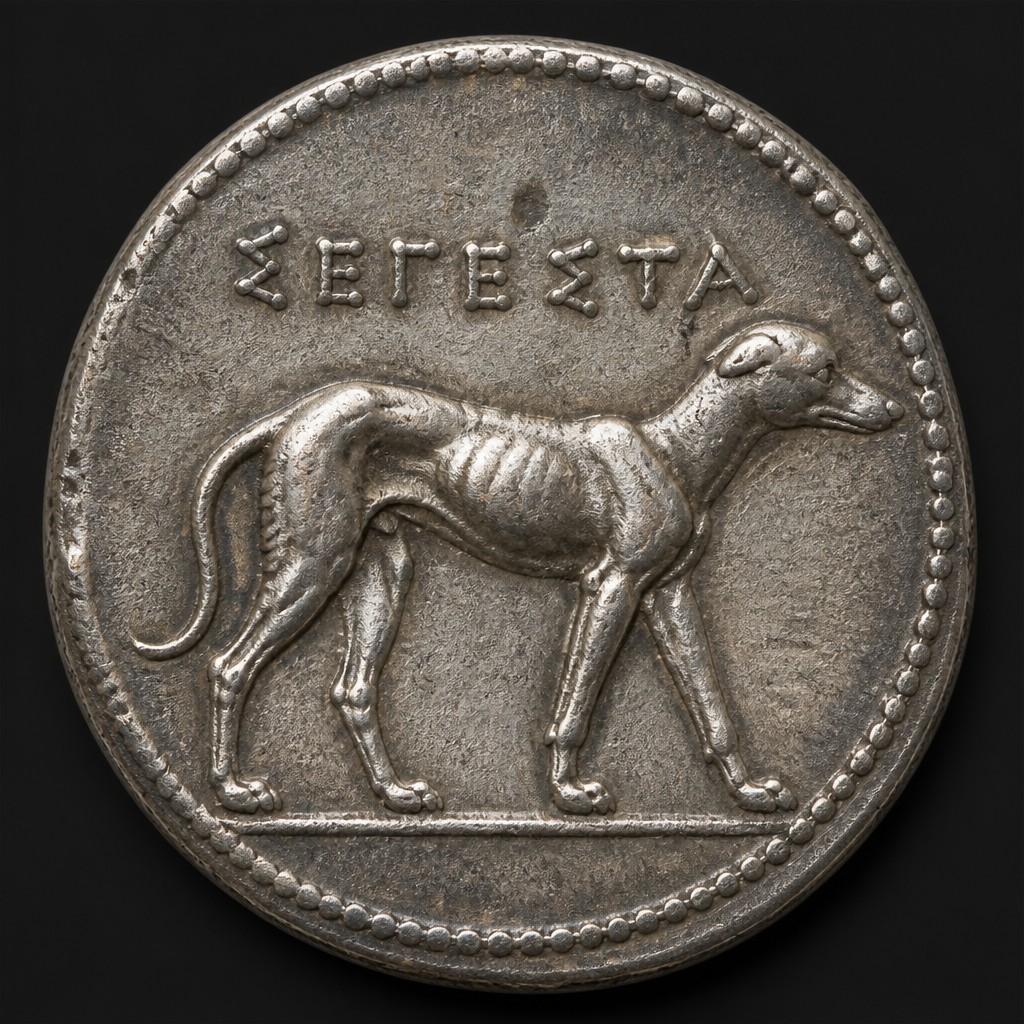
What This Coin Is
This is a silver tetradrachm struck by the city of Segesta, a settlement of the indigenous Elymian people in northwestern Sicily that adopted Greek coinage conventions, primarily during the fifth century BC. Segesta's coinage is best known for its recurring hunting dog motif, tied to a local legend involving the river god Krimisos, who was said to have taken the form of a dog.
Obverse Design
The obverse typically shows a hunting hound, standing, sniffing the ground, or in a alert stance, rendered with careful attention to musculature and posture. This device likely alludes to the mythological tradition connecting the local river god to a dog, a story linked to the legendary founding of the city.
Reverse Design
The reverse shows the head of a female figure, generally identified as the local nymph Segesta, facing right or left, with hair bound simply or waved beneath a plain band. The ethnic ΣΕΓΕΣΤΑΙΙΒ, ΣΕΓΕΣΤΑΖΙΒ, or a related early form of the city name appears in the field, with spelling that can look unfamiliar due to Segesta's non-Greek Elymian origins being rendered in Greek letters.
Size, Weight, and Metal
Struck in silver on the Attic-Sicilian weight standard, these tetradrachms typically weigh close to 17 grams and measure roughly 24 to 27 millimeters in diameter, with the usual plain, hand-struck edge.
Mint Marks and Where to Find Them
Look for the city ethnic in its early Elymian-Greek spelling near the nymph's head on the reverse, and note that the exact letter forms can differ somewhat from standard Greek city names due to Segesta's distinct linguistic background. Small secondary symbols occasionally appear in the field as additional control marks.
Telling It Apart From Similar Coins
The hunting hound obverse is unique to Segesta among Sicilian mints and easily distinguishes this coin from other animal-themed Sicilian tetradrachms like Leontini's lion or Messana's hare. Because Segesta's ethnic spelling can look unusual compared to more familiar Greek city names, the hound device itself is often the fastest visual confirmation of attribution, with the inscription serving as secondary confirmation.
Judging Condition at a Glance
On the obverse, check the hound's legs, ears, and overall musculature for sharpness, since this animal study relies on fine linear detail that wears down with circulation. On the reverse, the nymph's hair and facial features are the primary wear points; a coin retaining crisp hair strands and a clear profile is in better condition than one where these details have smoothed into a general outline.
Authenticity Red Flags
Because the hound device is distinctive and appealing, watch for cast copies that render the dog's legs and outline as soft or blurred rather than crisply linear, along with a grainy surface texture or visible seam around the edge. Unusual or inconsistent rendering of the Elymian-Greek ethnic, an implausible weight, or surfaces that look artificially aged are additional signs that a piece may not be a genuine ancient issue and warrants closer comparison against well-documented examples.
Frequently asked questions
Why does this coin feature a hunting dog?
The hound likely references a local legend in which the river god Krimisos took the form of a dog, connecting the animal to Segesta's founding myths rather than serving as a purely decorative device.
Why does the city name look unusual compared to other Greek coin inscriptions?
Segesta was originally an Elymian settlement rather than a Greek colony, and its name was rendered into Greek letters using early spellings that can look less standardized than typical Greek city ethnics.
Who is depicted on the reverse?
The reverse shows the head of a female figure generally identified as the local nymph Segesta, following the common Greek practice of personifying cities or regions as female figures on coinage.
What weight should a genuine example have?
Genuine tetradrachms typically weigh close to 17 grams, consistent with the Attic-Sicilian weight standard used broadly across classical Sicilian mints.