How to Identify the Seated Liberty Dollar
A collector's checklist for spotting a genuine Seated Liberty Dollar by its seated figure, stars, ONE DOL. reverse, size, mint mark, and motto type.
Read the full Seated Liberty Dollar encyclopedia entry →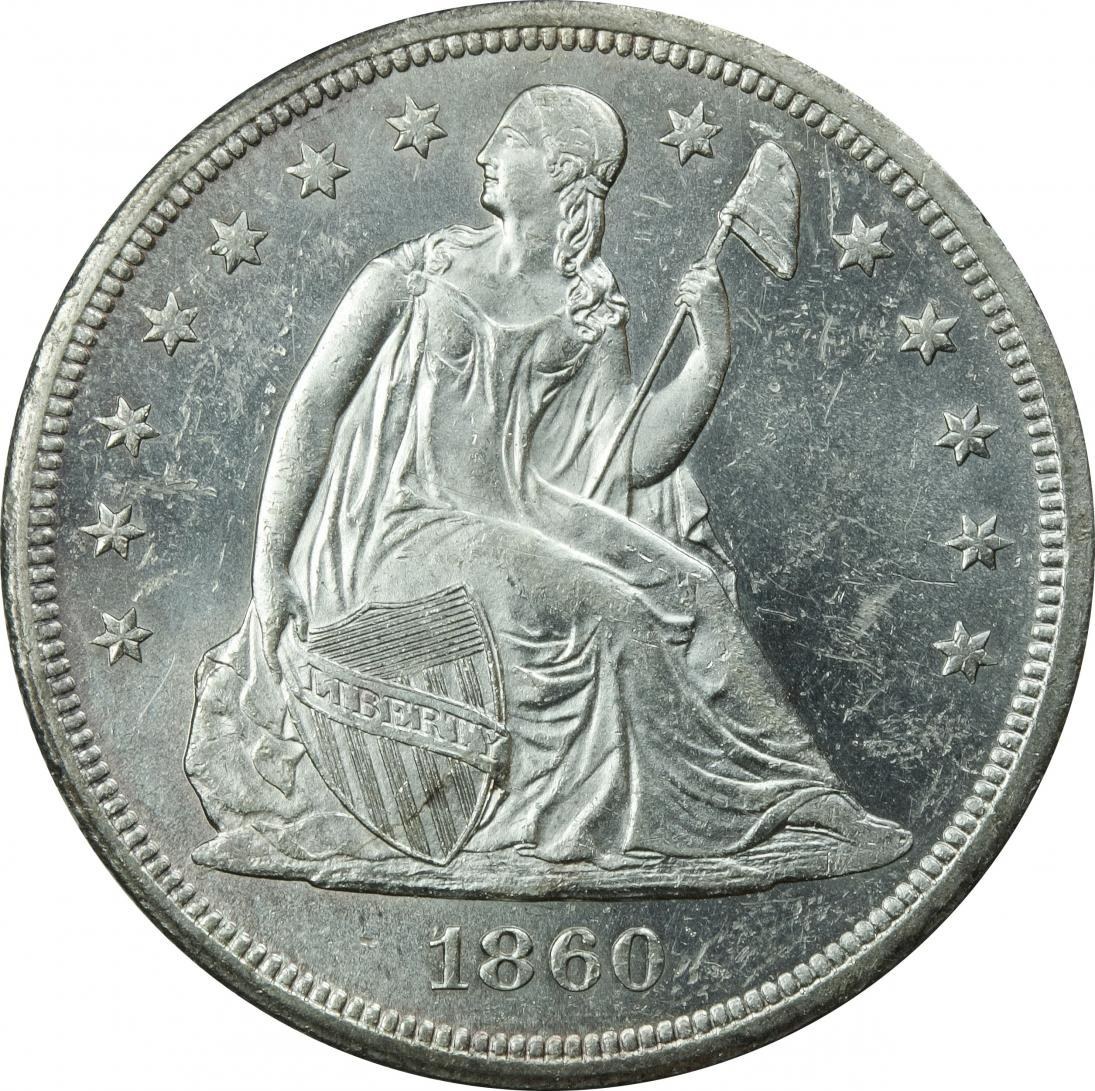
Begin with the obverse figure. A Seated Liberty Dollar shows Liberty seated on a rock, facing left, holding an upright shield inscribed LIBERTY in one hand and a pole capped with a liberty cap in the other. Confirm a ring of thirteen stars around the field and a four-digit date below; the pictured example reads 1860. The same seated design was used on smaller silver coins, so the portrait alone does not confirm the denomination.
Confirm the denomination on the reverse. The eagle should have a striped shield on its breast and clutch an olive branch and arrows, with UNITED STATES OF AMERICA around the rim and ONE DOL. directly beneath the eagle. That ONE DOL. legend, combined with the coin's large size, is what separates the dollar from the half dollar, quarter, and dime that share the seated motif.
Use the physical specs to rule out look-alikes. A genuine coin is silver, about 38.1 mm in diameter, near 26.7 grams, and has a reeded edge. Do not confuse it with the later Trade dollar, which shares a seated theme but reads 420 GRAINS, 900 FINE on the reverse, or with the Morgan dollar, which shows a Liberty head in profile. A stated weight legend or a head-only portrait means you are not looking at a Seated Liberty dollar.
Read the motto and mint mark to place the exact coin. Coins dated 1840-1865, including 1860, are No Motto and have a blank field above the eagle; coins dated 1866-1873 add a scroll reading IN GOD WE TRUST. The mint mark, if any, is a small O, S, or CC below the eagle on the reverse, while Philadelphia coins carry none. Note both, since date-plus-mint-mark combinations drive scarcity.
Treat authentication as essential. Weigh and measure the coin, examine the date and any mint mark under magnification for signs of alteration or tooling, and check the edge reeding and surfaces for casting seams. Because even worn examples are valuable and counterfeits exist, submit any promising coin to a reputable third-party grading service before buying, selling, or insuring it.
Frequently asked questions
How do I tell a Seated Liberty dollar from the smaller seated coins?
Go by size and the reverse legend. The dollar is about 38.1 mm across — much larger than the half dollar, quarter, or dime — and its reverse reads ONE DOL. beneath the eagle, which the smaller denominations do not.
My coin looks like this but reads 420 GRAINS, 900 FINE. What is it?
That is a Trade dollar, a related but separate type introduced in 1873 for export. It shares a seated Liberty theme but states its silver weight on the reverse instead of ONE DOL.
Is a blank area above the eagle a defect?
No. On No Motto coins dated 1840-1865, such as an 1860, the field above the eagle is intentionally plain. The IN GOD WE TRUST scroll only appears on With Motto coins struck from 1866 to 1873.
Should I clean a dark or toned Seated dollar?
No. Original toning is normal on 19th-century silver, and cleaning strips the surfaces and lowers collector value. Leave the coin as found and let a grading service evaluate it.
Seated Liberty Dollar identified by the community
Recent Seated Liberty Dollar coins identified with Coin Identifier.