
How to Identify the Scudo (Philip V)
A collector's guide to recognizing the gold scudo of Philip V for Spanish Sardinia by its columned shield, cross reverse, hand-struck fabric, and mint marks.
Read the full Scudo (Philip V) encyclopedia entry →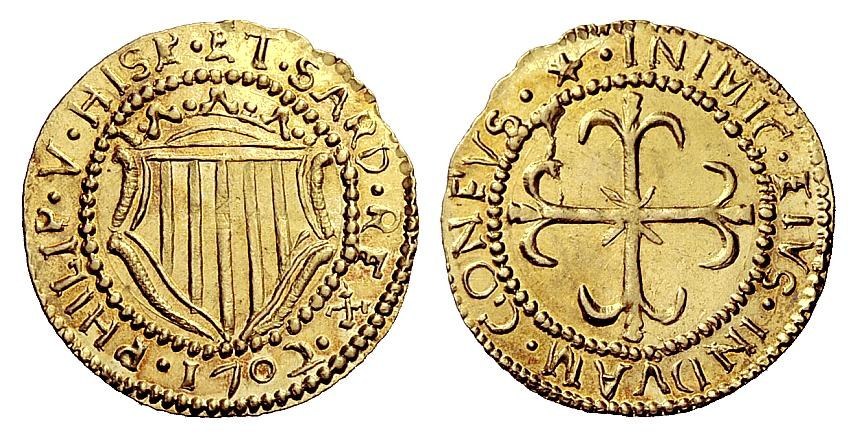
Start With the Core Diagnostics
This is a gold coin, so weigh it and note its warm deep-yellow color and heft; base-metal fakes usually feel too light or look brassy. Confirm it is hand-struck rather than machine-milled: expect an irregular, slightly oval flan, uneven rims, and legends that drift toward or off the edge. A neatly round blank with perfectly even lettering is a warning sign for a later reproduction.
Read the Obverse
The obverse should show a crowned heraldic shield with the field rendered in vertical hatching, flanked by the two Columns of Hercules — the paired pillars, sometimes wrapped with a scroll or banner. Around the shield, look for a Latin royal legend naming Philip (forms such as PHILIP or PHILIPPVS) with the title of king (D G — Dei Gratia — and REX). The crown and columns together are the quickest signal that you are looking at Spanish-style gold rather than an Italian city or papal issue.
Read the Reverse and Date
The reverse carries a cross with floral or foliate ornaments in the angles, surrounded by a continuation of the royal titles. The date — 1702 on the documented example — appears within or beside the legend. Study the legends and the area beside the shield or cross for small mint marks and assayer/control letters; these are what tie the coin specifically to Sardinia rather than to the mainland or another Italian territory, so photograph them clearly for attribution.
Watch for Look-Alikes
The crowned-shield-and-cross layout was shared across Spain and its possessions, so the same general design appears on mainland escudos and on coins of Naples, Sicily, and Milan. Denomination within the scudo series (single versus two or more scudi) is judged mainly by diameter and weight, so measure carefully. Do not assume the country or denomination from the design alone — the mint marks, legend details, and metrology decide it.
Authentication Cautions
Gold coins of this profile are heavily reproduced, from period-style souvenir strikes to modern cast copies and outright forgeries. Casting seams, a soft or 'sandy' surface, incorrect weight, or unnaturally sharp uniform detail all point to a fake. Because values run well above bullion, have any promising piece examined by a specialist in Spanish or Italian-states gold and, ideally, authenticated by a reputable third-party grading service before purchase.
Frequently asked questions
How can I tell a genuine hand-struck scudo from a modern copy?
Genuine pieces have an irregular flan, uneven rims, and slightly inconsistent lettering from hand striking, plus correct gold weight and color. Cast copies often show seams, a grainy surface, wrong weight, or suspiciously uniform, over-sharp detail.
Where do I find the mint mark on this coin?
Check within or beside the legends and in the field next to the shield or cross for small letters or symbols. These control and assayer marks are essential for confirming a Sardinian attribution and should be photographed clearly.
How do I know if it is a single scudo or a larger denomination?
Because the design is shared across the series, denomination is determined chiefly by diameter and weight rather than by the imagery. Measure both and compare against published standards for the Sardinian scudo.
Could a coin with this design be from somewhere other than Sardinia?
Yes. The crowned shield with Columns of Hercules and a cross reverse was used across Spain and its Italian and colonial territories. Mint marks, legend specifics, and metrology are needed to separate a Sardinian scudo from mainland escudos or other Italian-states issues.