
How to Identify the Sassanian Silver Drachm
The Sassanian drachm is a broad, thin silver coin from ancient Persia, easily recognized by the elaborate royal crown on the obverse and the fire altar with attendants on the reverse.
Read the full Sassanian Silver Drachm encyclopedia entry →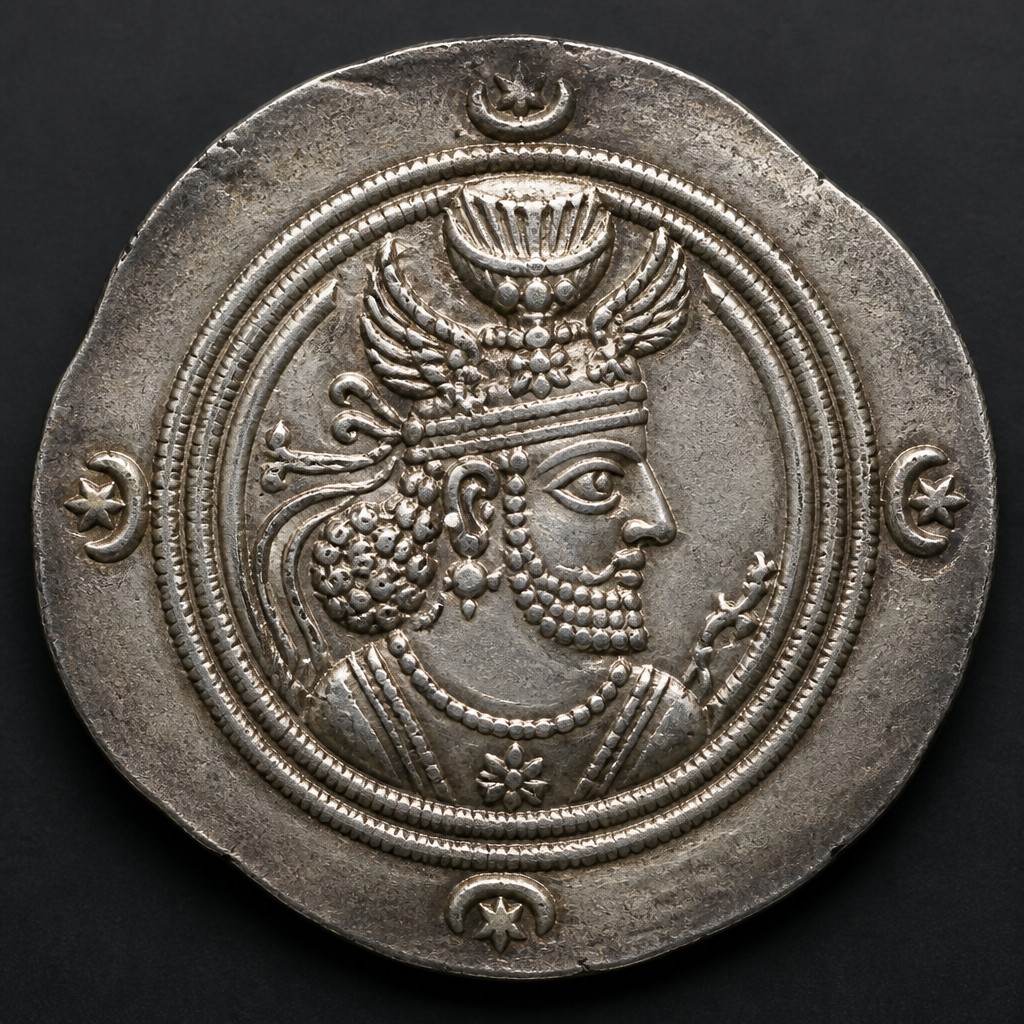
What It Is
The silver drachm was the principal coin of the Sassanian (Sasanian) Empire of Persia, struck continuously from the dynasty's founding under Ardashir I in 224 AD until the empire's fall to Arab-Muslim conquest in the mid-7th century. Its design conventions were so influential that early Islamic coinage in the region initially copied its layout.
Obverse Design
The obverse shows a bust of the reigning Shah in profile, distinguished above all by an elaborate, often uniquely shaped crown—wings, crescents, stars, or korymbos (a globe held by a ribbon) were used to make each king's crown visually distinct. A Pahlavi (Middle Persian) legend naming the king and his titles curves around the bust, and small crescents-and-stars often flank the portrait, called "hairstyle" or margin ornaments.
Reverse Design
The reverse depicts a fire altar, the central symbol of Zoroastrian worship, usually flanked by two attendants or guards facing the flames. Ribbons often decorate the altar shaft. Regnal year and mint name in Pahlavi script typically appear to either side of the altar's base.
Size, Weight, and Metal
Sassanian drachms are struck in silver on a broad, thin, slightly dished flan, typically 25-33mm in diameter but only about 3.4-4.2 grams in weight—large in spread but light for their size compared to more compact ancient coinages. Edges are irregular and hand-struck, often not perfectly round.
Mint Marks and Dates
Unlike most ancient coinages, Sassanian drachms commonly record both a mint abbreviation and a specific regnal year in Pahlavi letters positioned in the reverse margin, usually to the left and right of the fire altar. This makes many Sassanian drachms more precisely datable than most other ancient coins, though reading the abbreviations requires familiarity with Pahlavi script.
Telling It Apart From Similar Coins
Because crown styles changed with each king (and sometimes mid-reign), the crown shape is the fastest way to identify which Shah issued a given drachm. Compared to later Arab-Sassanian transitional coins (struck after the Islamic conquest), genuine Sassanian-era drachms lack any Arabic script, which was added only on the hybrid issues that followed.
Judging Condition at a Glance
Look at the crown details and facial features for sharpness, and check whether the fire-altar attendants and flame details remain distinct. Because the flans are thin and broad, edge cracks and off-center striking are common and do not necessarily indicate heavy circulation wear.
Authenticity Red Flags
Modern fakes sometimes show a crown design that does not match any documented Sassanian king, blundered or nonsensical Pahlavi legends, or a flan that is too thick and small for the period. A weight well outside the roughly 3.4-4.2 gram range, or metal with a base, dull gray look rather than silver's typical luster, both warrant a closer second look.
Frequently asked questions
How can I identify which king issued a Sassanian drachm?
The crown is the key: each Sassanian king wore a distinctively shaped crown on his coinage, and reference charts of crown types by ruler are the standard tool numismatists use to attribute these coins.
What is shown on the reverse of a Sassanian drachm?
A Zoroastrian fire altar, usually flanked by two attendants, symbolizing the state religion of the Sassanian Empire.
Can I tell the exact year a drachm was struck?
Often yes. Many Sassanian drachms carry a regnal year and mint abbreviation in Pahlavi script in the reverse margin, though deciphering them requires knowledge of the script and each king's chronology.
How do Sassanian drachms differ from Arab-Sassanian coins?
Arab-Sassanian coins, struck after the Islamic conquest, copy the Sassanian fire-altar design but add Arabic inscriptions (often in the margin), which never appear on true Sassanian-era issues.
Why are these coins so thin and broad?
Sassanian mints used a light, wide flan standard rather than a thick, compact one, giving the drachm its characteristic large diameter relative to its modest silver weight.