
How to Identify the Sassanian Drachm of Khusro II
A thin, broad silver drachm of the Sasanian Persian king Khusro II (r. 590-628 AD), identified by his winged crown on the obverse and a fire altar with attendants on the reverse.
Read the full Sassanian Drachm of Khusro II encyclopedia entry →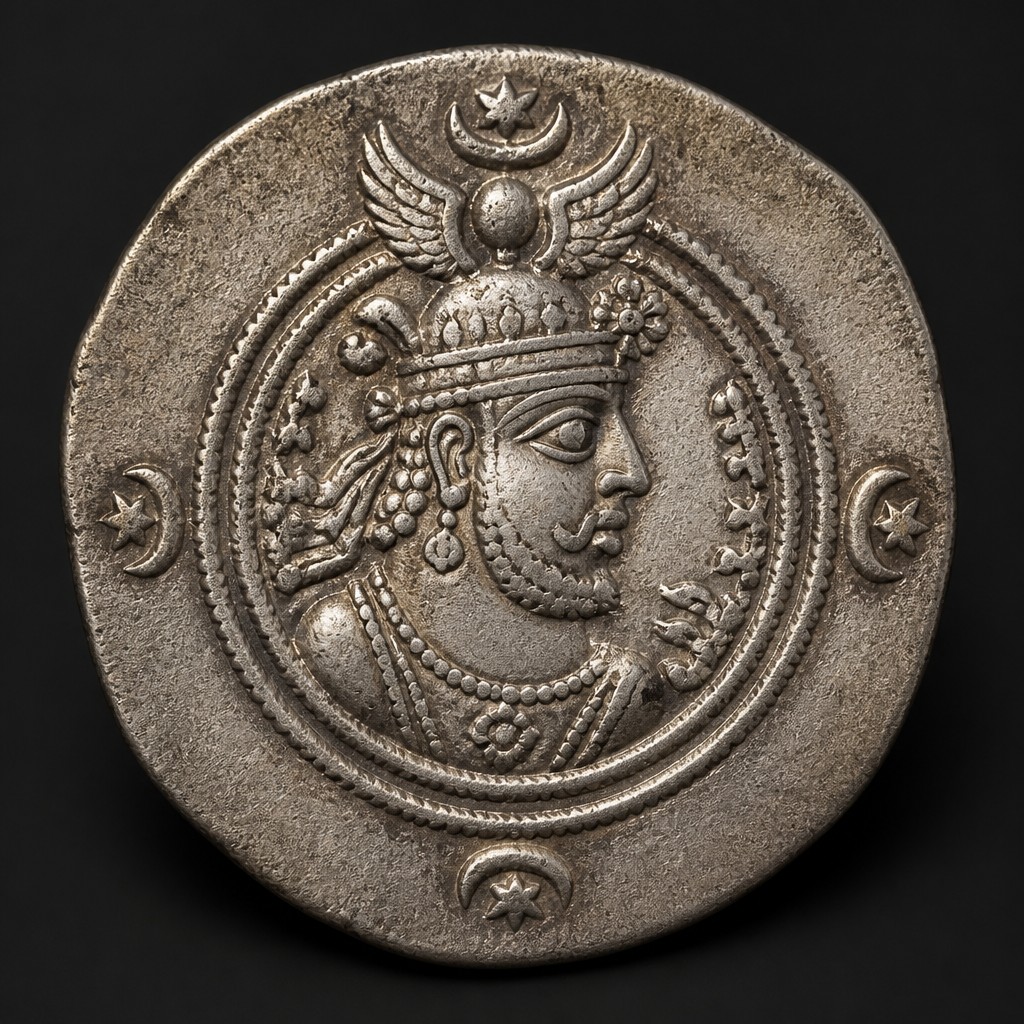
What It Is
Khusro II ruled the Sasanian Persian Empire from 590 to 628 AD, and coins struck in his name are among the most commonly encountered Sasanian silver drachms today because of the sheer volume minted across his long reign and the empire's many regional mints.
Obverse Design
The obverse shows a right-facing bust of the king wearing an elaborate crown topped with a korymbos (a globe-like ornament), flanked by wings and often decorated with a crescent and star. A Pahlavi (Middle Persian) legend runs around the margin, generally invoking the king's name and royal titles. A crescent-and-star device usually appears in the field near the king's face.
Reverse Design
The reverse depicts a fire altar flanked by two attendants standing in profile facing the flames, a standard Zoroastrian religious image used on Sasanian coinage for centuries. Ribbons decorate the altar shaft, and a star-and-crescent symbol typically appears on either side of the flames at the top.
Size, Weight, Metal, and Edge
These are broad, thin silver coins, roughly 30-33mm in diameter but only about 3.7-4.2 grams in weight. The flan is thin enough that edge cracks and a slightly wavy, irregularly cut edge are common and not a defect. There is no raised rim or edge design.
Mint Marks and Regnal Dates
At the base of the fire altar, a mint abbreviation in Pahlavi script appears on the right and a regnal year (counted from Khusro II's accession) appears on the left. Sasanian coinage used well over a hundred different mint signatures, so identifying the exact mint requires comparing the short Pahlavi abbreviation against known mint lists.
Telling It Apart from Similar Coins
The crown is the key to distinguishing Khusro II from earlier Sasanian kings: his crown's combination of wings and a crescent supporting the korymbos is distinctive compared to, for example, the differently shaped crowns of Khusro I or Hormizd IV. After the Arab conquest, "Arab-Sasanian" coins continued using this same basic design with added Arabic inscriptions, so the presence of Arabic text on an otherwise similar coin points to a later imitative issue rather than a genuine Khusro II drachm.
Judging Condition at a Glance
Look at how well-centered the strike is and how crisp the crown, facial features, and fire-altar attendants appear. Because these coins were hand-struck on broad thin flans, some off-center or weak strikes are common regardless of actual circulation wear, so examine high points like the king's cheek and crown details for genuine wear versus striking weakness.
Authenticity Red Flags
Modern tourist-market fakes are frequently cast rather than struck, which produces soft, mushy details and a grainy surface instead of the crisp lines typical of hand-struck originals. Checking the coin's weight against the expected range and looking for legible, correctly formed Pahlavi script (rather than blurred or nonsensical marks) helps separate genuine drachms from reproductions.
Frequently asked questions
How can I recognize Khusro II specifically among Sasanian kings?
Look at the crown: Khusro II's crown has wings on either side and a crescent supporting the top globe (korymbos), a combination distinct from the crown styles used by earlier or later Sasanian rulers.
What do the marks at the base of the fire altar mean?
The mark on the right is a mint abbreviation in Pahlavi script identifying where the coin was struck, and the mark on the left is the regnal year counting from the king's accession.
Why is the coin so thin and broad compared to other ancient silver coins?
Sasanian drachms were deliberately struck on wide, thin silver flans as the empire's standard coinage format, which is why edge cracks and slightly irregular edges are common on genuine examples.
Is a coin with Arabic letters added to this design still a Khusro II drachm?
No, coins combining this Sasanian design with Arabic inscriptions are later Arab-Sasanian issues struck after the Islamic conquest, imitating the earlier royal type rather than being an original Khusro II issue.
What's the easiest way to spot a fake?
Cast reproductions tend to have soft, blurry details and a slightly grainy or pitted surface, while genuine hand-struck drachms show crisper lines in the crown, facial features, and altar attendants even when off-center.