
How to Identify the San Diego Pacific Exposition Half Dollar
A 1935-1936 silver commemorative for San Diego's Pacific exposition, identified by its seated allegorical figure with a bear obverse and the California Tower reverse, struck at two mints.
Read the full San Diego Pacific Exposition Half Dollar encyclopedia entry →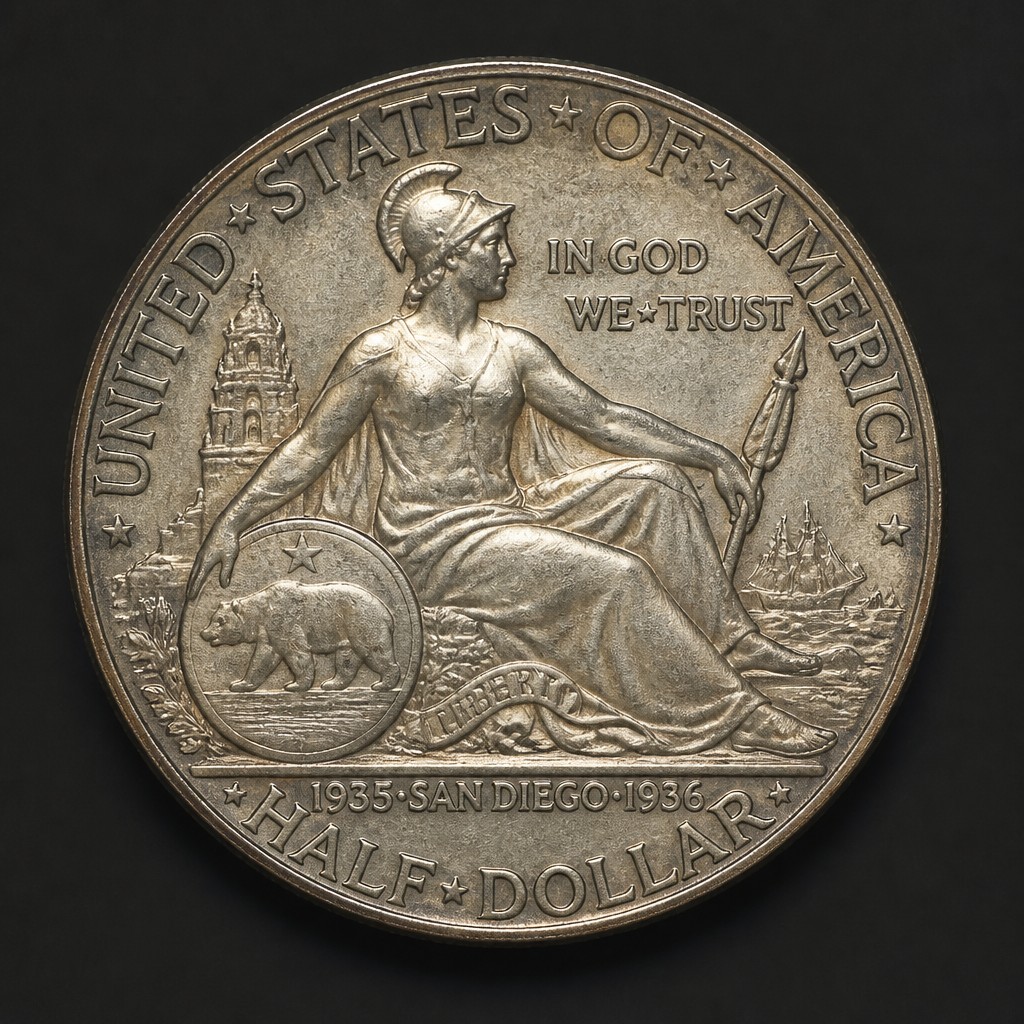
What This Coin Is
The San Diego Pacific Exposition Half Dollar was struck in 1935 and 1936 to commemorate the California Pacific International Exposition held in San Diego's Balboa Park. Designed by Robert Aitken, it is one of the few classic commemoratives issued across two different years and from two different mints, making mint mark identification more relevant here than for many other coins in the series.
Obverse Design
The obverse shows a seated allegorical female figure, often interpreted as representing the state of California, holding a spear and a bear cub, with a full-grown California grizzly bear resting at her side. "UNITED STATES OF AMERICA" arcs along the rim, with "HALF DOLLAR" below the figure.
Reverse Design
The reverse depicts the California Tower, the landmark building constructed for the exposition in Balboa Park, along with palm trees framing the scene. "SAN DIEGO" and the applicable dates ("1935" or "1935-1936" depending on the year of striking) appear in the design, along with "CALIFORNIA PACIFIC INTERNATIONAL EXPOSITION."
Size, Weight, Metal, and Edge
The coin is struck in 90% silver, 10% copper, weighs about 12.5 grams, measures roughly 30.6mm in diameter, and has a reeded edge, consistent with other classic commemorative half dollars.
Mint Marks and Where to Find Them
Unlike many single-mint commemoratives in this series, the San Diego Pacific Exposition half dollar was struck at both the San Francisco Mint (dated 1935, with an "S" mint mark) and the Denver Mint (dated 1936, with a "D" mint mark). The mint mark appears on the reverse, typically near the base of the design close to the inscriptions. Checking the date and mint mark together helps identify which striking year and mint produced a given coin.
Telling It Apart from Similar Coins
The seated figure with a bear and the California Tower reverse are unique to this issue, so confusion with other commemoratives is unlikely once the design is recognized. The main identification task specific to this coin is distinguishing the 1935-S from the 1936-D by checking both the date and the mint mark rather than relying on date alone, since both years share the same overall design.
Judging Condition at a Glance
On the obverse, check the seated figure's arm, the bear cub, and the grizzly bear's fur for wear and flattening. On the reverse, examine the California Tower's architectural detail and the palm fronds for sharpness, since fine linear elements in the tower and foliage wear down first. A coin with crisp architectural lines and well-defined bear fur texture indicates lighter circulation wear.
Authenticity Red Flags
Be cautious of coins with blurred or overly smooth detail in the tower's architecture or the bears' fur, which can suggest a cast counterfeit. Confirm the coin's mint mark is consistent with its date (S with 1935, D with 1936), verify standard weight and diameter, and inspect the edge for even, machine-applied reeding. As always, unnaturally uniform or artificially bright toning should prompt closer scrutiny compared to natural, varied aging.
Frequently asked questions
Where can I find the mint mark on this coin?
On the reverse, near the base of the design close to the inscriptions; look for an 'S' on 1935-dated coins or a 'D' on 1936-dated coins.
Why was this coin struck at two different mints?
The exposition ran across two years, and additional coins were struck at the Denver Mint in 1936 after the initial 1935 San Francisco Mint production.
What does the obverse design represent?
A seated allegorical female figure, generally understood to represent California, shown with a spear, a bear cub, and a grizzly bear.
What building appears on the reverse?
The California Tower, a landmark structure built in Balboa Park for the California Pacific International Exposition.
How do I judge this coin's condition?
Check the bear's fur texture and the seated figure's arm on the obverse, and the tower's architectural lines on the reverse, for wear versus sharp detail.