
How to Identify the Sachsen-Weimar-Eisenach 5 Mark Wedding Commemorative
Spot this issue by its conjoined bride-and-groom profile busts, its circular commemorative inscription, and its large silver German-Empire 5 Mark module.
Read the full Sachsen-Weimar-Eisenach 5 Mark Wedding Commemorative encyclopedia entry →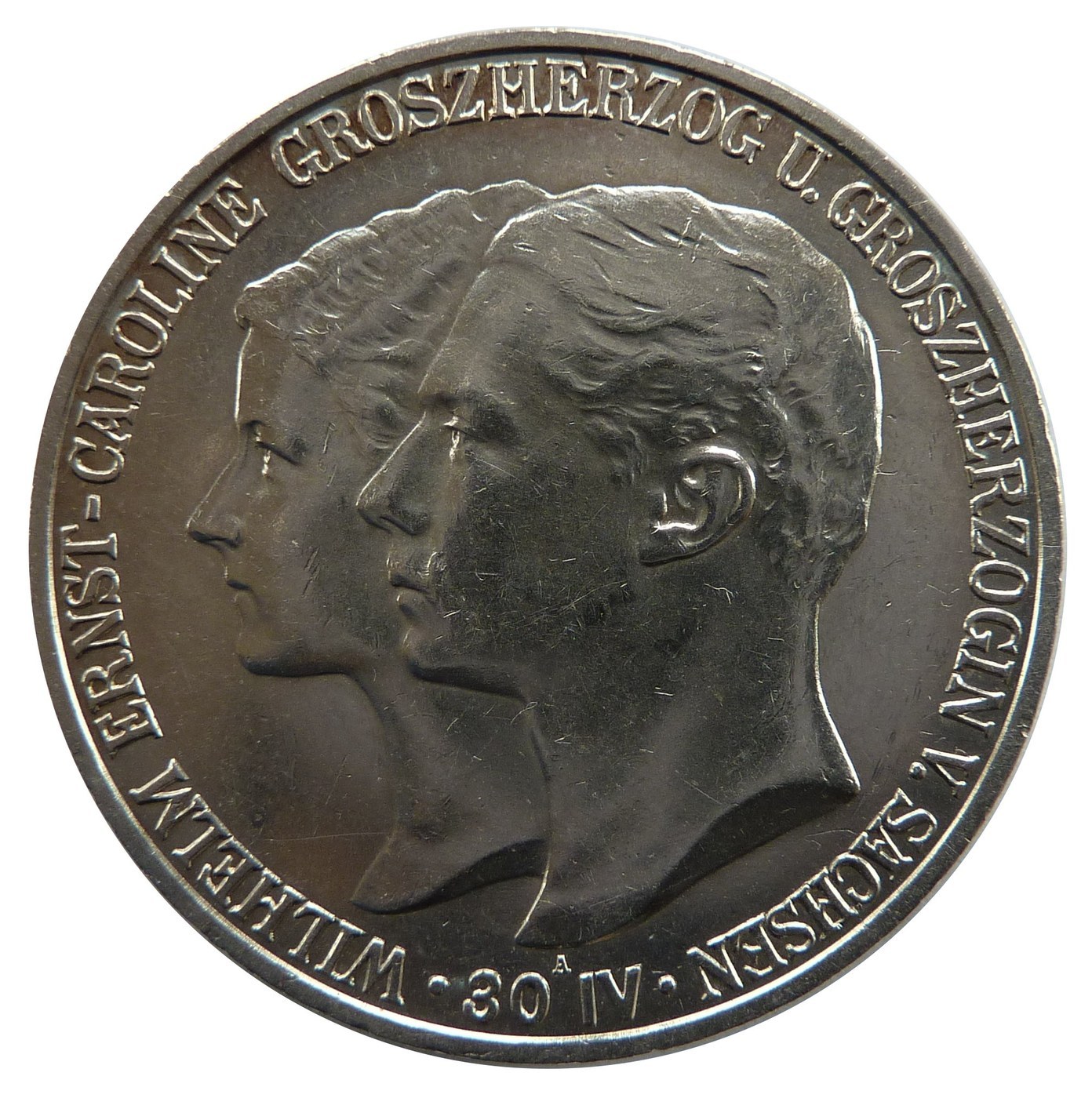
Start with the paired portraits. The defining feature is a pair of conjoined (overlapping) profile busts facing the same way — a bride and groom. This double portrait immediately separates a wedding commemorative from a standard single-ruler 5 Mark. Read the surrounding legend to confirm the names and titles of the grand-ducal couple.
Read the reverse inscription. Look for a commemorative inscription arranged within a circular border that names Saxe-Weimar-Eisenach and points to the marriage occasion. Matching the couple on the obverse to the state and event named on the reverse links both faces to the correct type; note the exact wording and any date so you can pin down which wedding it marks.
Check size, metal, and value. This is a silver coin of the imperial 5 Mark module — a large, heavy crown-sized piece. Weigh and measure it and compare against published specifications for German-Empire 5 Mark coinage; genuine silver is dense and non-magnetic. Look for a mint-mark letter in the design and for the edge lettering that imperial 5 Mark coins normally carry.
Watch for look-alikes. Many German states struck silver 2, 3, and 5 Mark commemoratives with conjoined portraits for weddings and jubilees, so a paired-bust coin is not automatically this type — confirm the Saxe-Weimar-Eisenach legend rather than relying on the double portrait alone. Be aware that the grand duke's marriages produced more than one commemorative, so verify the specific date and couple named.
Authenticate carefully. Attractive imperial commemoratives are sometimes cast-copied, cleaned, or artificially toned to imitate age. Inspect the edge for casting seams, judge whether the portraits and lettering are crisp rather than soft, and check that weight and diameter fall within specification. For a valuable example, obtain a specialist opinion or third-party certification and compare recent auction records for the matching Saxe-Weimar-Eisenach wedding coin.
Frequently asked questions
How do I know it is a wedding commemorative and not an ordinary 5 Mark?
Look for two conjoined profile busts, a bride and groom, on the obverse. Ordinary imperial 5 Mark coins show a single ruler or a coat of arms; the paired couple portrait is the marker of a wedding issue.
How can I confirm the Saxe-Weimar-Eisenach attribution?
Read the legends on both sides. The obverse names the grand-ducal couple and the reverse inscription references the state and event. Do not rely on the double portrait alone, since other German states issued similar wedding coins.
Where are the mint mark and edge details?
German 5 Mark coins carry a single-letter mint mark within the design and lettering or an ornamental pattern on the edge. Check both, as they help confirm the issue and are hard for casual copies to reproduce well.
What are the main authentication risks?
Cast copies, cleaning, and artificial toning are the usual concerns for imperial silver commemoratives. Inspect the edge for seams, look for crisp detail, verify weight and diameter, and get valuable pieces professionally authenticated.