
How to Identify the Sachsen-Weimar-Eisenach 5 Mark Commemorative
Identify the 1908 Saxe-Weimar-Eisenach 5 Mark by its capped founder's portrait, University of Jena jubilee dates, crown-size silver flan, and imperial eagle.
Read the full Sachsen-Weimar-Eisenach 5 Mark Commemorative encyclopedia entry →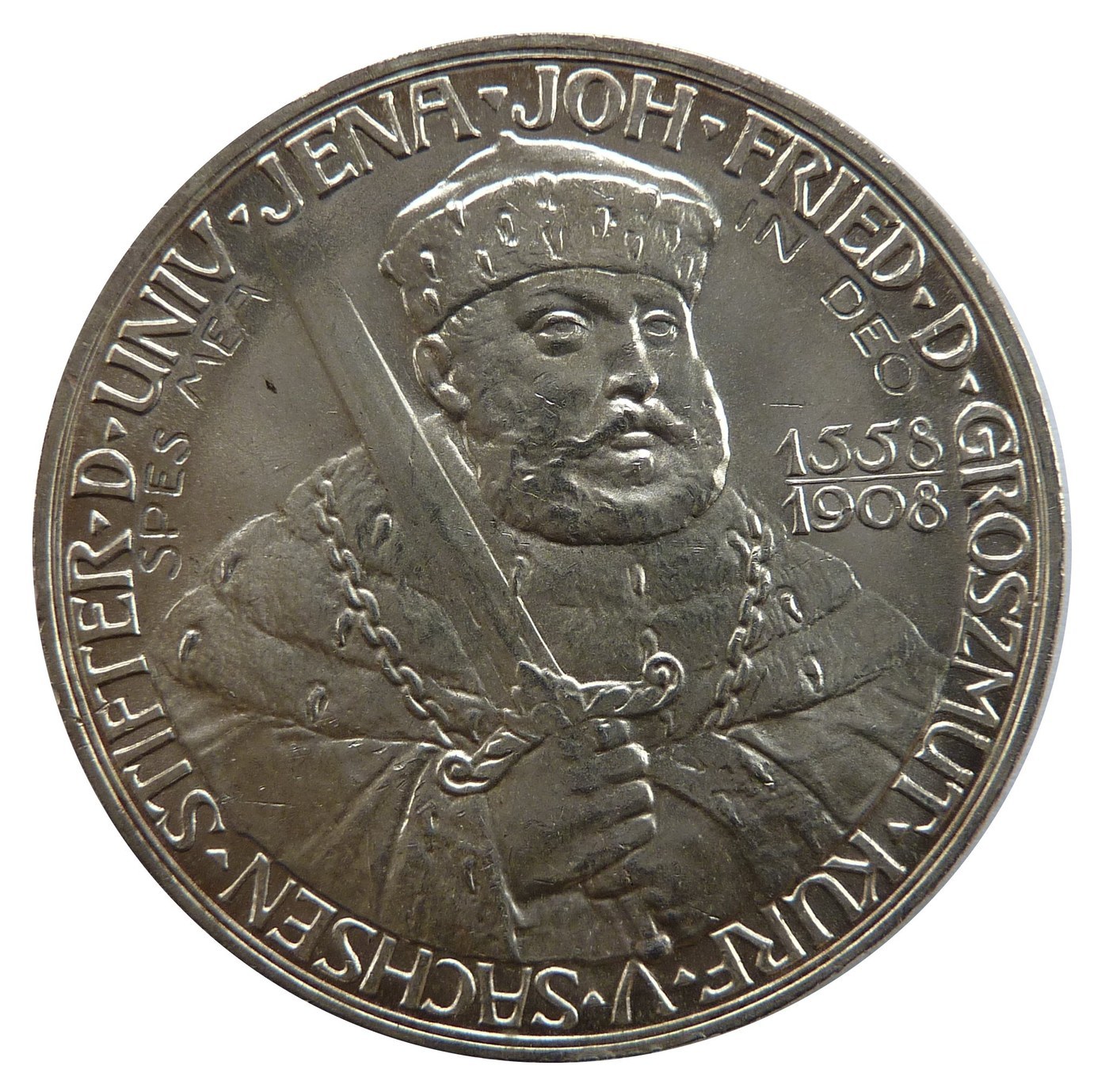
Begin with size, metal, and denomination. This is an imperial 5 Mark, the largest silver coin of the German Empire — a crown-sized disc roughly 38 mm wide and about 27.8 g in .900 fine silver. Confirm you have a big, heavy silver coin with a reeded or lettered edge; a lightweight, magnetic, or undersized piece is not a genuine imperial 5 Mark.
Read the obverse portrait. The example shows a nobleman in a decorative flat cap (a Renaissance-era beret) rather than a modern bare-headed or uniformed ruler. This is Johann Friedrich I, the university's founder, and the soft cap is the single most recognizable visual cue. Note the surrounding inscription naming him and the commemorated event; the styling deliberately evokes the 16th century, unlike the contemporary portraits on most Kaiserreich coins.
Confirm the commemorative side and dates. Look for the jubilee inscription with paired dates ending in 1908 referencing the University of Jena. On imperial 5 Mark coins you should also find the Reichsadler (imperial eagle), the legend DEUTSCHES REICH, the value FÜNF MARK, and a small mint-mark letter (for example A, D, E, F, G, or J) that pins down the striking mint. The 1908 date plus the Jena reference together confirm the type.
Separate it from look-alikes. Many German states struck large silver commemoratives around 1900–1918, and several — including other Saxon and Thuringian duchies — used similar layouts. Do not confuse this with an ordinary circulating Saxe-Weimar or Saxony 5 Mark, or with a different state's jubilee coin. The capped founder's portrait, the University of Jena legend, and the 1908 date are what set it apart.
Watch for authenticity red flags. Crown-sized silver commemoratives are copied and cast. Check that the coin is good, non-magnetic silver of correct weight and diameter; inspect the edge for casting seams and the fields for soft, grainy, or blurry detail. Suspect any harshly cleaned or re-engraved surfaces. For a valuable or uncertain example, compare the exact legends, mint mark, and weight against documented specimens and have it authenticated or slabbed by a reputable grading service before buying or selling.
Frequently asked questions
What is the quickest way to recognize this coin?
Look for the capped Renaissance-style portrait on one side and a University of Jena jubilee inscription with dates ending in 1908 on the other, all on a crown-sized silver 5 Mark flan.
Where is the mint mark and why does it matter?
Imperial 5 Mark coins carry a small letter (such as A, D, E, F, G, or J) identifying the mint that struck them. Reading it, along with the full legend, helps confirm the exact issue and distinguishes genuine strikes from copies.
How do I tell it from an ordinary German 5 Mark?
Ordinary 5 Mark coins show the reigning ruler and a plain date. This commemorative instead depicts the 16th-century founder in a flat cap and adds a University of Jena jubilee inscription with the 1908 date.
How can I check that it is authentic?
Verify the weight (about 27.8 g), diameter (about 38 mm), and that the metal is non-magnetic silver, then inspect the edge for casting seams and the fields for mushy detail. Have any high-value example professionally authenticated.