How to Identify the Sacagawea Dollar
A collector's walkthrough for confirming a Sacagawea Dollar: the golden color, Sacagawea-and-child obverse, flying-eagle reverse, plain edge, and mint marks.
Read the full Sacagawea Dollar encyclopedia entry →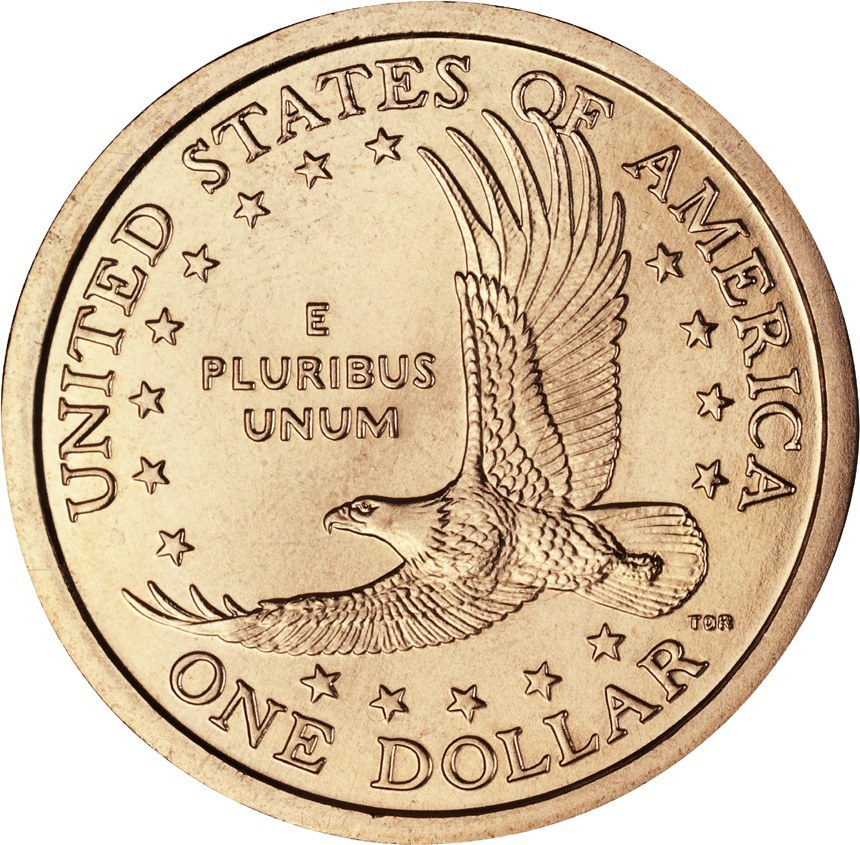
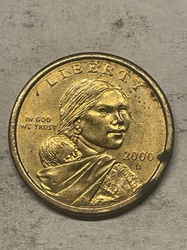
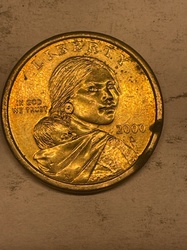
Start with color and size. The Sacagawea Dollar is unmistakably golden and larger than a quarter, at 26.5 mm across and about 8.1 g. That warm golden tone, produced by a manganese-brass surface over a copper core, is the first thing to confirm — a silvery dollar of the same size is the older Susan B. Anthony issue, not this coin.
Read the obverse. A genuine Sacagawea Dollar shows Sacagawea in three-quarter profile glancing back over her shoulder, with her infant son Jean Baptiste in a cradleboard on her back, LIBERTY above and IN GOD WE TRUST to the left. The date sits at the lower rim; the coin here reads 2003. This portrait is the anchor of the type and was carried forward into later series, so pair it with the reverse to pin down the exact coin.
Confirm the reverse. On 2000–2008 coins, including 2003, the reverse shows an eagle in flight with seventeen surrounding stars and the motto E PLURIBUS UNUM, above UNITED STATES OF AMERICA and ONE DOLLAR. If instead the reverse shows a themed design such as an agricultural scene or a tribal motif, the coin is a 2009-or-later Native American $1 Coin, which reuses the Sacagawea portrait but changes the reverse each year.
Check the edge and mint mark. The eagle-reverse Sacagawea Dollars have a plain, smooth edge with no lettering; edge lettering points to the later Native American series. The mint mark sits on the obverse just below the date: P for Philadelphia, D for Denver, and S for San Francisco proofs. For nearly all of these coins authentication is unnecessary because they are common; reserve professional grading through a service such as PCGS or NGC for proofs, pristine uncirculated pieces, or a coin you believe is a genuine error, and be skeptical of ordinary golden dollars promoted as rare simply for their color.
Frequently asked questions
How do I tell a Sacagawea Dollar from a Susan B. Anthony dollar?
Color and design. The Sacagawea Dollar is golden with a smooth plain edge and shows Sacagawea and her child; the Anthony dollar is silvery with a reeded edge and shows Susan B. Anthony.
How can I tell this from a newer Native American dollar?
Check the reverse and edge. The 2000–2008 Sacagawea Dollar has a flying eagle reverse and a plain edge. Native American dollars from 2009 on have changing themed reverses and lettering on the edge.
Where is the mint mark?
On the obverse, just below the date. P is Philadelphia, D is Denver, and S is a San Francisco proof.
Is a 2003 Sacagawea Dollar rare?
It is a lower-mintage collector date rather than a circulation workhorse, so nice examples can carry a small premium, but it is not rare. Only proofs, top grades, and genuine errors bring meaningful value.
Sacagawea Dollar identified by the community
Recent Sacagawea Dollar coins identified with Coin Identifier.