
How to Identify the Rose Noble (Ryal)
The Rose Noble, or Ryal, was a large gold coin of Edward IV showing the king standing in a ship, introduced to reflect a revaluation of English gold coinage.
Read the full Rose Noble (Ryal) encyclopedia entry →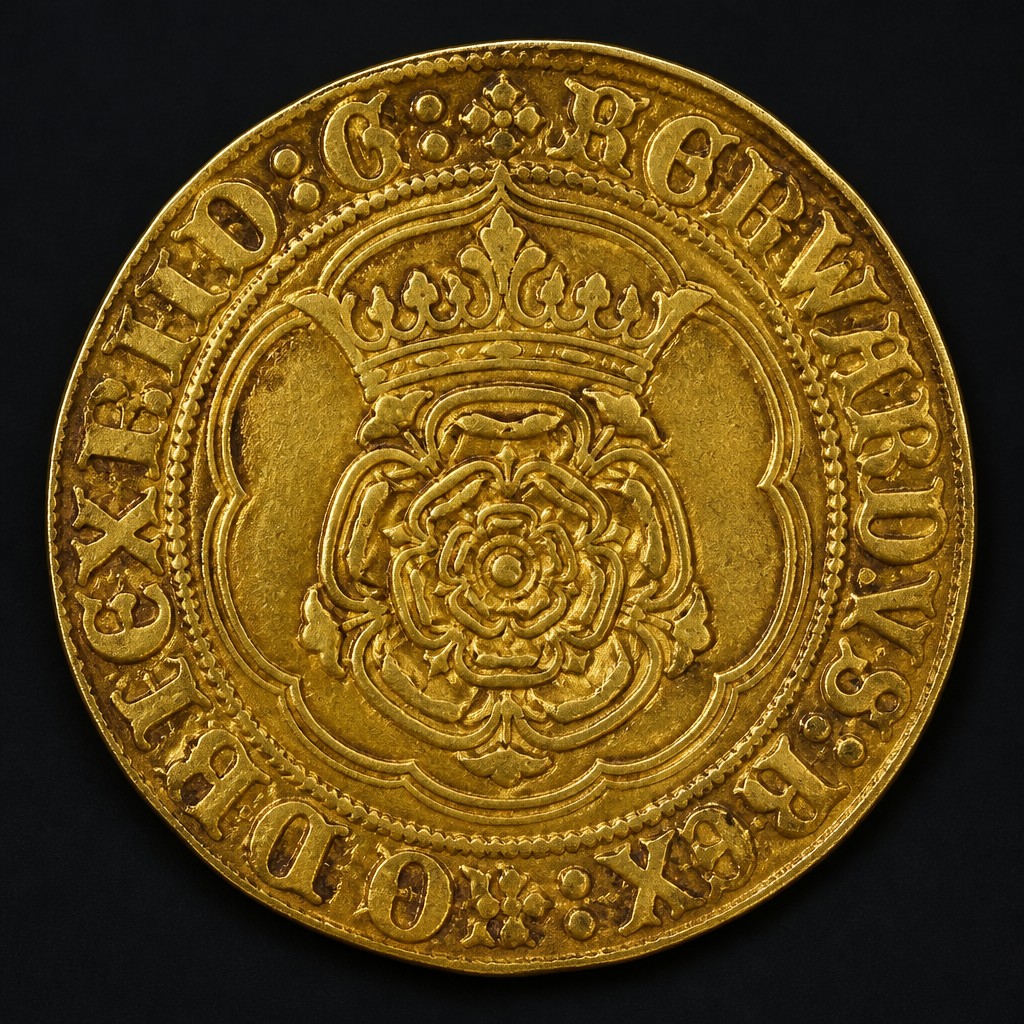
What It Is
The Rose Noble, also called the Ryal, was an English gold coin introduced under Edward IV around 1465. It replaced the earlier noble after a revaluation of gold, and was valued at ten shillings, later raised to fifteen shillings. It takes its popular name from the small rose that appears in the coin's design, distinguishing it visually from the plainer noble it succeeded.
Obverse Design
The obverse depicts the king standing within a ship, holding a sword and shield, echoing the ship imagery of the earlier noble. A prominent rose appears on the side of the ship, giving the coin its common name, and the king's title surrounds the edge in Latin, naming him ruler of England and France.
Reverse Design
The reverse shows an ornate sun with radiating rays and a rose at its center, surrounded by a floriated cross and Latin inscription, often drawn from a biblical verse about Christ passing unharmed through a crowd - a phrase traditionally used on English gold coinage as a symbolic protection against counterfeiting and misfortune alike.
Size, Weight, Metal & Edge
The Rose Noble was struck in gold, weighing close to 7.8 grams and measuring roughly 33-34mm across. As a hand-hammered coin, it has no milled edge; edges are typically irregular and slightly uneven compared to later machine-struck coinage, and the flan thickness can vary slightly from coin to coin.
Mint Marks & Dating
Being a hammered coin, it carries no date in the modern sense. Instead, small privy marks at the start of the legend can help specialists identify the mint period. These marks are subtle and require close comparison with reference examples rather than an obvious numeral date, since Edward IV's reign spanned two separate periods on the throne.
Telling It Apart From Similar Coins
The Rose Noble is often compared to the earlier plain noble, which lacks the rose on the ship and has a slightly different weight standard. It should also be distinguished from the smaller Angel, which shows St Michael slaying a dragon rather than a king standing in a ship, and from the Half Angel, which is smaller still.
Grading at a Glance
Because hammered gold coins were struck by hand, striking quality varies naturally. Look for a well-centered strike with the full ship and sun design visible, minimal edge clipping (a common issue with hammered gold), and clear, unworn detail on the king's figure and the sun's rays, which are the first areas to show flattening.
Authenticity Red Flags
Genuine Rose Nobles show hand-hammered irregularities, not perfectly round, machine-made edges. Be suspicious of examples that are perfectly circular with mechanically uniform edges, incorrect weight for gold, or a design that is too crisp and modern-looking for a hand-struck 15th-century coin, since dies of this age rarely produce flawless, razor-sharp results across the whole design.
Frequently asked questions
Why is it called a Rose Noble?
Because of the small rose depicted on the side of the ship in the obverse design, distinguishing it from the plain noble.
What is the difference between the Rose Noble and the Ryal?
They are the same coin; 'Ryal' is simply an alternative historic name for the Rose Noble.
What metal is the Rose Noble made from?
Gold, reflecting its status as a high-value coin in medieval English currency.
Does the Rose Noble have a printed date?
No, as a hand-hammered coin it does not carry a numeral date; specialists rely on subtle privy marks instead.