
How to Identify the Rosa Americana Coinage
A series of copper alloy halfpence, pence, and twopence struck by William Wood in the early 1720s for use in the American colonies, identifiable by the crowned double rose and Latin legends.
Read the full Rosa Americana Coinage encyclopedia entry →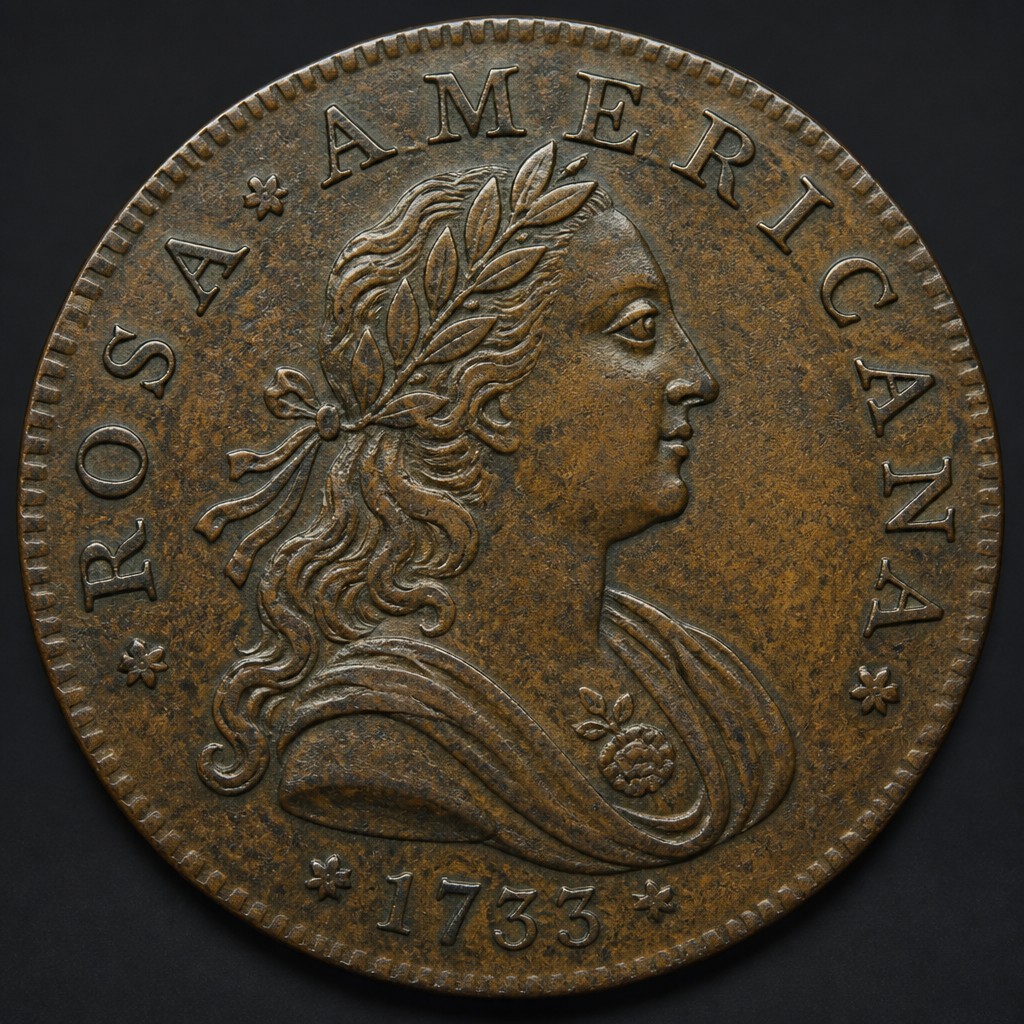
What It Is
Rosa Americana coinage was produced under a patent granted to English entrepreneur William Wood between about 1722 and 1724, intended for circulation in Britain's American colonies. Made from a copper alloy sometimes described as containing traces of brass to give it a golden look, these coins were unpopular with colonists who distrusted their light weight and odd color, but they remain an important part of early American coin history.
Obverse Design & Inscriptions
The obverse carries a right-facing laureate bust of King George I with the legend GEORGIVS · DEI · GRATIA · REX around the border. This is the standard royal portrait used across Wood's colonial issues of the period.
Reverse Design & Inscriptions
The reverse shows a crowned double rose — the "Rosa Americana" of the series' name — with the Latin motto ROSA AMERICANA UTILE DULCI ("the American rose, useful and pleasant") encircling it. The denomination, such as PENNY, TWO PENCE, or the abbreviated forms, appears within the legend depending on the piece.
Size, Weight, and Metal
Rosa Americana coins were struck in three denominations: halfpenny, penny, and twopence, each with weight and diameter scaled to its value. The alloy is notably lighter in color than pure copper and softer in strike quality, a byproduct of the tin-copper-zinc mixture Wood used, which was part of what made the series controversial in its time.
Mint Marks
There are no mint marks in the modern sense; these were struck at private mints in England under royal patent rather than at an official colonial or Tower mint. Identification instead relies on denomination, date (1722, 1723, or 1724 depending on the piece), and minor die varieties in the king's bust or the rose.
Telling It Apart From Similar Coins
Rosa Americana pieces are easily confused with Wood's Hibernia coinage from the same patent-holder, but the reverse design differs: Hibernia coins show a seated harp-playing female figure, while Rosa Americana shows the crowned double rose. Genuine Rosa Americana pieces also have a distinctly pale, brassy tone compared to the redder color of pure copper colonial issues like the Connecticut or Vermont coppers.
Judging Condition at a Glance
Look at the king's hair curls and the petals of the rose for strike sharpness; Wood's dies often produced weak areas even on higher-grade coins, so uneven detail alone does not always mean heavy wear. Genuine surviving pieces typically show a smooth, slightly granular alloy surface rather than the glossy red-brown patina typical of pure copper coppers.
Authenticity Red Flags
Because Rosa Americana coins are studied and collected, replica and fantasy pieces exist, particularly in white metal or with incorrect alloy color. A coin that looks bright orange-red like pure copper, rather than pale brass-gold, should raise questions, as should soft or blurry lettering that suggests a cast rather than struck origin. Comparing the bust style and legend spacing to known die varieties is the best way to confirm a piece matches an accepted type.
Frequently asked questions
What denominations exist in the Rosa Americana series?
Halfpenny, penny, and twopence pieces were struck, each dated 1722, 1723, or 1724 depending on the specific issue.
Why is the metal color different from other colonial coppers?
Rosa Americana coins used a copper alloy mixed with tin and zinc, giving them a paler, brassier tone than pure copper issues.
How do I tell Rosa Americana apart from Wood's Hibernia coinage?
Rosa Americana shows a crowned double rose on the reverse, while Hibernia coinage shows a seated harp-playing figure; both share the same George I obverse bust.
Do these coins have mint marks?
No, they were produced under a private royal patent, not at a formal mint, so there is no mint mark to check.
Were Rosa Americana coins widely accepted by colonists?
No, many colonists rejected them due to their light weight and unusual alloy, which limited circulation despite the royal patent behind them.