
How to Identify the Roman Victoriatus
A collector's guide to recognizing the silver Roman victoriatus by its Jupiter head, Victory-and-trophy reverse, ROMA legend, and ancient strike.
Read the full Roman Victoriatus encyclopedia entry →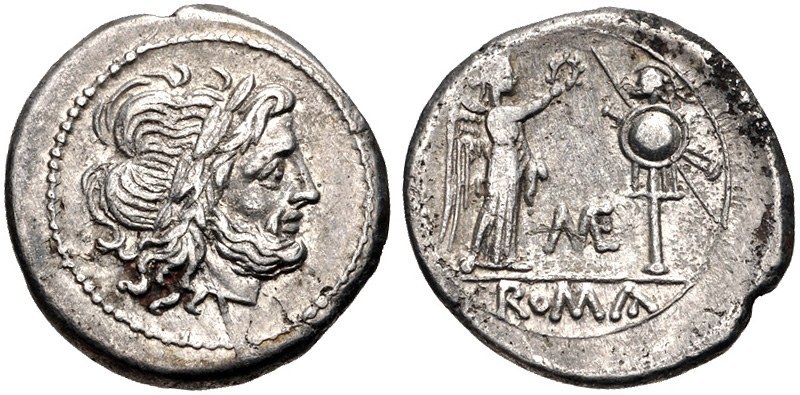
Start with the format and metal. The victoriatus is a small, hand-struck silver coin of the Roman Republic, roughly the diameter of a denarius but usually lighter, broadly in the range of about 3 to 3.4 grams for full-weight early issues and often less for later ones. The flan is commonly a little irregular, and the surfaces should show the toning and honest wear of ancient silver rather than the flawless finish of a modern machine-struck coin. Many genuine examples look somewhat gray or dull because the silver is less pure than a denarius.
Read the reverse first, because it is the clearest diagnostic. Look for Victory, winged and standing, crowning a trophy of captured arms with a wreath, and the inscription ROMA in the exergue beneath the design. This Victory-and-trophy scene above ROMA is what defines the denomination and separates it from other Republican silver.
Check the obverse for the laureate head of Jupiter facing right, with heavy curled hair and a beard. Together, the Jupiter head and the Victory-and-trophy reverse confirm a victoriatus. Some issues add a small control symbol, monogram, or a few letters in the reverse field that pin down a specific series or moneyer; record any such mark, since it can help attribute the coin to a catalog variety, but its absence is normal for the many anonymous issues.
Be careful with look-alikes and fakes. Do not confuse the victoriatus with the later Victory-reverse quinarius or with denarii that also show Victory or trophies; match the specific Jupiter-head-plus-ROMA-in-exergue combination and the coin's lighter weight. Watch for cast reproductions with a grainy surface or a mold seam, tooled or re-engraved details, and plated forgeries with a copper core showing through breaks in the silver. When value is at stake, weigh the coin, examine it under magnification, and rely on reputable dealers or third-party authentication.
Frequently asked questions
What single feature best confirms a victoriatus?
The reverse: a winged Victory crowning a trophy of captured arms with a wreath, above the word ROMA in the exergue. Paired with the laureate head of Jupiter on the obverse, it confirms the denomination.
How do I tell a victoriatus from a denarius?
The victoriatus is generally lighter and often of paler, less pure silver, and it carries the Jupiter head with the Victory-and-trophy reverse. Denarii of the period usually show the helmeted head of Roma and different reverse types with a value mark.
What should it weigh and measure?
It is a small silver coin roughly the diameter of a denarius, typically in the broad range of about 3 to 3.4 grams for early full-weight pieces and often lighter later. A coin far outside that range is likely a different denomination, a fake, or badly corroded.
Could my coin be a plated or cast forgery?
Both ancient and modern copies exist. Check worn high points and edges for a copper core beneath the silver, look for a mold seam or grainy surface that would indicate a cast, and confirm the weight before assigning value.