
How to Identify the Roman Republic Semuncia
A collector's guide to recognizing Rome's smallest bronze fraction by its Mercury head, galley prow, missing value marks, and tiny size.
Read the full Roman Republic Semuncia encyclopedia entry →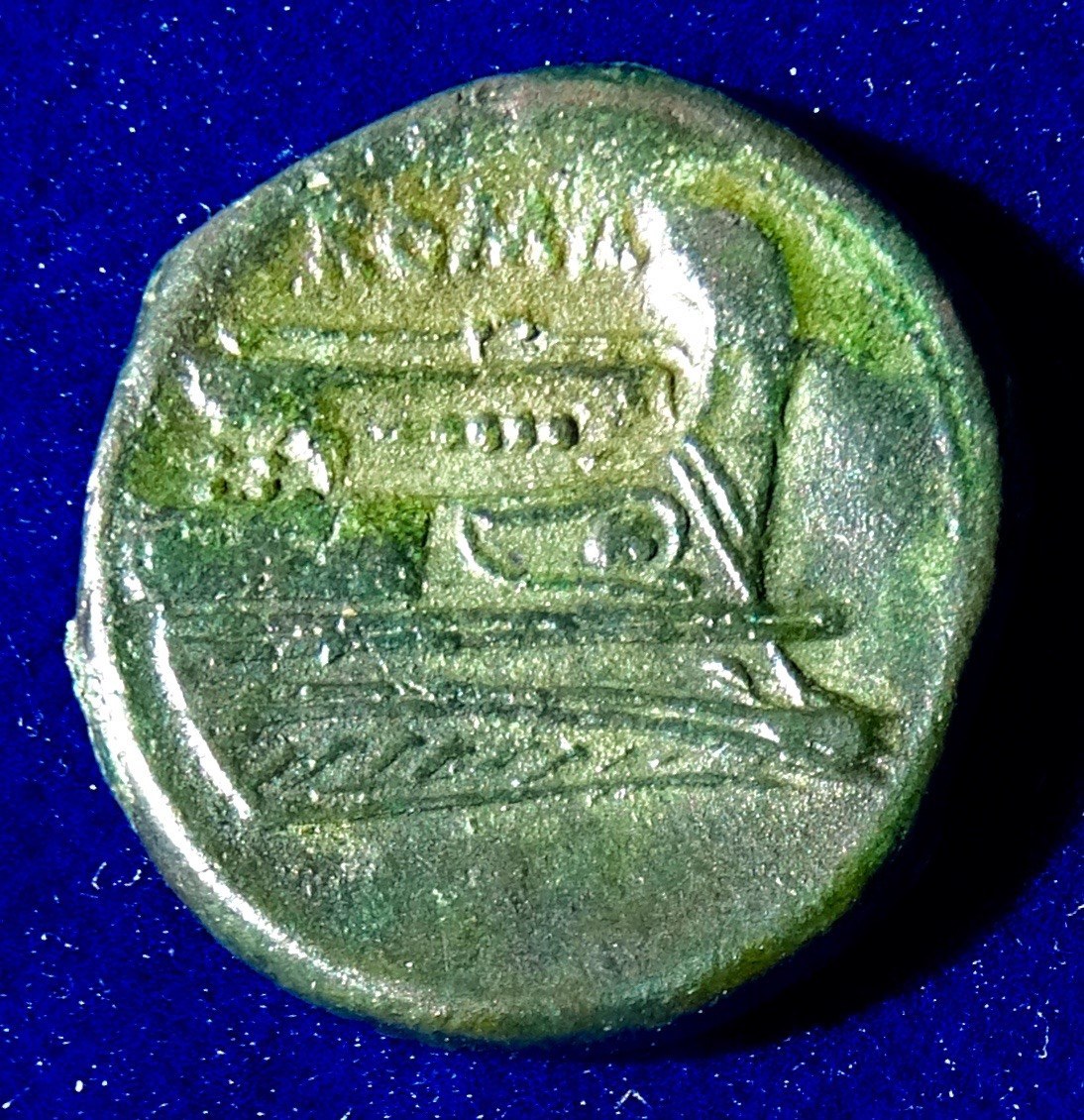
Begin with the reverse, which is usually the clearer side on these small bronzes and is the side visible on this specimen. Look for the prow of a galley facing right: a warship's bow with a pointed ram, a raised deck line, and an oar or steering-rudder along the hull. The legend ROMA typically sits above the prow, though on a fraction this small it is often weak, off-center, or lost to wear.
Turn to the obverse for the denomination's signature: the head of Mercury in a winged petasos (traveler's cap). Mercury also appears on the larger sextans, so the portrait alone is not enough. The decisive test is marks of value — the semuncia carries none, whereas the sextans shows two pellets and the uncia one. No value pellets plus a very small flan means you are almost certainly looking at a semuncia.
Check size, weight, and metal. A genuine semuncia is a small bronze, roughly 15-19 mm across and only a few grams, made of aged copper alloy. It should show a brown, green, or earthen patina, not the bright yellow of modern brass or the dull gray of lead. Ancient flans are often irregular in shape and thickness rather than perfectly round; this is normal, not a defect.
Beware look-alikes and misattributions. Every Republican bronze fraction — semis, triens, quadrans, sextans, uncia — shares the prow reverse, so the prow alone does not identify the denomination. Distinguish them by the obverse deity and the number of value pellets, and by overall size. When those details are worn away, an exact denomination may not be certain from a single side.
Finally, weigh authentication cautions. Ancient bronzes are faked by casting; watch for a seam around the edge, a too-uniform surface, unnatural bright-green "paint" patina, or fine tooling that sharpens worn detail. A crisp cast with no honest wear, or a coin that feels light and porous, is a red flag. For anything beyond a low-value example, favor pieces with a clear attribution and reputable provenance.
Frequently asked questions
How do I tell a semuncia from other Roman bronze fractions?
They all share the galley-prow reverse, so use the obverse and value marks. The semuncia shows Mercury's head with no value pellets and is the smallest of the fractions. Pellets (or the letter I on the as) mean it is a larger denomination.
What if the ROMA legend or Mercury head is worn off?
That is common on these tiny coins. Fall back on size and the prow style, and accept that a badly worn fraction may not be attributable to an exact denomination from one side alone. A clearer image of the obverse helps confirm it.
What size and weight confirm a genuine semuncia?
Expect a small bronze around 15-19 mm in diameter and only a few grams, with an irregular ancient flan and natural brown or green patina. Bright brass color, a seamed edge, or a porous cast surface suggests a modern fake.
How can I avoid buying a fake?
Inspect for casting seams, unnaturally even surfaces, and painted-on green patina, and be suspicious of sharp detail with no honest wear. Buy from established dealers or auctions, and prefer coins attributed to a standard reference like Crawford's catalog.