
How to Identify the Roman Denarius
A collector's guide to recognizing an ancient Roman silver denarius by its portrait, abbreviated Latin legends, size, hand-struck flan, and telltale look-alikes.
Read the full Roman Denarius encyclopedia entry →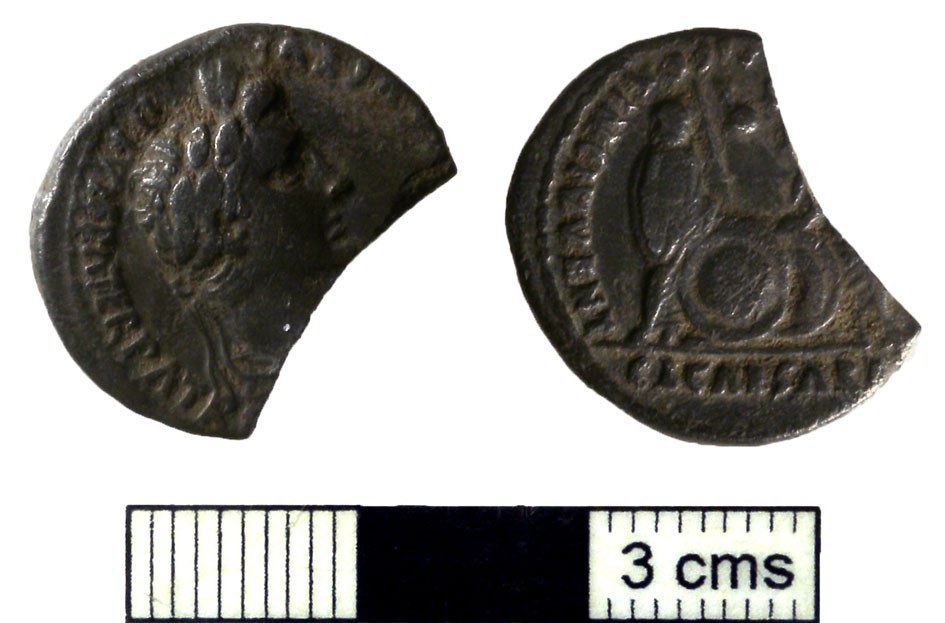
Start With the Portrait and Legend
Turn to the side with the profile head. A denarius almost always shows a single male portrait facing right (occasionally left), surrounded by an abbreviated Latin legend that runs around the rim. Fragments like PONTIF, MAX, TR POT, COS, IMP, or AVG are imperial titles, not the emperor's name by itself, so transcribe as many letters as you can. That string is what a specialist uses to attribute the coin to a particular ruler and even a date range, since titles such as TR POT and COS numbers changed year to year.
Read the Reverse Type
The other face typically carries a single standing or seated figure, a god or a personification such as Pax, Fortuna, Salus, or Roma, identified by attributes like a scepter, cornucopia, patera, or spear, and by its own short legend. Note what the figure holds and how it stands; the reverse type is a second key that, together with the obverse legend, narrows the coin to a specific issue. On the photographed coin the reverse legend is only partly visible, which is common and still workable.
Check Size, Weight, and Metal
A denarius is small, about 17-20 mm in diameter, and light, generally in the 3-4 gram range for imperial pieces. It is struck in silver, which on genuine ancient coins tones to a gray patina with darker tone settled in the recesses. A coin that is much larger and heavier, or clearly a base-metal color under the surface, is likely a different denomination (such as a bronze sestertius) or a fake.
Confirm It Was Struck, Not Cast
Genuine denarii were hammered between hand-engraved dies, so expect an irregular, slightly off-round flan, occasional off-center strikes with the legend running off the edge, and high but individualized relief. Look at the edge: struck coins have no casting seam and no trapped air bubbles. A visible mold seam around the rim, a grainy or pitted surface, mushy lettering, or two identical 'twins' are strong signs of a cast reproduction.
Rule Out Look-Alikes and Fakes
The denarius is one of the most reproduced ancient coins. Watch for modern tourist replicas, cast forgeries, and 'fantasy' pieces with invented legends or the word COPY. Silver-washed base metal, unnaturally smooth fields, and perfectly centered, perfectly round flans all warrant caution. Because so many exist, valuable or unusual examples are worth confirming through a reputable ancient-coin dealer or third-party expert before you rely on any attribution or price.
Frequently asked questions
What do the abbreviated letters around the head mean?
They are the emperor's Latin titles in heavy abbreviation, PONTIF MAX for chief priest, TR POT for tribunician power, COS for consul, IMP for imperator, AVG for Augustus. Reading them is the main way to attribute the coin to a specific ruler and period.
How do I know it is silver and not bronze?
Denarii are silver and are small and light (about 17-20 mm, 3-4 g), toning to gray. A larger, heavier coin with a brown or green surface is more likely a bronze denomination such as a sestertius or as, not a denarius.
What are the clearest signs of a fake?
A seam around the edge, air bubbles or pitting, grainy or soapy-smooth fields, blurry lettering, the word COPY, or two coins that are exactly identical. Genuine denarii are hand-struck and show natural, individual variation and no casting seam.
Can a worn coin still be identified?
Often yes. Even a partial obverse legend combined with the portrait style, reverse figure, size, and weight lets an experienced collector or dealer place the coin. Heavy wear lowers value but does not necessarily prevent attribution.