
How to Identify the Roman As
A collector's guide to recognizing the Roman bronze As by its two-faced Janus head, chariot reverse, ROMA legend, and heavy bronze fabric.
Read the full Roman As encyclopedia entry →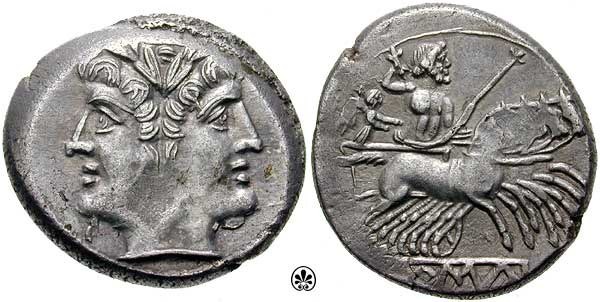
Begin with the obverse, which is the single most reliable clue. The As carries the head of Janus, shown as one head with two faces pointing in opposite directions. If you see that unmistakable double-faced portrait on a heavy bronze coin, you are almost certainly looking at a Roman As rather than any later or foreign type. No other everyday ancient coin shares this design so consistently.
Turn to the reverse and read the imagery and letters. On this coin the reverse shows a chariot with a driver, accompanied by the inscription ROMA that names the issuing state. Look also for a mark of value: many Asses carry the letter I in the field, indicating a single As. Republican bronze used a range of reverse types over the years, so treat the reverse as confirming detail while the Janus obverse does the primary identifying work.
Judge the metal and fabric. The As is a thick, weighty bronze disc, dark in color, typically with a green-to-brown earthen patina and an irregular, hand-struck flan rather than a perfectly round machine-made edge. A coin that is bright silver or gold, thin, or perfectly circular is not a genuine bronze As. Feel the heft and note the base-metal surfaces as part of the identification.
Watch for look-alikes and reproductions. This is one of the most copied areas of ancient numismatics, and tourist replicas, cast fakes, and modern fantasy pieces imitating the Janus design are common. Genuine ancient strikes show subtle die-cutting irregularities, slightly uneven lettering, and off-center images; suspiciously crisp, uniform, or seam-edged coins suggest a cast copy. When value or authenticity matters, rely on a reputable dealer's attribution, an auction pedigree, or professional authentication rather than the design alone.
Frequently asked questions
What is the quickest way to recognize a Roman As?
Look for the two-faced head of Janus on the obverse of a heavy, dark bronze coin. That double-faced portrait is the signature feature of the As and separates it from most other ancient coins.
Does every Roman As have a chariot on the back?
No. Republican bronze used many reverse types over the years, including ship prows and various figural scenes. This particular coin shows a chariot with a driver and the legend ROMA, but the Janus obverse is the more constant identifier.
How can I tell a real As from a modern copy?
Genuine strikes show hand-cut die irregularities, slightly uneven lettering, an off-round flan, and a natural earthen patina. Overly crisp, uniform, seam-edged, or artificially colored pieces suggest a cast replica, so seek expert confirmation.
What should I look for beyond the two faces and the chariot?
Check for a mark of value such as the letter I for one As, confirm the ROMA legend, and assess the metal: it should be a heavy base-metal bronze, not silver or gold.