
How to Identify the Republic India One Pice
A collector's guide to the 1950 bronze one pice: the state-emblem face, ornamental denomination side, copper color, small size and easy look-alikes.
Read the full Republic India One Pice encyclopedia entry →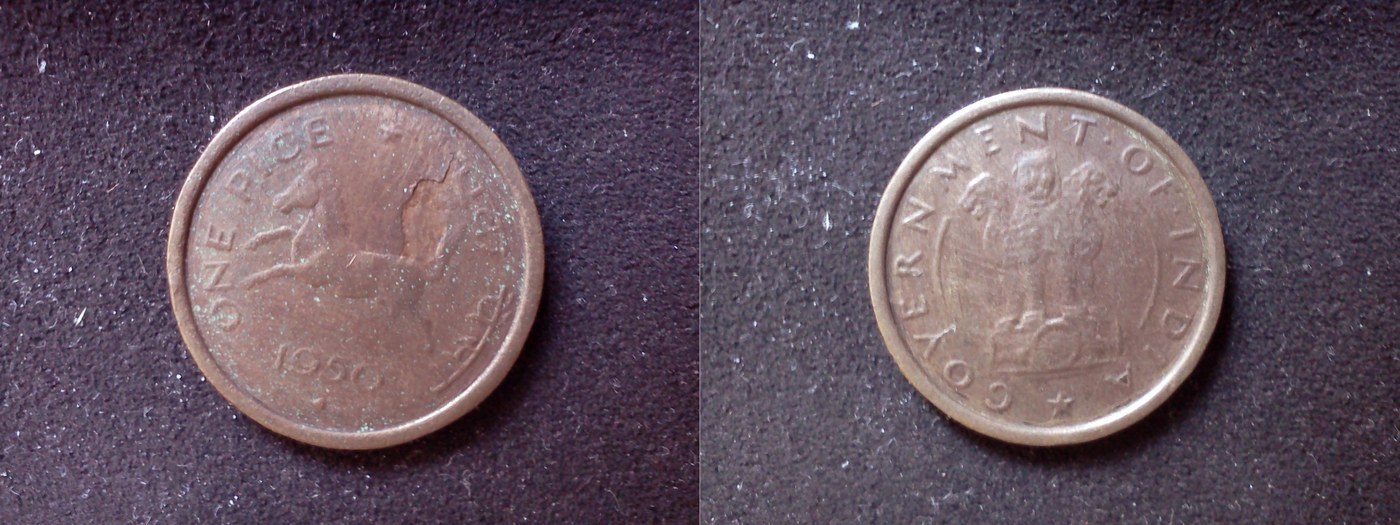
Start with the date and the metal. This type is dated 1950 and struck in bronze, a copper alloy, so it shows a warm brown, red-brown or reddish surface. That copper color is the quickest way to separate the one pice from the pale, silvery-looking cupro-nickel and nickel coins (half anna up to one rupee) of the same 1950 anna series. If the coin looks silvery, it is not the pice.
Check the two faces of the type. One face carries the Lion Capital of Ashoka — three addorsed lions on a stepped abacus — with GOVERNMENT OF INDIA around the top, the Devanagari country name भारत, and the date. The other face carries an ornamental, patterned design with the denomination; the ornamental side is what appears in our photograph. Because the second face is not visible in our image, verify a coin in hand by turning it over and confirming both the emblem side and the denomination.
Confirm the size and denomination. The one pice is a small, lightweight coin, roughly 20–21 mm in diameter and only a few grams, in keeping with its position as the lowest value of the series. Read the denomination legend to be sure you have a one-pice and not a fractional-anna coin: the anna coins of this era are larger, differently shaped in some cases, and made of the pale alloys rather than bronze.
Watch for look-alikes and naming confusion. The biggest pitfall is mixing up this pre-decimal 1950 pice (one sixty-fourth of a rupee) with the later decimal one-naya-paisa coins from 1957 onward (one hundredth of a rupee), which are a different system and often a different shape and metal. Also distinguish the coin from older British-era Indian pice that carry a monarch's name rather than GOVERNMENT OF INDIA and the Lion Capital.
Apply normal authentication sense. Genuine coins are struck, with crisp lettering, a sharp emblem and a clean ornamental pattern; be cautious of pieces with soft, mushy detail, casting seams or bubbles, and of heavily corroded or cleaned bronze that can hide diagnostic features. A small mint mark, where present, sits beneath the date. When in doubt, weigh and measure the coin and compare it against a standard catalog of Republic India coinage.
Frequently asked questions
How do I tell the one pice from the other 1950 coins?
Color and size. The one pice is small and bronze (copper-colored), while the half-anna through one-rupee coins of the same series are larger and struck in pale cupro-nickel or nickel. A warm brown, small coin dated 1950 is the pice.
Where is the date and any mint mark?
The date appears on the state-emblem face beneath the Lion Capital and country name. A mint mark, when present, is a small symbol below the date. Reading these confirms the year and, for specialists, the striking mint.
Is my 1950 pice the same as a 1 paisa coin?
No. The 1950 pice is part of the pre-decimal anna system (one sixty-fourth of a rupee). The decimal paisa (one hundredth of a rupee) only began in 1957. Similar names, different systems — check the date and the denomination wording.
How can I spot a fake or altered example?
Genuine coins are struck with sharp lettering, a clear Lion Capital and a crisp ornamental pattern. Watch for casting seams, bubbles or soft detail, and be wary of heavily cleaned or corroded pieces. Verify weight and diameter against a standard reference when unsure.