
How to Identify the Quincunx of Luceria
A collector's guide to recognizing the cast bronze Luceria quincunx by its five-part reverse, female head, weight, and Apulian mint traits.
Read the full Quincunx of Luceria encyclopedia entry →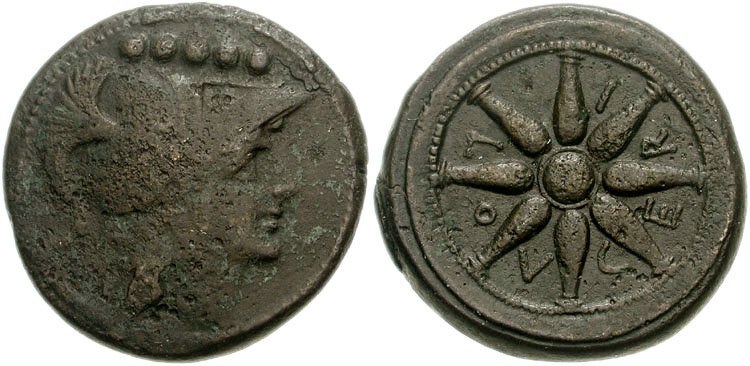
Begin with the count of five. The quincunx takes its name from a value of five unciae, and its designs advertise that number: look for a reverse built around five elements, whether a five-petaled flower, a five-point star, or a group of five pellets. On this coin the reverse is a five-petaled floral or star pattern. Confirming a cluster of five is the single most useful step, because it separates the quincunx from neighboring denominations such as the quadrans (three) or the sextans (two), which use different pellet counts.
Read the obverse next. This type shows a female head facing right, identified as Roma. Pairing that head with the five-part reverse points to an Apulian bronze in the Roman uncial tradition rather than a Greek civic issue, which more often shows a full deity, an animal, or an ethnic legend in Greek letters. Any Latin lettering or an abbreviated town signature supports an attribution to Luceria, though many pieces are worn and the legend may be faint or off the flan.
Assess the metal and fabric. This is bronze, thick and heavy for its diameter, with the irregular flan, casting or striking flaws, and green-to-brown patina normal for 3rd-century BC Italic bronze. A suspiciously light, thin, or perfectly smooth piece, or one with bright uniform color, warrants caution. Genuine ancient bronze usually shows real depth of patina and micro-pitting under magnification rather than a painted or sandy surface.
Watch for look-alikes and modern reproductions. Other Republican and Italic mints struck quincunxes and similar five-pellet bronzes, so a five-part reverse alone does not guarantee Luceria; the combination of the Roma head, the floral or star device, and the fabric is what supports the attribution. Cast copies and tourist replicas exist, so compare against published examples in standard references, be wary of pieces with seams from a mold, and for any significant purchase rely on a specialist dealer or recent auction records rather than the seller's label alone.
Frequently asked questions
What is the quickest way to confirm it is a quincunx?
Count the design. A quincunx is five unciae, so its reverse is built around five elements, here a five-petaled flower or star. Finding a deliberate cluster of five, rather than two, three, or four, is the fastest confirmation.
How do I tell Luceria from another Italic mint?
No single feature is decisive from wear alone. Use the combination: a right-facing head of Roma, the five-part floral or star reverse, heavy bronze fabric, and any Latin town signature together support Luceria over other Republican or Greek issues.
Are there fakes of this coin?
Yes. Cast copies and replicas exist for ancient bronze. Look for mold seams, unnaturally uniform surfaces, or too-light weight, examine the patina under magnification, and buy from specialists or against auction records for anything valuable.
Why is there no date on the coin?
Ancient coins were not dated by year. The 3rd-century BC attribution comes from the weight standard, style, and mint, established by comparing the piece with catalogued examples rather than reading a year off the coin.