
How to Identify the Qatar and Dubai Riyal
A short-lived joint currency issued by the Qatar and Dubai Currency Board in the 1960s, identifiable by its dual-emirate Arabic inscriptions before both states adopted separate currencies.
Read the full Qatar and Dubai Riyal encyclopedia entry →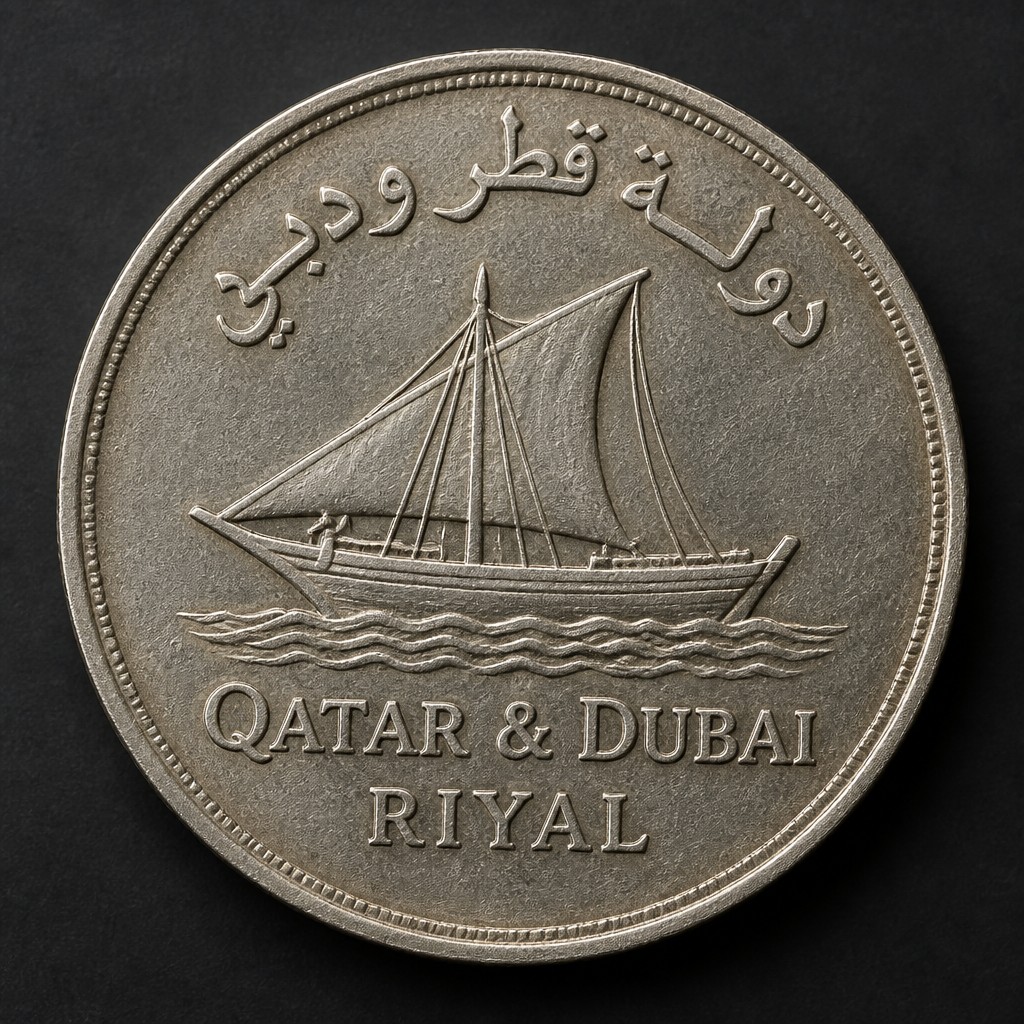
What It Is
The Qatar and Dubai riyal was issued by the Qatar and Dubai Currency Board starting in 1966, filling the gap after the Gulf rupee was devalued and before Qatar and the United Arab Emirates (which absorbed Dubai) each introduced their own national currencies in the early 1970s. Because the issuing period was brief, the series is compact and well defined by date range.
Obverse Design & Inscriptions
The obverse carries Arabic script naming the "Qatar and Dubai Currency Board" and the denomination, without any ruler's portrait. Text is arranged around a central design element, with the Hijri or Gregorian date (issues used Gregorian dating) included in the legend.
Reverse Design & Inscriptions
The reverse typically features a palm tree, a common Gulf motif symbolizing the region's date-palm agriculture, along with the numeral value spelled out and repeated in Western numerals for practical use in trade with foreign merchants.
Size, Weight, Metal & Edge
Denominations ranged from small dirham-equivalent coins up to larger riyal pieces, struck in base metals such as cupro-nickel for higher values and bronze for the smallest denominations. Sizes and weights follow standard mid-20th-century Gulf coinage conventions, with larger silver-colored pieces for higher denominations and smaller copper-colored pieces for minor values; edges are plain or reeded depending on denomination.
Mint Marks & Where to Find Them
These coins do not carry a distinct mint-mark symbol; instead, the identifying feature is the specific "Qatar and Dubai Currency Board" wording in the Arabic legend, which by itself narrows the coin to this short-lived joint issue.
Telling It Apart From Similar Coins
Because the series was replaced quickly, collectors sometimes confuse it with the earlier Gulf rupee coinage or the later separate Qatari riyal and UAE dirham series. The clearest test is the legend: only this joint issue names both Qatar and Dubai together on the same coin, a combination that does not appear on any earlier or later Gulf coinage.
Judging Condition at a Glance
As practical circulation coins struck for everyday use, wear appears first on the palm tree fronds and the raised numerals. A well-preserved coin shows crisp, separated palm leaves and fully legible Arabic and Western numerals, while a worn example shows a flattened tree silhouette and thinned digits.
Authenticity Red Flags
Because the series is a relatively narrow historical footnote rather than a high-value bullion coin, outright fakes are uncommon, but look out for coins that have been re-plated to hide corrosion, mismatched wear between the two faces (suggesting a fabricated pairing of mismatched coin halves), and legends that do not clearly read "Qatar and Dubai," which would indicate a different, unrelated Gulf issue rather than a fake of this specific coin.
Frequently asked questions
Why does the coin name two different places, Qatar and Dubai?
It was issued jointly by the Qatar and Dubai Currency Board in 1966 as a shared transitional currency before each later adopted its own national money.
How long was this currency in use?
Only a few years, roughly from 1966 until Qatar and Dubai (via the UAE) introduced separate currencies in the early 1970s, making it a short and clearly bounded series.
What is the main design symbol on the reverse?
A palm tree is the dominant motif on the reverse of most denominations, a common regional symbol in Gulf coinage of that era.
How do I distinguish it from the later Qatari riyal or UAE dirham?
Check the legend: only this joint issue reads 'Qatar and Dubai Currency Board'; later coins name only Qatar or only the United Arab Emirates.