
How to Identify the Prussian Vereinsthaler
A standardized German silver thaler issued by the Kingdom of Prussia under the 1857 Vienna Monetary Treaty, identified by the Prussian king's portrait and the state eagle reverse.
Read the full Prussian Vereinsthaler encyclopedia entry →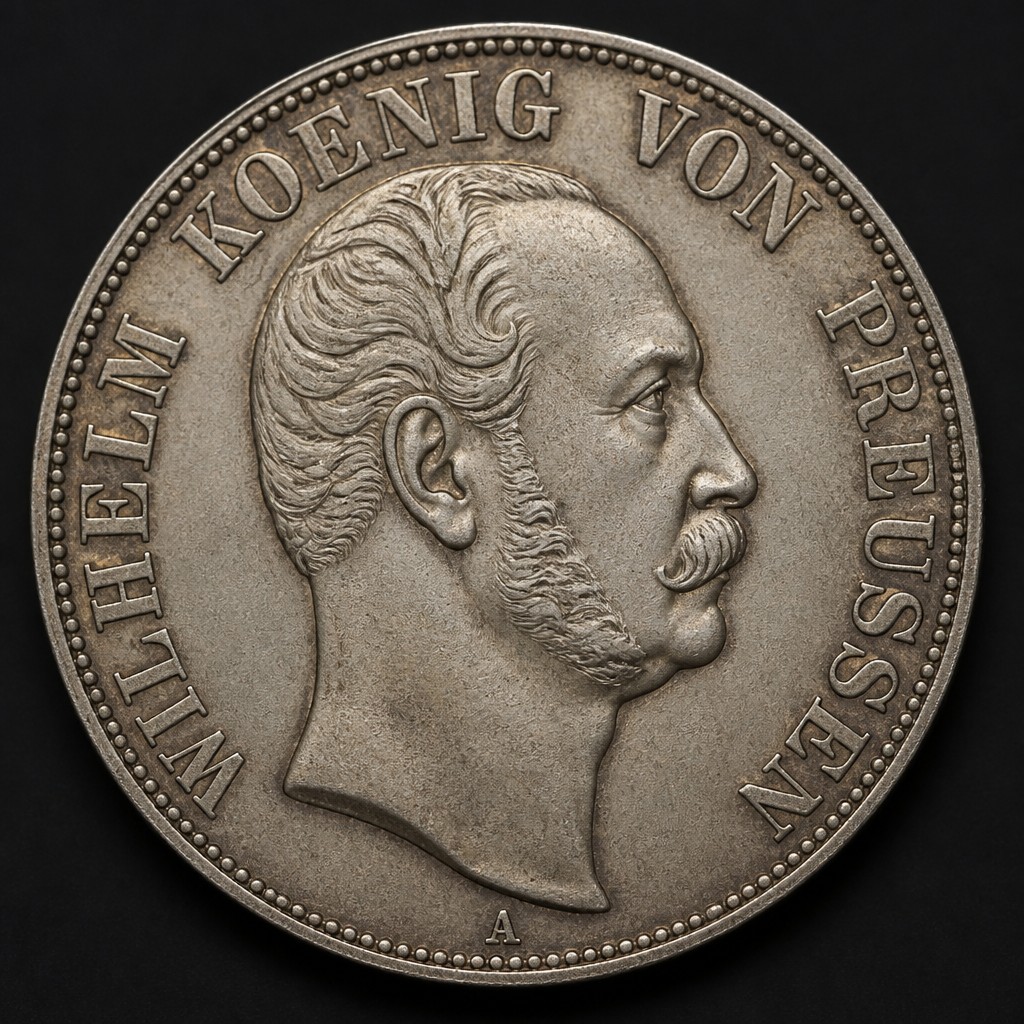
What It Is
The Prussian Vereinsthaler is a silver thaler struck by the Kingdom of Prussia following the 1857 Vienna Monetary Treaty, which established the "Vereinsthaler" (union thaler) as a common monetary standard across most German states. This standardization made thalers from different German kingdoms interchangeable at par value, and Prussia, as the dominant German power, issued large quantities of these coins under successive kings. Because Prussia later absorbed most other German states into the unified German Empire in 1871, Prussian Vereinsthalers are historically significant as a direct predecessor to the imperial mark coinage that eventually replaced the thaler system altogether.
Obverse Design and Inscriptions
The obverse shows a profile portrait of the reigning Prussian king, such as Friedrich Wilhelm IV or Wilhelm I, with his name and title in German or Latin encircling the bust, for example "WILHELM KOENIG VON PREUSSEN" (Wilhelm, King of Prussia).
Reverse Design and Inscriptions
The reverse displays the Prussian eagle, a large single-headed eagle with outstretched wings, often crowned, within a wreath or decorative border, along with the denomination "EIN VEREINSTHALER" (one union thaler) and the date.
Size, Weight, Metal, and Edge
Under the Vienna Monetary Treaty standard, the Vereinsthaler weighs approximately 18.52 grams at .900 fine silver, with a diameter of about 33 mm, a specification shared by other German states' thalers of the same treaty period, making weight and fineness consistent across state boundaries. The edge is typically lettered with a motto or reeded, depending on the specific type.
Mint Marks and Where to Find Them
Look for a small mint letter near the base of the design or near the date, commonly "A" for Berlin, the main Prussian mint, though other Prussian mint towns used different letters in earlier periods before centralization.
Telling It Apart from Similar Coins
Because the Vereinsthaler standard was shared across many German states, a Prussian example can be confused with Vereinsthalers from Bavaria, Saxony, or Hesse, among others. The decisive identifier is the specific king's name and the Prussian eagle design, which differs from the checkered Bavarian shield, the Saxon horse, or other state-specific reverse devices.
Judging Condition at a Glance
Check the fine feather detail on the eagle's wings and the king's hair or wreath detail. A well-struck, lightly worn coin shows individually distinct feathers and crisp facial features, while a heavily circulated example shows a smoothed, indistinct eagle silhouette and flattened portrait relief.
Authenticity Red Flags
Watch for coins with incorrect weight or diameter relative to the 18.52 gram, .900 fine silver Vereinsthaler standard, blurred or shallow eagle feather detail, or a portrait style inconsistent with the documented bust changes across a king's reign. A grainy surface or visible edge seam suggests a cast counterfeit rather than a genuinely struck coin.
Frequently asked questions
What is a Vereinsthaler?
It is a standardized German silver thaler established by the 1857 Vienna Monetary Treaty, allowing thalers from different German states, including Prussia, to circulate interchangeably at the same value.
Which Prussian kings appear on Vereinsthalers?
Rulers such as Friedrich Wilhelm IV and Wilhelm I issued Vereinsthalers, each identifiable by the portrait style and name in the surrounding legend.
How do I tell a Prussian Vereinsthaler from a Bavarian one?
The reverse eagle design and the king's name in the legend are distinct to Prussia, while Bavaria uses a checkered shield and its own ruler's name.
What weight and fineness should a genuine coin have?
About 18.52 grams at .900 fine silver and roughly 33 mm in diameter, per the Vienna Monetary Treaty standard.