
How to Identify the Prussian Taler
A collector's guide to recognizing Frederick II's Prussian silver taler by its portrait legend, heraldic reverse, size, mint marks and common pitfalls.
Read the full Prussian Taler encyclopedia entry →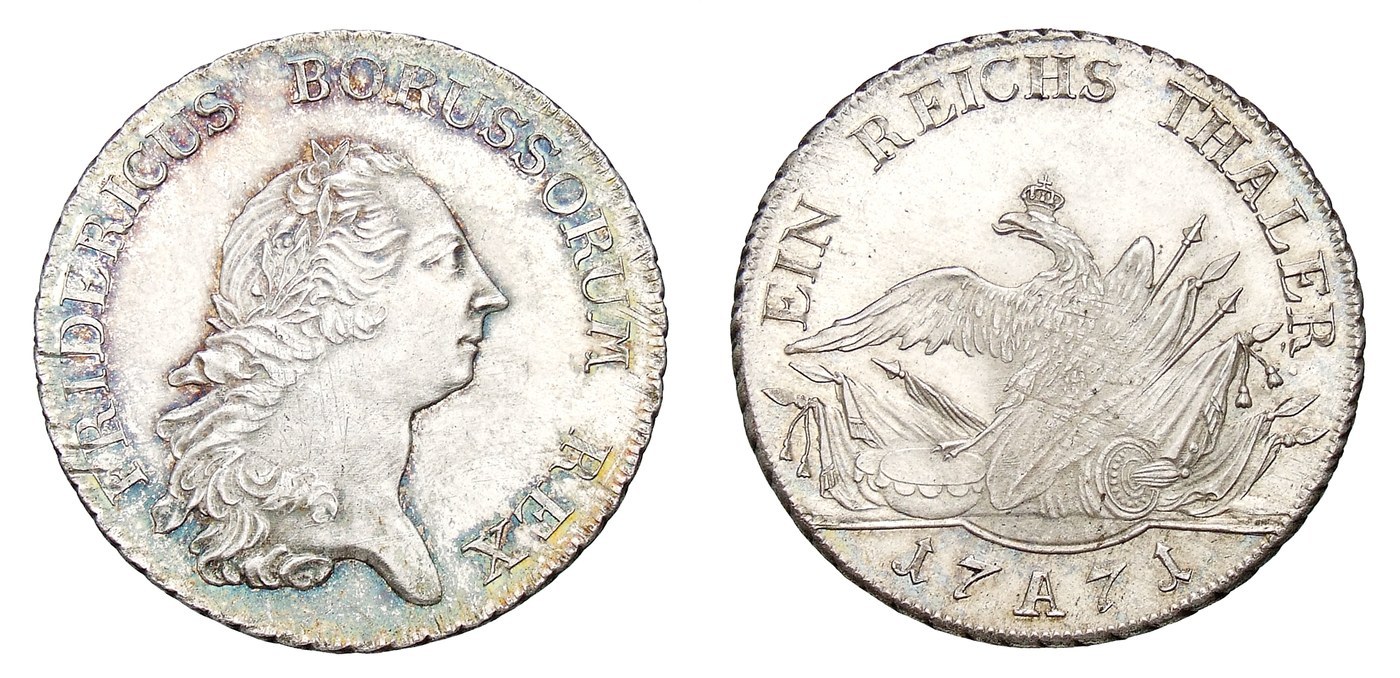
Start with the obverse legend and portrait. A Prussian Taler of Frederick II carries the Latin inscription FRIDERICUS BORUSSORUM REX wrapped around a profile bust of the king, often crowned or shown in armour. Reading that legend confirms both the ruler and the issuing kingdom in one step and is the single most reliable identifier of the type.
Turn to the reverse to confirm the denomination and gather date and mint information. Expect a heraldic coat of arms — commonly the crowned Prussian eagle arms — set within an ornate frame or decorative border, with the date in the legend. Look closely for small letters near the arms or in the legend: these indicate the mint and mint-master and are important because the same type was struck at several Prussian mints across different years.
Weigh size and metal together. A genuine taler is a large, heavy silver coin, distinctly bigger than the fractional silver pieces of the same reign. Confirm the pale silver colour and substantial heft; a small silver coin with a similar portrait is a lesser denomination, not the full taler. Note that many talers show an inscribed or decorated edge, and the edge should be examined as part of authentication.
Rule out look-alikes and related types. Other German States and later Prussian rulers issued talers with different legends and arms, so do not identify from the portrait alone — verify the FRIDERICUS BORUSSORUM REX wording and the specific date range. Commemorative restrikes, gilded pieces and modern fantasy or replica "talers" also exist; a legend, arms or date that does not match documented Frederick II issues is a warning sign.
Approach authentication with care, because desirable eighteenth-century silver is a frequent target for forgery. Watch for cast fakes with soft, mushy detail and seam lines, wrong weight or diameter, incorrect edge treatment, and tooled or re-engraved portraits. Compare any candidate against reference images of a confirmed Frederick II taler of the same date and mint, and for higher-value coins seek third-party grading and authentication rather than relying on appearance alone.
Frequently asked questions
What is the single easiest way to identify this coin?
Read the obverse legend. FRIDERICUS BORUSSORUM REX around a profile portrait confirms it is a taler of Frederick II of Prussia; the reverse then shows the arms and date.
Where do I find the mint and date?
On the reverse, alongside the coat of arms. The date is in the legend, and small letters near the arms indicate the mint and mint-master, which vary across the reign.
How do I tell the taler from smaller Prussian silver coins?
By size and weight. The taler is a large, heavy silver piece; a much smaller silver coin with a similar portrait or arms is a fractional denomination, not the full taler.
How can I spot a fake or replica?
Check weight, diameter and edge, and look for soft cast detail or seams. Legends, arms or dates that do not match documented Frederick II issues suggest a replica or forgery; seek authentication for valuable examples.