
How to Identify the Presidential Dollar - Thomas Jefferson
The third coin in the Presidential $1 Coin Program, honoring the nation's third president, identifiable by his portrait, inscribed name, and edge-incused lettering.
Read the full Presidential Dollar - Thomas Jefferson encyclopedia entry →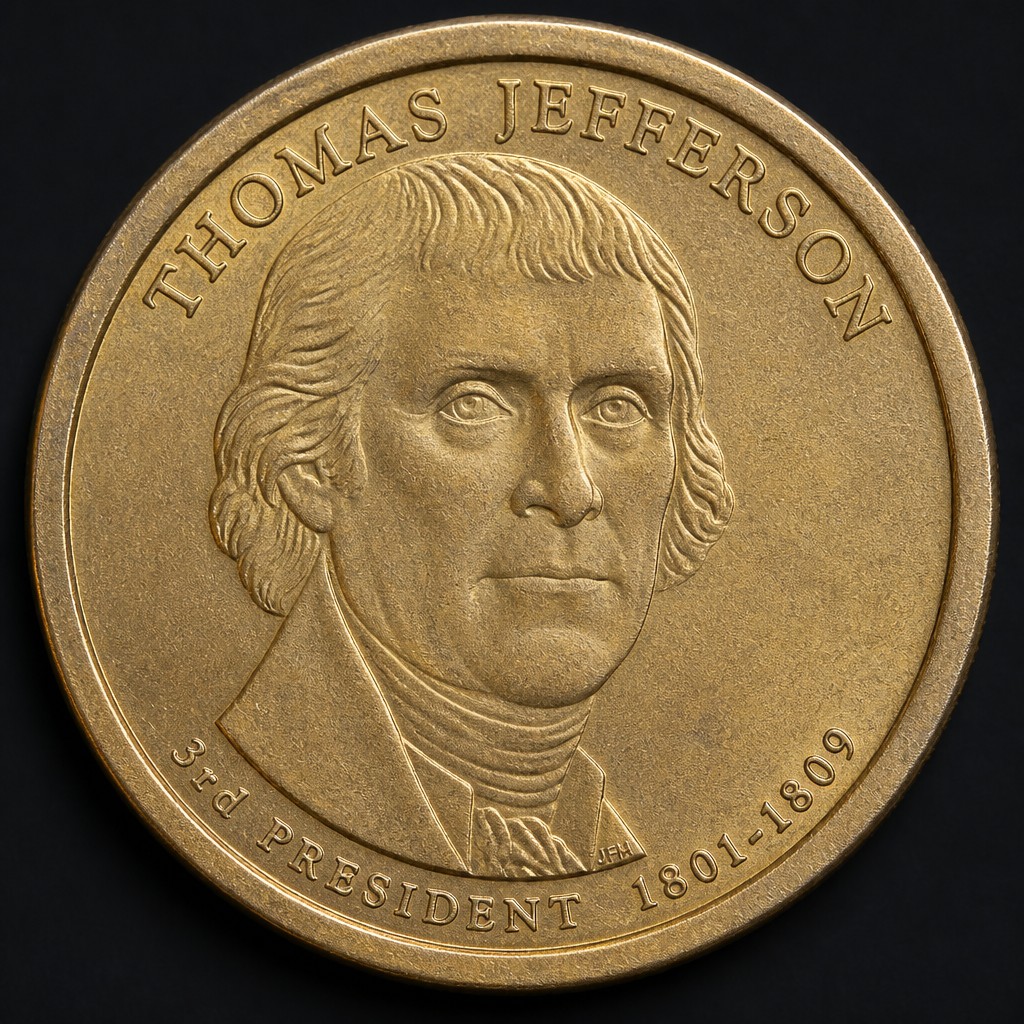
What It Is
The Thomas Jefferson Presidential Dollar was the third release in the Presidential $1 Coin Program, issued in 2007 to honor the third president of the United States as part of the series' chronological rollout.
Obverse Design
The obverse shows a portrait of Thomas Jefferson facing forward-left, with "THOMAS JEFFERSON," his years in office "1801-1809," and "3RD PRESIDENT" inscribed around the design.
Reverse Design
The reverse carries the Statue of Liberty design used across all 2007 and 2008 Presidential dollars, along with "UNITED STATES OF AMERICA" and "$1."
Size, Weight, Metal, and Edge Lettering
The coin measures 26.5 mm across, weighs 8.1 grams, and is struck in manganese-brass clad over a copper core, giving it the same golden appearance as the Sacagawea dollar. The mint mark, date, and mottos E PLURIBUS UNUM and IN GOD WE TRUST appear as incused lettering on the coin's edge rather than on either face.
Mint Marks
Look for a small "P," "D," or "S" incused into the edge alongside the date to determine where the coin was struck.
Telling It Apart From Similar Coins
The obverse portrait and inscribed name make this coin easy to identify: any example reading "THOMAS JEFFERSON" and "3RD PRESIDENT" belongs to this issue. Since the reverse is shared with the rest of the 2007-2008 Presidential dollars, the obverse text and portrait are the key distinguishing features from Washington, Adams, or Madison dollars of the same period.
Judging Condition at a Glance
Examine Jefferson's hair and coat details for smoothing from wear, and check the Statue of Liberty's fine robe lines and torch on the reverse. Since identifying details like the mint mark sit on the edge, check that the edge lettering remains clear and legible, as damage or heavy wear there can obscure this information.
Authenticity Red Flags
Like other early Presidential dollars, some Jefferson dollars are known with edge lettering errors, including missing or smooth edges and doubled or misaligned lettering, which are recognized mint varieties rather than counterfeits. Still, be wary of coins with edge inscriptions that appear unusually crude, too deep, or spaced inconsistently compared to genuine pieces, and confirm the coin's weight and diameter match specifications, since incorrect heft or a non-golden surface would suggest an altered or fake coin.
Frequently asked questions
How do I identify a Thomas Jefferson Presidential Dollar?
Look for his portrait on the obverse with the inscriptions 'THOMAS JEFFERSON,' '1801-1809,' and '3RD PRESIDENT.'
Where is the mint mark found?
Incused into the edge of the coin along with the date, not on the obverse or reverse face.
What is shown on the reverse?
The Statue of Liberty, a design shared across all Presidential dollars struck in 2007 and 2008.
Can this coin have a missing edge lettering error?
Yes, some examples from this era of the series are known to exist with smooth edges lacking the inscription, similar to other early Presidential dollar issues.
What gives this coin its gold color?
A manganese-brass clad outer layer over a copper core, the same composition used throughout the Presidential dollar series.