
How to Identify the Presidential Dollar - George Washington
The first coin in the Presidential $1 Coin Program, featuring George Washington's portrait and a golden color, notable for early strikes with edge lettering errors.
Read the full Presidential Dollar - George Washington encyclopedia entry →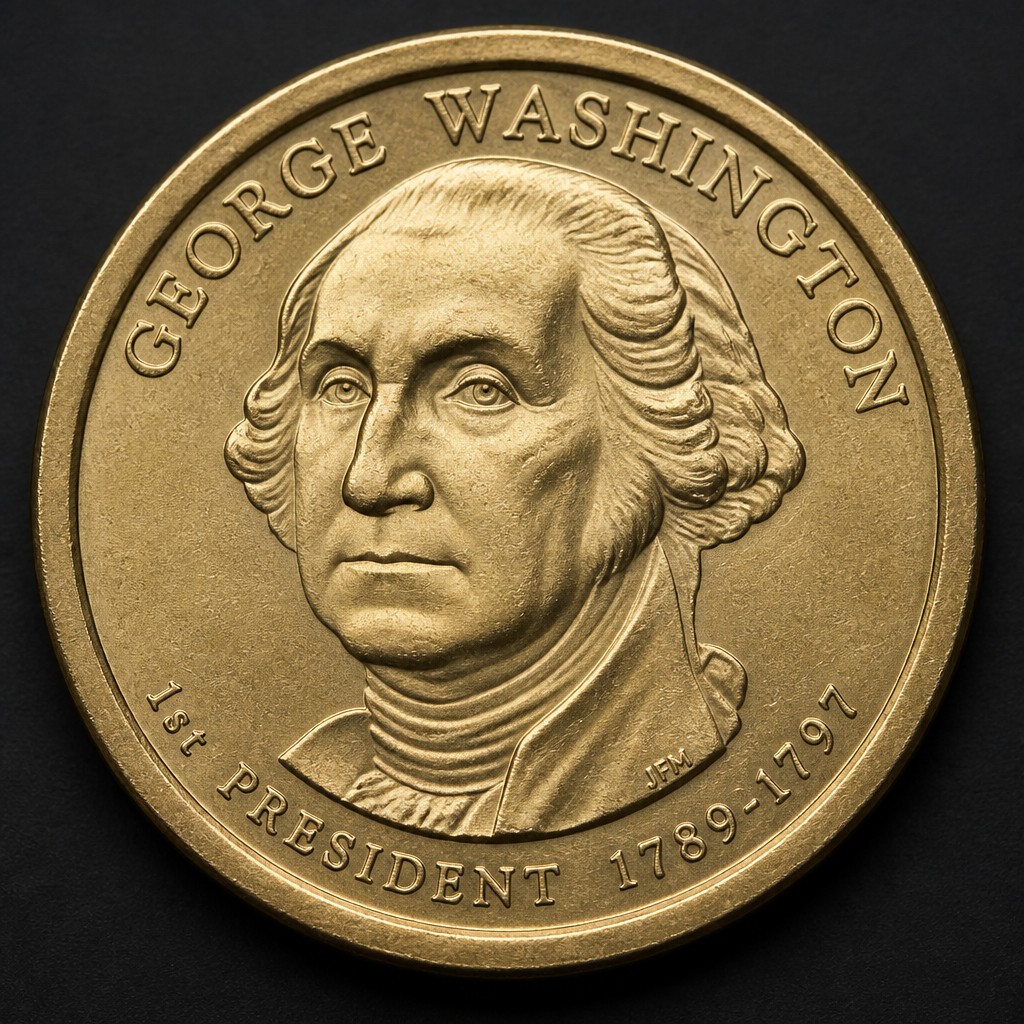
What It Is
The George Washington Presidential Dollar launched the Presidential $1 Coin Program in February 2007, the first of a series honoring US presidents in the order they served. It shares its golden color and size with the earlier Sacagawea dollar but introduced a new design format with edge-incused lettering.
Obverse Design
The obverse features a portrait of George Washington facing forward-left, with the inscription "GEORGE WASHINGTON," his years in office "1789-1797," and "1ST PRESIDENT" around the design.
Reverse Design
The reverse, used across all coins from 2007 and 2008 in the series, shows the Statue of Liberty along with "UNITED STATES OF AMERICA" and "$1."
Size, Weight, Metal, and Edge Lettering
The coin measures 26.5 mm in diameter and weighs 8.1 grams, made of a manganese-brass clad composition over a copper core, giving it a golden appearance similar to the Sacagawea dollar. Unlike earlier dollar coins, the mint mark, year, and mottos E PLURIBUS UNUM and IN GOD WE TRUST were placed as incused lettering on the edge rather than on the coin's face for the earliest issues.
Mint Marks
The mint mark appears on the edge alongside the date, rather than on the obverse or reverse face. Look for a small "P," "D," or "S" as part of the edge inscription.
Telling It Apart From Similar Coins
Compared to the Sacagawea dollar, which shows Sacagawea and her infant son on the obverse and an eagle on the reverse, the Washington dollar clearly shows Washington's portrait. Within the Presidential series itself, each president's name is inscribed directly on the obverse, making identification straightforward by reading the portrait's name.
Judging Condition at a Glance
Examine Washington's hair detail and the folds of his coat for wear, along with the fine lines of the Statue of Liberty's robe and torch on the reverse. Because the coin's edge carries important lettering, also check that the edge inscription remains legible, as heavy wear or damage there can obscure the mint mark and date entirely.
Authenticity Red Flags
Early production issues led to a well-documented error where some 2007 Washington dollars left the mint with smooth, blank edges missing the lettering entirely, an authentic minting error rather than a fake, which briefly drew strong collector interest. Separately, watch for coins with edge lettering that appears too crisp, misaligned, doubled, or oriented upside down compared to genuine examples, and confirm that the coin's weight and diameter match specifications, since a coin lacking the correct golden clad composition would suggest an altered or counterfeit piece.
Frequently asked questions
Where is the mint mark on a Washington Presidential Dollar?
It's incused into the edge of the coin, alongside the date and mottos, rather than on the obverse or reverse face.
What does the reverse of the coin show?
The Statue of Liberty, a design used on all Presidential dollars struck in 2007 and 2008.
Why do some 2007 Washington dollars have no edge lettering?
A known minting error caused some coins to be struck without the usual edge lettering, leaving the edge completely smooth.
How can I tell this coin apart from a Sacagawea dollar?
The obverse portrait is different: Washington's dollar shows his portrait and name, while the Sacagawea dollar shows Sacagawea carrying her infant son.
What metal gives the coin its gold color?
A manganese-brass clad outer layer over a copper core, the same composition used for the Sacagawea dollar.