
How to Identify the Pound Coin
How to identify the UK one-pound coin, from the original round nickel-brass version to the 12-sided bimetallic coin with micro-lettering and hologram.
Read the full Pound Coin encyclopedia entry →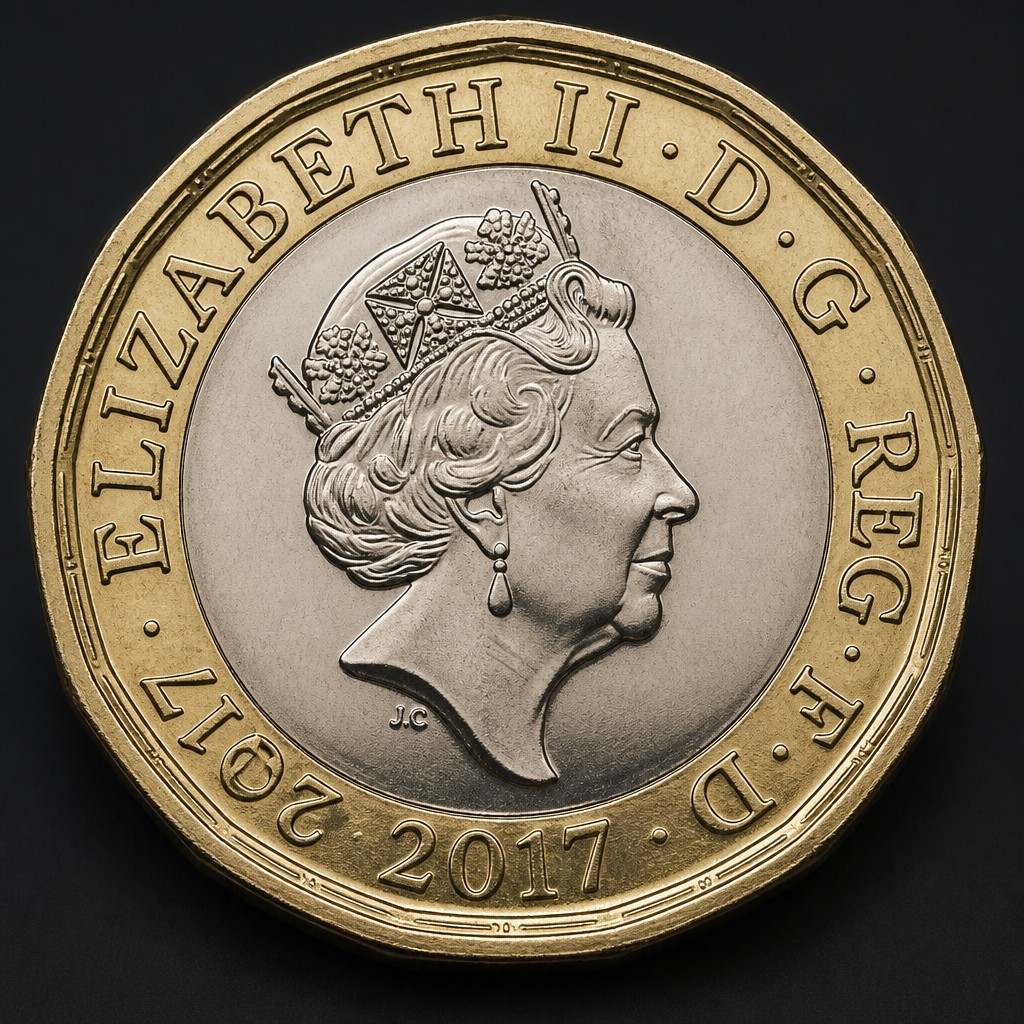
What It Is
The pound coin is the United Kingdom's circulating £1 denomination. It was introduced in 1983 to replace the paper £1 note, originally as a round coin, and was replaced in 2017 by a new 12-sided bimetallic design intended to cut down on counterfeiting.
Obverse Design & Inscriptions
Both versions carry a portrait of Queen Elizabeth II with "ELIZABETH II" and the date. Several official portraits were used over the decades, with the 12-sided coin using the Jody Clark effigy.
Reverse Design & Inscriptions
The old round pound cycled through many reverse themes, including national and regional floral emblems, bridges, gates, and the Royal Arms. The 12-sided coin's standard reverse, by David Pearce, shows an English rose, Welsh leek, Scottish thistle, and Northern Irish shamrock all emerging from a single stem.
Size, Weight, Metal, and Edge
The original round pound was nickel-brass, 22.5mm across, and weighed 9.5 grams, with edge lettering that varied by year. The 12-sided coin is bimetallic, with a nickel-brass outer ring around a nickel-plated alloy center, measures 23.43mm across its flats, and weighs 8.75 grams. It carries micro-lettering reading "ONE POUND" alternating with the year around the lower obverse rim, plus a hidden image near the Queen's portrait that appears to switch between a "£" symbol and the number "1" depending on the viewing angle.
Mint Marks & Where to Find Them
Both versions were struck at the Royal Mint in Llantrisant. Neither uses a separate branch mint mark; instead, security relies on edge lettering, micro-text, and, on the newer coin, the latent switching image.
Telling It Apart From Similar Coins
The old round pound was withdrawn from circulation in October 2017 after estimates suggested roughly one in thirty coins in circulation was counterfeit. If you find a round £1 coin today, it is no longer legal tender for everyday spending, only exchangeable through certain banks.
Judging Condition & Grade
Wear shows first on the raised portrait and rim lettering. Uncirculated examples retain sharp micro-lettering and full luster on the reverse design.
Authenticity Red Flags
On the 12-sided coin, check for crisp, readable micro-lettering, a working latent image, correct two-tone bimetallic color, and accurate weight and diameter. Blurred text, a missing hologram effect, or a single uniform metal color are signs of a counterfeit.
Frequently asked questions
Is the old round £1 coin still usable as money?
No, it was withdrawn from general circulation in October 2017 and is no longer accepted for everyday spending, though some banks may still exchange it.
What is the easiest way to check if a 12-sided pound coin is genuine?
Look for sharp micro-lettering reading ONE POUND alternating with the date around the lower rim, and check that the hidden image near the portrait appears to change between a £ symbol and the number 1 when tilted.
Why was the 12-sided pound introduced?
It replaced the round pound mainly to combat counterfeiting, since a significant share of round pound coins in circulation were estimated to be fake.
How many different reverse designs exist for the pound coin?
The round pound had numerous designs representing UK nations and regions over its run, while the 12-sided coin mainly uses one standard four-nations floral design alongside occasional commemorative issues.