How to Identify the Portuguese Escudo
Portugal's 20th-century currency unit adopted after the monarchy fell, identifiable by its republican arms obverse and denomination reverse.
Read the full Portuguese Escudo encyclopedia entry →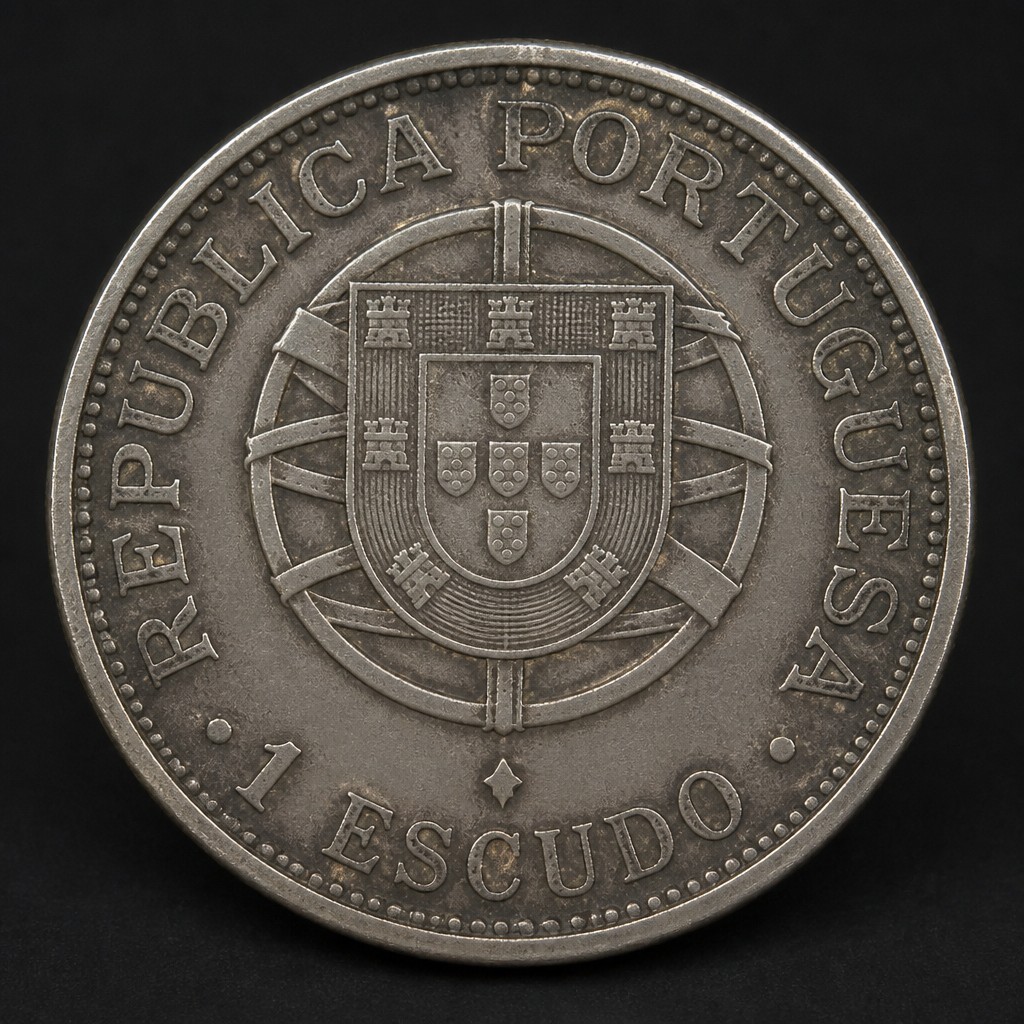
What Is the Portuguese Escudo?
The Escudo became Portugal's official currency in 1911, following the establishment of the Portuguese Republic in 1910, replacing the centuries-old real system at a rate of 1 escudo to 1,000 réis. Escudo coins were issued in various denominations and metals throughout the 20th century until Portugal adopted the euro in 2002.
Obverse Design
Early Republic-era escudo coins commonly feature the Portuguese national arms — a shield bearing five smaller shields (quinas) representing the wounds of Christ, surrounded by castles referencing Portugal's historic kingdoms, all set within a larger decorative border. The legend "REPUBLICA PORTUGUESA" typically appears around the design.
Reverse Design
The reverse states the denomination — such as 1, 2.5, 5, 10, or 20 escudos depending on the coin — along with the date, often bordered by a wreath or decorative pattern. Later 20th-century issues sometimes introduced allegorical figures or simplified numeral designs as the series evolved through the decades.
Size, Weight & Metal
Escudo coins were struck in a range of metals depending on denomination and era, including silver for higher values in the early Republic period and later cupronickel or other base metals as the currency modernized. Sizes and weights vary considerably by denomination, so the specific figures must be checked against the stated face value.
Mint Marks
Portuguese escudo coins were produced at the national mint (Casa da Moeda) in Lisbon. Because Portugal generally relied on a single minting authority for this series, a separate regional mint mark is not usually a distinguishing feature; instead, focus on the date and denomination to identify a specific issue.
Telling It Apart from Similar Coins
The escudo series can be confused with the earlier real-denominated coinage it replaced, so always check whether the coin explicitly states "ESCUDOS" or "CENTAVOS" (100 centavos = 1 escudo) rather than "REIS." Within the escudo series itself, denominations of similar size — such as the 5 and 10 escudo coins from a given era — should be distinguished by their stated numeral value rather than size alone, since designs were periodically updated.
Judging Condition at a Glance
Check the fine details of the national arms, including the small shields and castle towers, along with the numeral denomination on the reverse. Well-preserved coins show crisp separation between these small design elements, while worn coins show a smoothed, less distinct shield and softened lettering.
Authenticity Red Flags
Because escudo coins span many decades and metal types, verify that the metal color and apparent weight are consistent with the stated denomination and era — a coin that looks unusually light, discolored, or inconsistent with known genuine specimens for its date deserves closer inspection. Blurred or poorly centered strikes can also indicate a low-quality counterfeit rather than an official mint product.
Frequently asked questions
When did Portugal adopt the escudo?
In 1911, after the establishment of the Portuguese Republic, replacing the older real currency system.
What replaced the escudo?
The euro replaced the escudo when Portugal joined the eurozone currency changeover completed in 2002.
What appears on the obverse of most escudo coins?
The Portuguese national arms, featuring five small shields and castles, along with the legend 'REPUBLICA PORTUGUESA.'
How many centavos make an escudo?
100 centavos equal 1 escudo, and coins from this era are marked accordingly.
Where were escudo coins minted?
At the Casa da Moeda, Portugal's national mint in Lisbon.
Portuguese Escudo identified by the community
Recent Portuguese Escudo coins identified with Coin Identifier.