
How to Identify the Pine Tree Shilling
Diagnostic features of the Massachusetts Pine Tree Shilling: the pine tree obverse, MASSACHUSETTS legend, XII denomination, and authentication cautions.
Read the full Pine Tree Shilling encyclopedia entry →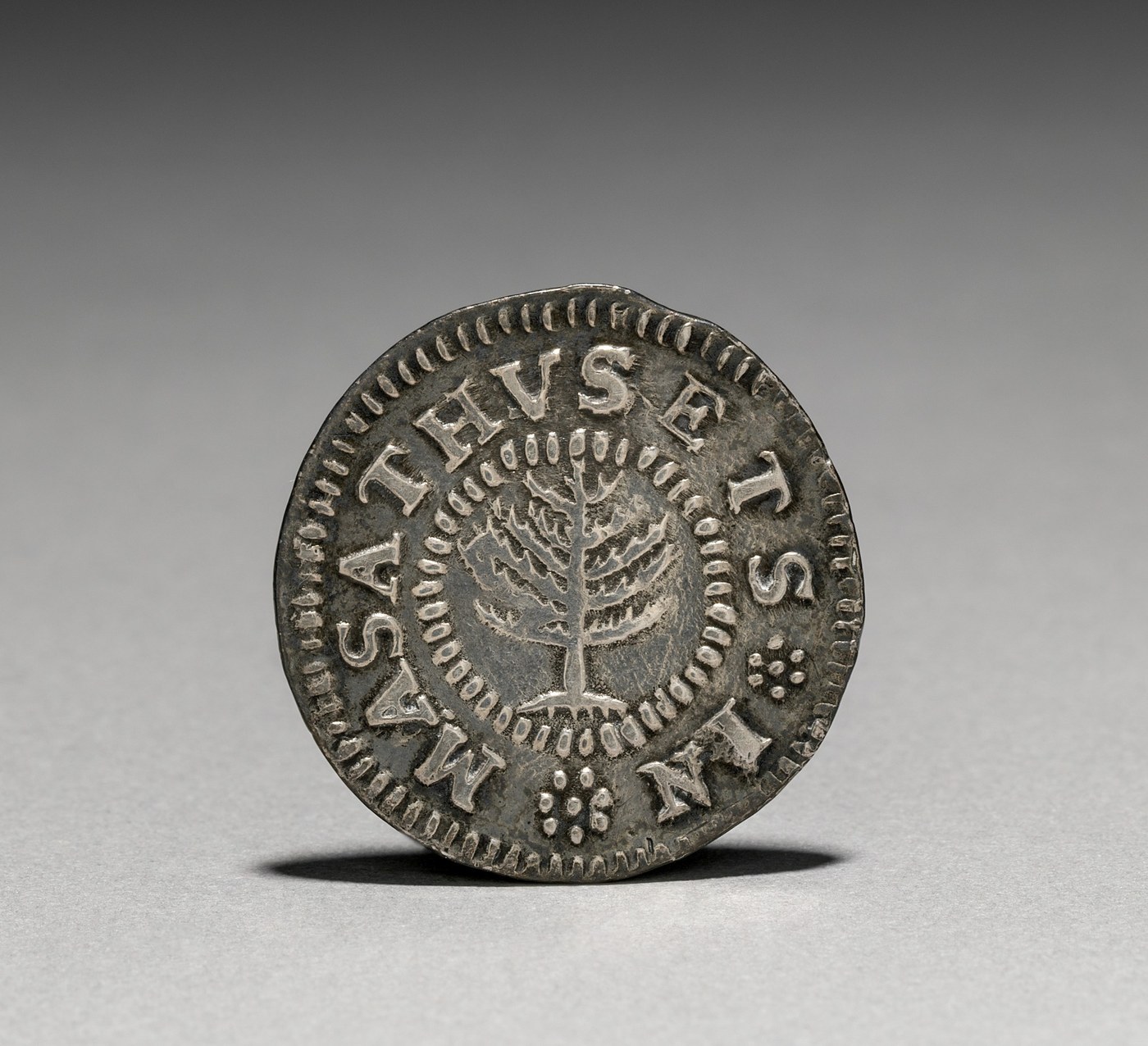
Start with the obverse, which is what the photographed coin shows. The key marker is a pine tree standing upright at the center, surrounded by the legend MASSACHUSETTS above and IN COLONY below, all inside a beaded border of small raised dots. A stylized evergreen with a full crown and a distinct trunk is what separates the Pine Tree type from the earlier Oak Tree and Willow Tree issues, whose trees are bushier and cruder.
Check the reverse if you can see it. A true shilling reads NEW ENGLAND, the abbreviation AN DOM, the date 1652, and the Roman numeral XII for twelve pence. The XII is the single most useful denomination check: sixpence coins read VI and threepence read III, and they are physically smaller. If the marked value and the diameter do not agree, be suspicious.
Confirm the fabric. These are hand-hammered silver coins on relatively broad, thin flans (the larger-planchet style struck about 1667–1674). Genuine pieces show honest silver toning, irregular edges, and often some off-center or doubled detail from the striking process. A perfectly round, uniformly sharp, mirror-smooth coin is a warning sign, not a plus.
Watch for look-alikes and reproductions. The Pine Tree Shilling has been copied for well over a century in the form of souvenir tokens, cast replicas, and outright forgeries; many are base metal, silver-plated, or made from crisp modern dies. Cast copies often have soft, mushy detail, seam lines on the edge, and the wrong weight. Because authentic examples are valuable, treat any uncertified coin as unproven and rely on a reputable grading service before buying or selling.
Frequently asked questions
How do I tell a Pine Tree Shilling from an Oak Tree Shilling?
Look at the tree. The Pine Tree type shows a slender evergreen with a clear trunk and layered branches, while the Oak Tree issue has a rounder, bushier tree. Both share the MASSACHUSETTS legend, so the tree style is the deciding feature.
What size and weight should a genuine shilling be?
It is a hand-struck silver shilling on a broad, thin flan, noticeably larger than the sixpence and threepence of the series. Because they were made by hand, weight and diameter vary somewhat, so exact figures alone cannot confirm authenticity.
Are there mint marks on a Pine Tree Shilling?
No conventional mint mark. The identifying legends are MASSACHUSETTS and IN COLONY on the obverse and NEW ENGLAND with the XII denomination and 1652 date on the reverse; there is no separate mint-mark letter.
How can I spot a fake or replica?
Be wary of coins with soft cast detail, edge seams, incorrect weight, base-metal or plated surfaces, or suspiciously crisp uniform strikes. Given the coin's value and how often it is reproduced, authentication by a major grading service is strongly recommended.