
How to Identify the Pillar Dollar (Columnario)
Spot a genuine Columnario 8 reales by its twin crowned pillars, two globes, PLVS VLTRA banners, decorated edge, and mint mark.
Read the full Pillar Dollar (Columnario) encyclopedia entry →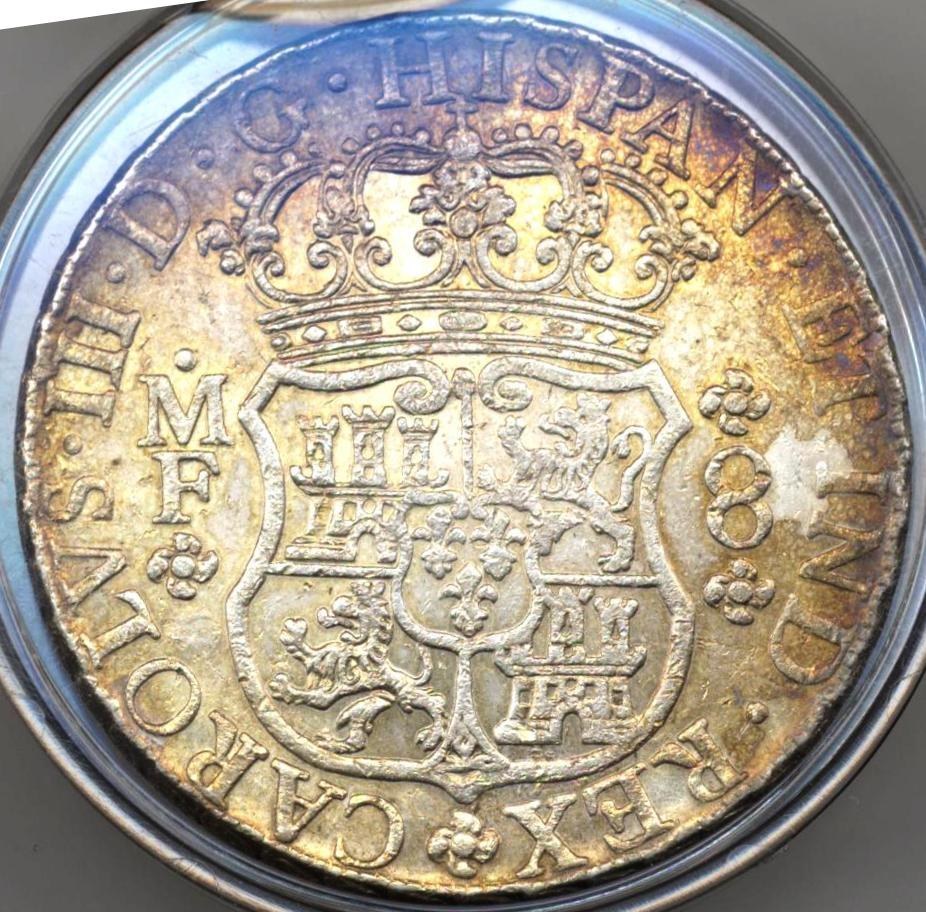
Start with the pillar side, which is the fastest way to confirm the type. Look for two tall crowned columns with banners reading PLVS VLTRA, and between them two crowned globes resting on sea waves. The legend VTRAQVE VNVM curves around the design, with the date and, at the very bottom, a small mint mark and assayer letters. If a coin shows a royal portrait bust instead of these globes, it is a later Spanish colonial dollar, not a pillar type.
Check the other side for the crowned Spanish coat of arms flanked by pillars, surrounded by a legend naming the king — a 1765 coin should reference Charles III — and his titles as ruler of Spain and the Indies. Reading the king's name and comparing it to the date is a good consistency check, since the ruler named must match the year.
Weigh and measure the coin. A genuine 8 reales is large, roughly 38 to 40 millimeters in diameter, and close to 27 grams of high-grade silver. Underweight, undersized, or non-magnetic-but-wrong-toned pieces deserve suspicion. Then inspect the edge: authentic Columnarios have an ornamental decorated edge rather than plain modern reeding, and a plain or seamed edge is a red flag for a cast copy.
Read the mint mark at the base of the pillar side to pin down origin: "Mo" for Mexico City, "P" for Potosí, "LM" or LIMA for Lima, "G" for Guatemala, and "S" for Santiago. Mexico pieces are by far the most common; scarcer mints are worth extra scrutiny because they attract counterfeiters.
Finally, be cautious with authentication. This popular type has been widely copied in cast and struck fakes, and genuine coins are often chopmarked, cleaned, holed, or repaired. Soft mushy detail, a wrong weight, a plain edge, or seams around the rim all point to a fake. For any higher-value example, seek third-party grading before committing to a purchase.
Frequently asked questions
How can I tell a Pillar Dollar from a later bust dollar?
The pillar type shows two crowned globes between columns. If the coin instead has the king's portrait bust facing right, it is a later Spanish colonial 8 reales that replaced the pillar design in the early 1770s.
What edge should a genuine Columnario have?
It should have an ornamental decorated edge, often described as a tulip or laurel pattern. A plain edge, modern reeding, or a visible seam suggests a cast counterfeit.
Are chopmarks a sign of a fake?
No. Chopmarks are small merchant stamps applied during trade, especially in Asia, and appear on many authentic coins. They affect value but do not by themselves indicate a counterfeit.
Where is the mint mark located?
It sits at the base of the pillar side, between or beside the columns near the waves, accompanied by small assayer initials that vary by mint and year.