
How to Identify the Philippines 20 Centavos
Spot the Commonwealth-era Philippine silver 20 centavos: the standing Liberty and Mayon volcano, the eagle-over-shield reverse, size, fineness and mint marks.
Read the full Philippines 20 Centavos encyclopedia entry →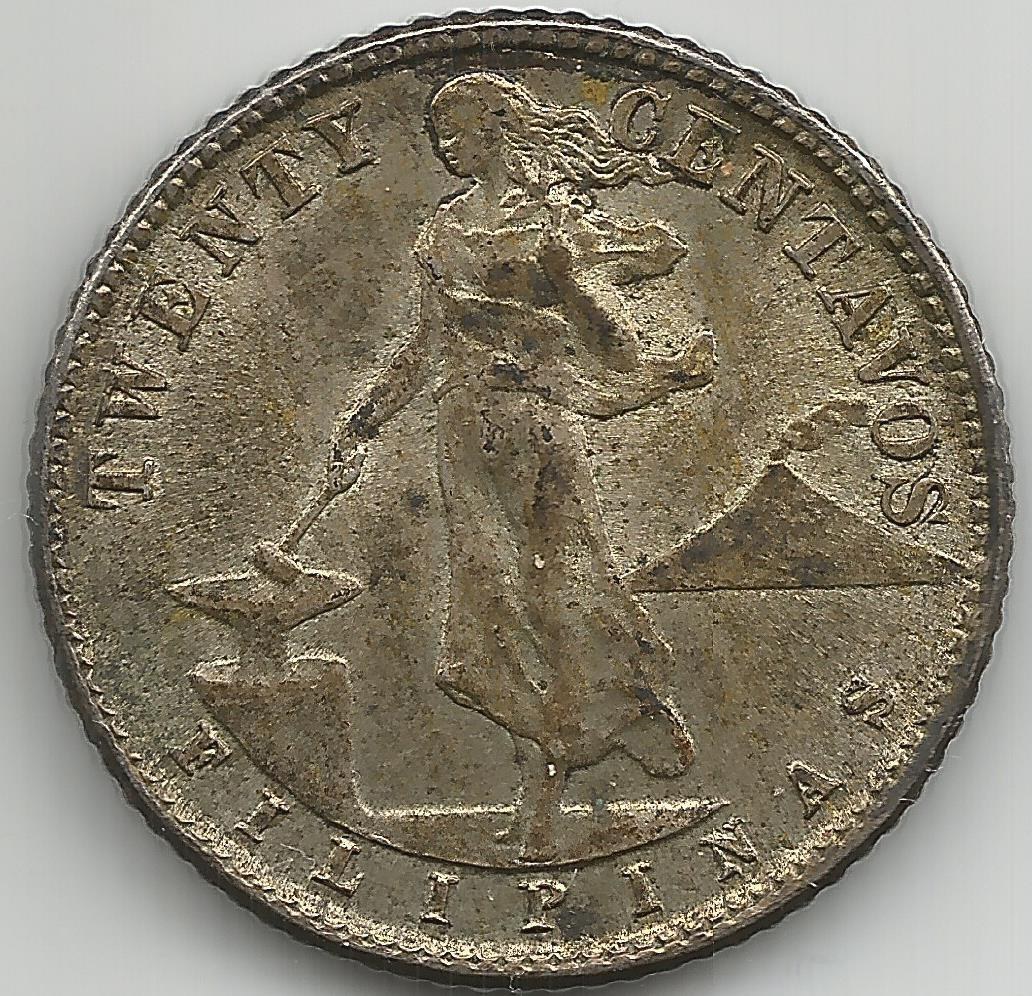
Start with the two faces together, because the pairing is diagnostic. One side shows a standing female figure with a hammer resting on an anvil and the volcano Mayon behind her, ringed by "TWENTY CENTAVOS FILIPINAS" and a date. The other shows an eagle with outspread wings above a shield. A coin that pairs a Spanish-legended centavo denomination with an eagle-and-shield reverse is American-era Philippine money, and the "TWENTY CENTAVOS" wording pins it to this denomination.
Confirm the denomination by the figure and legend, then by size. The silver 10, 20 and 50 centavos all use the standing woman, so read the value word and compare diameter: the 20 centavos is about 21 mm and roughly 4 grams in .750 silver, larger than the 10 centavos and smaller than the 50 centavos. Do not confuse it with the minor coins that show a seated man — those are the bronze and copper-nickel low denominations, which are not silver and use a different design.
Date the coin by its reverse legend. A reverse reading COMMONWEALTH OF THE PHILIPPINES marks the 1937–1945 series, which includes this 1944 piece, while an earlier reverse reading UNITED STATES OF AMERICA belongs to the pre-1937 issues. Both carry an eagle above a shield, so read the surrounding wording to place the coin in the right sub-series.
Locate the mint mark to the left of the date on the reverse. For 1944 expect D (Denver) or S (San Francisco); there is no Manila (M) striking that year because the Manila mint was out of action during the occupation. A supposed 1944-M twenty centavos, or a 1944 with no mint mark at all, should be treated with caution and checked carefully.
Apply normal authentication caution. Genuine coins are sharply struck with crisp lettering and a clean, even edge; be wary of cast copies with soft detail or seams, of coins that have been polished or artificially toned, and of pieces whose weight or diameter falls outside the expected range. Because this is a common, low-value date, altered mint marks or added detail are more of a concern on scarcer years, but weighing and measuring the coin and comparing it against a reliable catalog of United States–Philippines coinage remains the safest check.
Frequently asked questions
How do I tell the 20 centavos from the 10 or 50 centavos?
All three silver coins share the standing female design, so read the value legend and compare size. This coin says TWENTY CENTAVOS and sits in the middle at about 21 mm; the 10 centavos is smaller and the 50 centavos is larger and heavier.
How do I know it is the Commonwealth type and not an earlier issue?
Read the reverse legend. COMMONWEALTH OF THE PHILIPPINES indicates the 1937–1945 series, which the 1944 date belongs to. An earlier UNITED STATES OF AMERICA reverse marks the pre-1937 issues, even though both show an eagle above a shield.
Which mint marks are correct for 1944?
D for Denver and S for San Francisco, placed to the left of the date on the reverse. The Manila mint did not strike coins in 1944, so a 1944-M twenty centavos would be unexpected and worth checking closely.
How can I be sure it is silver and not a base-metal copy?
The Commonwealth 20 centavos is .750 silver at about 21 mm and roughly 4 grams. Check weight and diameter and look for crisp, struck detail. Cast or plated fakes tend to be the wrong weight, show seams or soft lettering, or fail a specific-gravity check.