
How to Identify the Philippines 10 Centavos
Spot the American-era Philippine silver 10 centavos: the standing Liberty and Mayon volcano, the U.S. eagle reverse, size, fineness, mint marks and look-alikes.
Read the full Philippines 10 Centavos encyclopedia entry →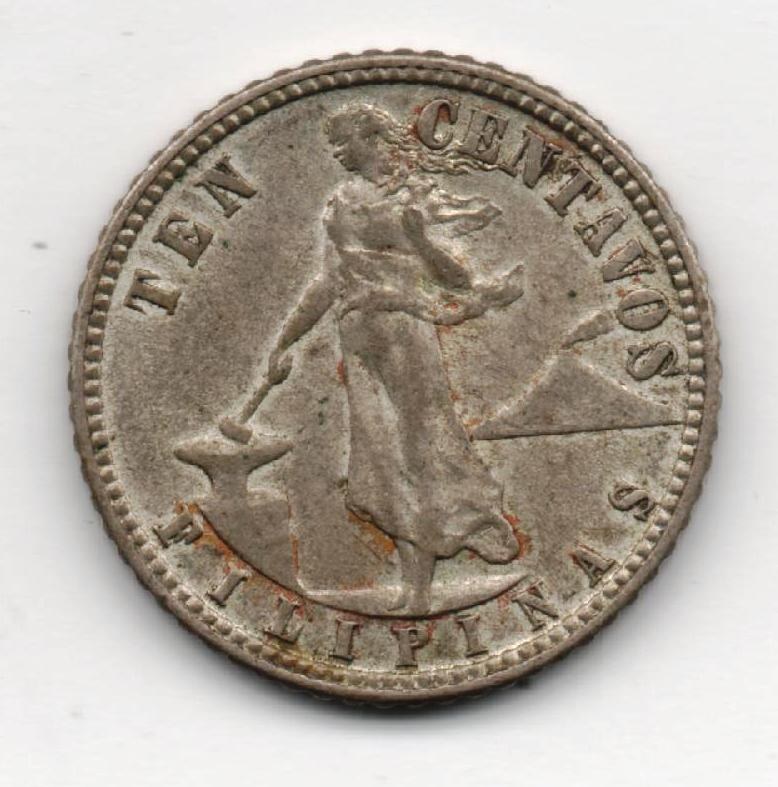
Start with the two faces together, because the combination is diagnostic. One side shows a standing female figure with a hammer resting on an anvil and the volcano Mayon behind her, ringed by "TEN CENTAVOS FILIPINAS" and a date. The other shows an eagle with outspread wings above a striped shield, encircled by "UNITED STATES OF AMERICA." A coin that pairs a Spanish-legended centavo denomination with the U.S. eagle is an American-administration Philippine issue, and the "TEN CENTAVOS" wording pins it to this denomination.
Confirm the denomination by the figure and legend. The silver 10, 20 and 50 centavos all use the standing woman, so read the value word to separate them: this coin says TEN CENTAVOS. Do not confuse it with the minor coins that show a seated man — those are the bronze half and one centavo and the copper-nickel five centavos, which are not silver and use a different design.
Check size and metal. The reduced-series 10 centavos (1907–1935, which includes this 1911 coin) is small — about 16.5 mm and roughly 2 grams — and struck in .750 silver, so it is smaller and thinner than a U.S. dime and gives a soft silvery ring. Earlier 1903–1906 10 centavos are a bit larger and of higher fineness; comparing diameter and weight helps place a coin in the correct sub-series.
Locate the mint mark to the left of the date on the reverse. S means San Francisco (the usual source for 1911), M means Manila on later dates, and no mark indicates an early Philadelphia striking. Reading the date and mint mark accurately is essential, because scarcity and value in this series vary sharply from year to year and mint to mint.
Apply normal authentication caution. Genuine coins are sharply struck with crisp lettering and a clean, even edge; be wary of cast copies with soft detail or seams, of coins that have been polished or artificially toned, and of pieces whose weight or diameter falls outside the expected range. When a date or mint mark looks altered, weigh and measure the coin and compare it against a reliable catalog of United States–Philippines coinage before drawing conclusions about rarity.
Frequently asked questions
How do I tell the 10 centavos from the 20 or 50 centavos?
All three silver coins share the standing female design, so read the value legend and compare size. This coin says TEN CENTAVOS and is the smallest of the three; the 20 and 50 centavos are progressively larger and heavier.
Is the 1911 coin a common date?
The 1911 is a San Francisco striking of moderate mintage. Circulated examples are readily available, while high-grade, original-surface coins are scarcer and more desirable. Always verify the mint mark, since other dates in the series can be much rarer.
How can I be sure it is silver and not a base-metal copy?
The reduced-series 10 centavos is .750 silver at about 16.5 mm and roughly 2 grams. Check weight and diameter and look for crisp, struck detail. Cast or plated fakes tend to be the wrong weight, show seams or soft lettering, or fail a specific-gravity check.
Does cleaning or damage affect identification?
Cleaning does not change the type but sharply reduces collector value, and harsh polishing can obscure a mint mark or date. Examine the coin under good light and, where wear is heavy, use the standing figure, the eagle reverse and the FILIPINAS legend to confirm attribution.