
How to Identify the Philip II Tetradrachm
A collector's guide to the Zeus head, starred horseman, size, legend, and control marks that identify a Philip II tetradrachm.
Read the full Philip II Tetradrachm encyclopedia entry →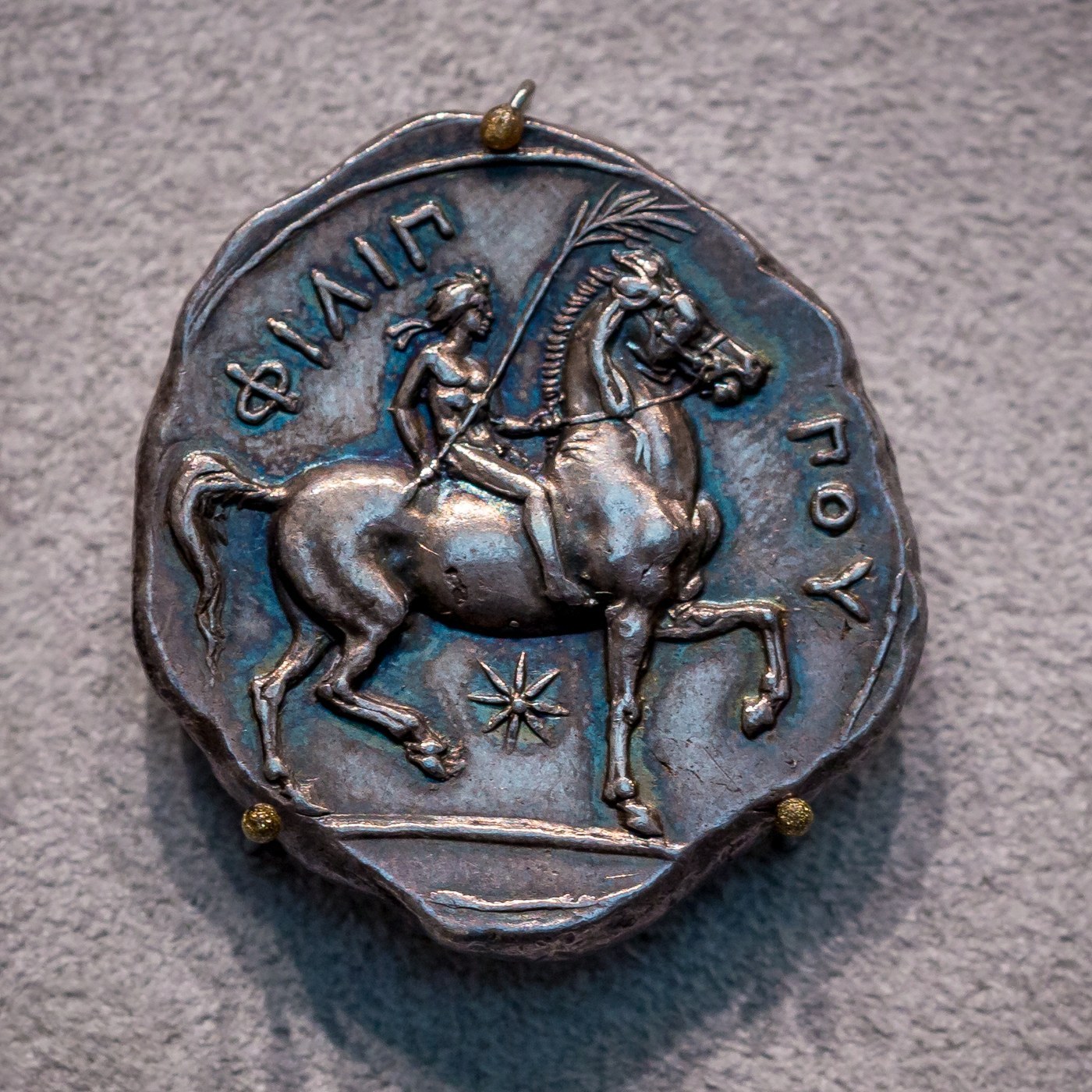
Begin with the obverse head. A genuine Philip II tetradrachm shows a laureate, bearded head of Zeus facing right, with a laurel wreath in the hair and no inscription around the portrait. If the head is youthful, beardless, or wears a lion scalp, you are looking at a coin of Alexander III or another ruler, not Philip's Zeus-and-horseman type. The dignified, mature male face is the first thing to confirm.
Turn to the reverse and read the scene. You should see a single youth on horseback moving right, often with a raised hand or a palm branch, and frequently accompanied by small stars, symbols, or letters in the field, which matches the starred horseman on this coin. Look for the Greek legend ΦΙΛΙΠΠΟΥ, meaning "of Philip," placed near the rider; this naming legend, combined with the Zeus obverse, is the core identification. The small symbols and control marks are not decoration alone, they help specialists assign the coin to a particular mint such as Pella or Amphipolis and to a phase of the long production run.
Check size, weight, and fabric. This is a large, heavy silver coin, generally about 23 to 26 mm in diameter and close to seventeen grams; a piece that is markedly light, undersized, or made of base metal is suspect. As a hand-struck ancient coin it will show natural variation in centering and flan shape, some flatness where the dies did not fully strike up, and honest wear on the high points of the head and horse. Perfectly round, uniform, or seamed edges are red flags.
Be cautious with look-alikes and forgeries. Two families of look-alikes are common: the Celtic and other tribal imitations struck to the north, which copy the Zeus-and-horseman design in cruder or stylized form, and Alexander-era or later issues that share the general style but differ in portrait or legend. Beyond those, this type is heavily faked, with cast copies, tooled surfaces, and modern replicas on the market. Warning signs include a casting seam around the rim, grainy or bubbly surfaces, mushy detail, lettering that does not match known styles, and weight outside the normal range. For any significant purchase, rely on a specialist attribution or a trusted pedigree rather than the design alone.
Frequently asked questions
What is the fastest way to confirm the type?
Check both sides together: a laureate bearded head of Zeus on one side and a youth on horseback with the legend ΦΙΛΙΠΠΟΥ on the other. That pairing, on a large silver coin near seventeen grams, is the signature of the Philip II tetradrachm.
How do I tell it apart from an Alexander the Great coin?
Look at the portrait. Philip's tetradrachm shows a bearded Zeus and a horseman reverse. Alexander's silver typically shows a youthful Herakles in a lion scalp with a seated Zeus reverse. The portrait and reverse scene, plus the name in the legend, separate them.
There are small letters or symbols by the horse. What are they?
Those are control marks and mint symbols. They do not change the identification as a Philip II tetradrachm, but they let specialists attribute the coin to a specific mint and issue, which can affect rarity and value.
How can I spot a fake or an imitation?
Watch for a casting seam, grainy or porous surfaces, soft detail, off-standard weight, and lettering that looks wrong for the period. Crude or stylized versions may be genuine Celtic imitations rather than Macedonian issues. When in doubt, get a specialist opinion.